
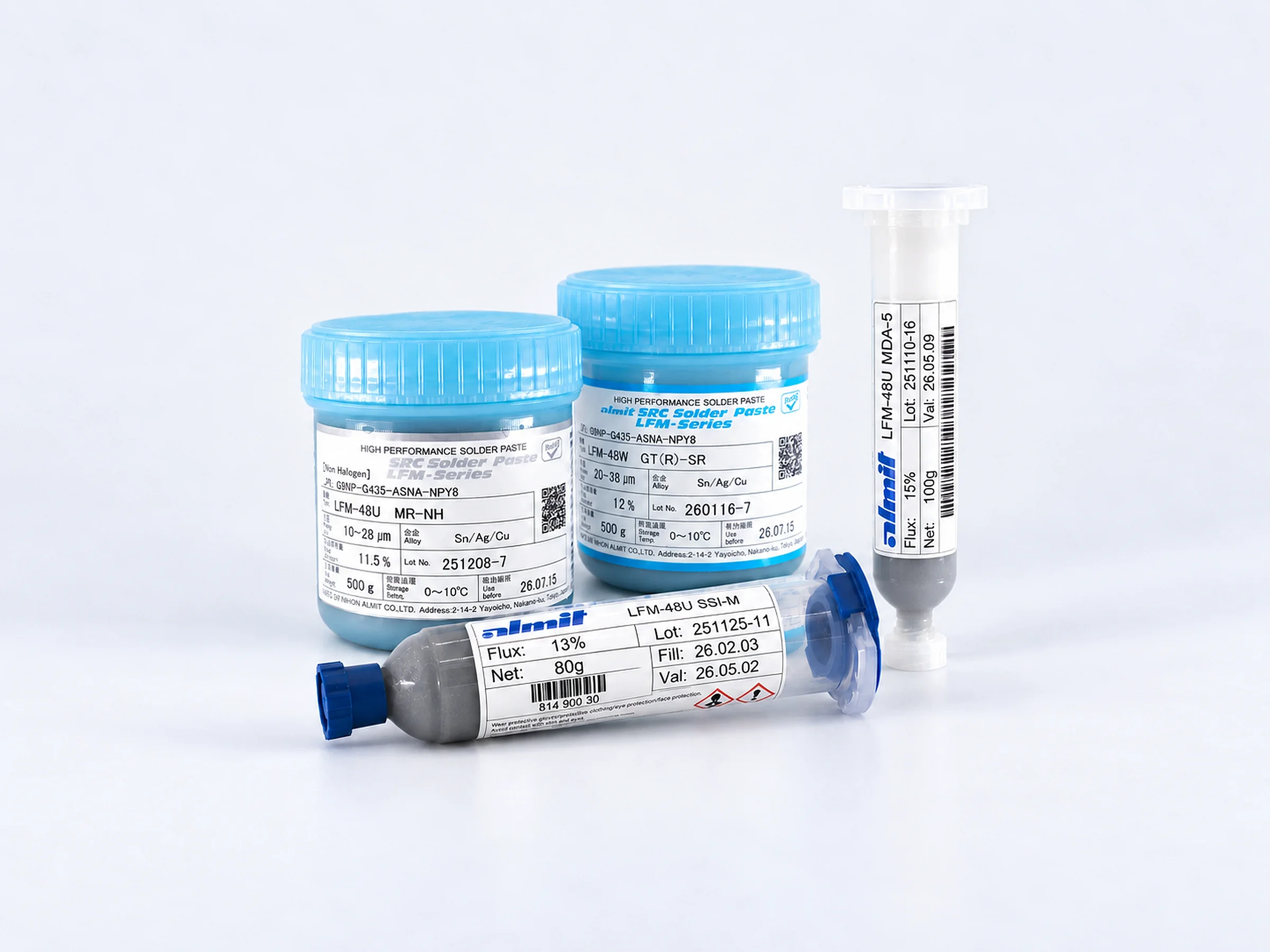
Lead-free solder paste
Almit’s lead-free solder paste combines maximum process reliability with environmental compatibility. Developed for modern electronics manufacturing, it guarantees clean solder joints and meets the most stringent quality and environmental standards.
- Excellent printing performance
- Consistent print images over a long stencil life
- Clean, shiny solder joints without mid-chip balling
- 100 % lead-free – RoHS and REACH compliant
Lead-free solder paste from Almit – sustainable and reliable. Lead-free pastes are the backbone of modern SMT manufacturing. Almit develops solder pastes that ensure clean print images, precise reflow behaviour and reproducible solder joint quality, even with the finest pitches – RoHS- and REACH-compliant and consistently tailored to the requirements of electronics manufacturing.
Lead-free solder paste
-
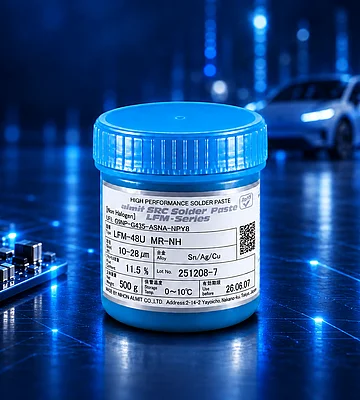
MR-NH
Small area ratio, high performance
- Excellent print image
- Outstanding release behaviour
- Optimal contour stability
-
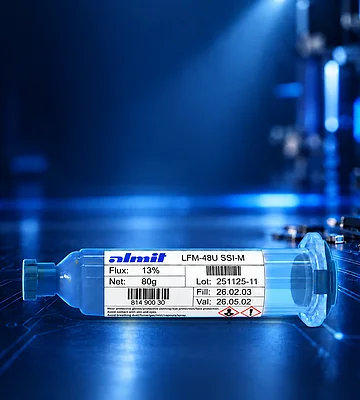
Laser pastes
Specially designed for contactless soldering
- Hardly any spatter
- Laser quality leader
- Perfect flow behaviour
-
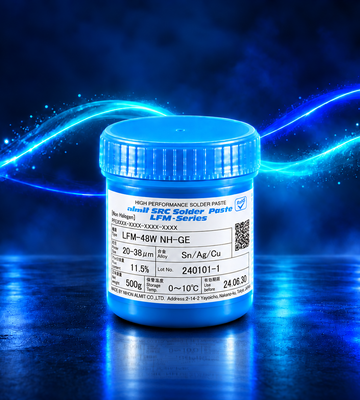
NH-GE
Halogen-free without compromise
- Minimal flux spatter
- No detachment of flux residues
- No cracking
-
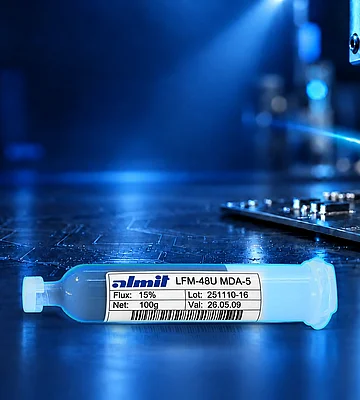
Jet pastes
Precise jet printing for maximum process reliability
- Minimal flux spatter
- No detachment of flux residues
- No cracking
-
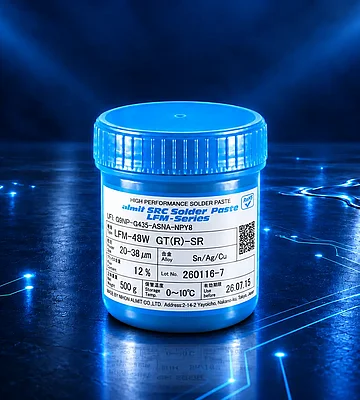
GT(R)-SR
The L1 all-rounder among Almit solder pastes
- Optimal wetting
- Designed for PIP/THR
- RoHS-compliant
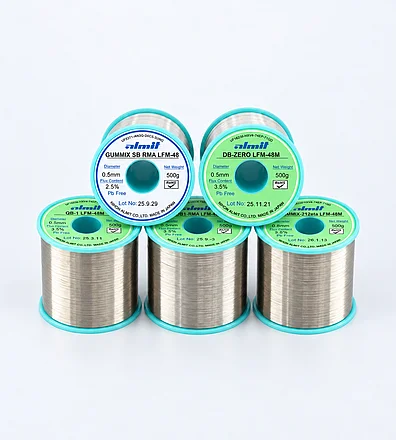
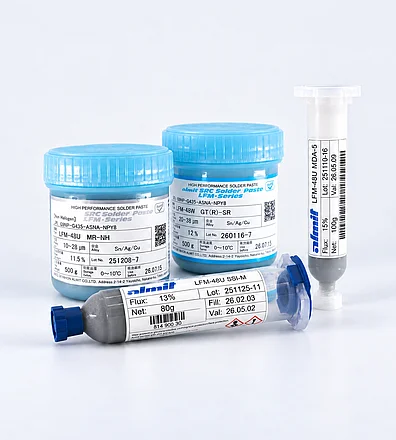
Lead-free solder paste
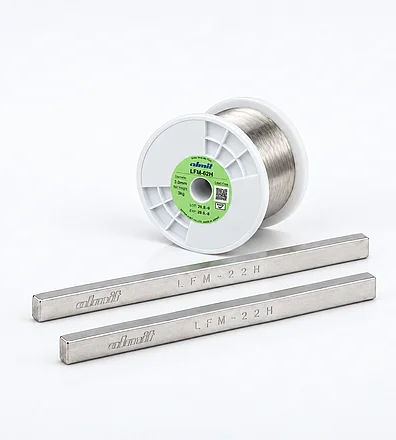
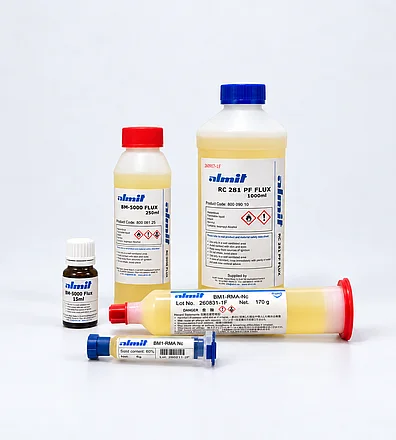
A solder paste consists of two components, both of which determine the soldering result: the solder powder and the flux in which it is suspended. Almit develops and manufactures both in-house. The lead-free range comprises fourteen flux systems in the ROL0, ROL1 and ROM1 classes in accordance with IPC J-STD-004, as well as fourteen alloys – ranging from the low-melting Sn-58Bi at 139 °C to the antimony-containing Sn-10.0Sb at 246 to 258 °C. The grain sizes range from 5–15 µm to 25–45 µm.
Why lead-free
Lead-free pastes are the backbone of modern SMT manufacturing. They are 100 % lead-free and therefore RoHS and REACH compliant – without the need for any exemptions. Almit develops them to ensure that clean print images, precise reflow behaviour and reproducible solder joint quality are achieved even with the finest pitches: stable print images over a long stencil life, clean and shiny solder joints without mid-chip balling.
The print image is crucial: the area ratio
Miniaturization results in ever-smaller stencil apertures. This causes the ratio of aperture area to wall area – the area ratio – to deteriorate, and the solder paste stays stuck in the aperture instead of being deposited on the pad when the stencil is lifted. The IPC guidelines recommend a value greater than 0.66 for good release behaviour. In many applications, however, the area ratio is already below this threshold, frequently in the case of smaller component sizes such as 0201 chips.
This is precisely where MR-NH comes into play. The halogen-free paste is suitable for applications with an area ratio of less than 0.6; in documented tests, it has proven compatible down to 0.43. Its surface resistance is four orders of magnitude higher than the IPC standard. In a single, unnamed customer case, the yield rose from 85 to 98 % because the improved release behaviour allowed more paste volume to reach the solder pads. The achievable increase depends on the layout, stencil and process parameters.
Halogen-free without compromise: the dual boost principle
Halogen-free pastes were long regarded as the more conservative choice: clean in terms of residues, but weaker in terms of wetting. NH-GE challenges this view. In its dual boost flux, two activators work together – one fast-acting and one long-lasting. The result is wetting behaviour that halogen-free pastes have not previously achieved, with ROL0 purity and the same soldering profile as a halogen-activated paste. Added to this are minimised graping and improved coalescence on small apertures. NH-GE was announced at productronica 2023, with the official product launch taking place at Nepcon in Tokyo.
Contactless and stencil-free
In laser and induction soldering, energy is applied instantaneously. The paste must maintain the exact dispensed quantity, melt reliably and form a secure joint – conditions for which a conventional reflow paste is not designed. Almit offers two laser pastes: SSI-M (halogen-activated) and NH-MDL (halogen-free). Both offer stable dispensing properties, easy control of the solder paste quantity and reliable solder joint connections.
In jet printing, the stencil is completely eliminated: piezo-printing technology ejects the paste in individual droplets onto the printed circuit board without making contact. To ensure this works consistently hundreds of thousands of times, the paste must be dispensed from the ejector in a constant and reproducible manner. Almit offers five of its own jetting flux systems with a 15 % flux content and grain sizes from 5 µm. SDK(NH) is the top halogen-free recommendation and is qualified for Mycronic jet printing; NH-JLB is suitable for low-melting SnBi alloys from 139 °C. The dot size ranges from 210 to 640 µm, depending on the ejector and paste.
Which alloy is suitable?
LFM-48 (SAC305, Sn-3.0Ag-0.5Cu, 217–220 °C) is the industry standard – qualified worldwide and suitable for universal use. Most flux systems are approved for use with it.
SJM-03 (Sn-0.3Ag-0.7Cu-2.0Bi, 210–225 °C) significantly reduces the silver content without compromising the strength of the solder joint, thereby reducing material costs. LFM-90 (Sn-1.0Ag-0.7Cu, 217–224 °C) and LFM-86 (Sn-0.3Ag-0.7Cu) follow the same approach.
SJM-40 (Sn-4.0Ag-2.0Bi-3.0Sb, 221–227 °C) is at the other end of the spectrum: high silver content, very high joint strength.
LFM-65 (Sn-58.0Bi, 139 °C), LFM-89 (Sn-57.6Bi-0.4Ag, 139–168 °C) and LFM-78 (Sn-57.0Bi-1.0Ag) are the low-melting-point alloys for temperature-sensitive assemblies. LFM-65 is eutectic: the solidus and liquidus coincide at 139 °C; there is no pasty range.
LFM-57 (Sn-5.0Sb, 235–240 °C) and LFM-74 (Sn-10.0Sb, 246–258 °C) cover the upper temperature range. All fourteen alloys, with their compositions and melting ranges, are listed in the solder paste classification.
Which flux is suitable?
Halogen-free (L0): MR-NH for applications with an area ratio of less than 0.6, NH (LVA) for fewer voids and better printability, NH (IMT), which behaves like an L1 paste and remains perfect even after a long stencil life, and HF-A and NH(-MDL) for laser and induction soldering.
Halogen-activated (L1): the GT series for high preheating temperatures and a perfect print image – including GT(R)-SR for pin-in-paste and THR – the SUC series for O2-reflow with minimal voids, PZV for low peak temperatures, SSI-M for laser soldering, INP for indium-based and SBR for alloys containing bismuth. TM-HP (O) (M1) denotes a particularly long open time.
What grain size?
The grain size determines how finely the material can be printed or dispensed. For stencil printing, Almit offers Type 4 (20–38 µm, W) and Type 5 (10–28 µm, U) – MR-NH is available in both grain sizes – as well as the coarser grain size X (25–45 µm). In jet printing, the range extends down to 5–15 µm (G); in this case, the grain size also determines which ejector model is used.
In short
Which lead-free solder paste is suitable for a small area ratio?
MR-NH. It is suitable for an area ratio of less than 0.6 and, in documented tests, is compatible down to 0.43 – a point at which standard pastes already fail to release from the stencil.
Is there a halogen-free solder paste that does not compromise on wetting performance?
NH-GE. This dual boost flux combines a fast-acting and a long-lasting activator and can be used with the same soldering profile as a halogen-activated paste – whilst maintaining ROL0 purity.
Which solder paste is suitable for laser soldering?
SSI-M (halogen-activated) and NH-MDL (halogen-free). Both have been specially developed for contactless soldering and offer stable dispensing properties.
Which solder paste is suitable for jet printing?
Almit offers five jetting flux systems with a 15 % flux content. SDK(NH) is the top halogen-free recommendation and is qualified for Mycronic jet printing.
Which alloy is standard for lead-free solder paste?
LFM-48, i.e. SAC305 (Sn-3.0Ag-0.5Cu) with a melting range of 217 to 220 °C.
Which lead-free solder paste has the lowest melting point?
LFM-65 (Sn-58.0Bi) at 139 °C. It is eutectic; the solidus and liquidus temperatures coincide.
Are Almit’s solder pastes RoHS and REACH compliant?
The lead-free pastes are 100 % lead-free and are therefore RoHS- and REACH-compliant.
Advice
Application methods, area ratio, reflow profile and cleaning requirements determine the choice – in stencil printing as well as for reflow soldering. Speak to your Almit specialist adviser; we have the right solution for every application.