
Low-melting
Low-melting-point solders reduce the process temperature – and thus the thermal stress on the assembly. Whilst a SAC305 alloy only melts at 217 °C, the eutectic SnBi alloy Sn-58Bi melts at just 139 °C. This protects temperature-sensitive components, reduces warpage of the printed circuit board and lowers the energy requirements of the process. Almit supplies low-melting-point systems as solder paste and solder wire, in both halogen-free and halogen-activated versions.
Low-melting-point solders reduce the process temperature – and thus the thermal stress on the assembly. Whereas a SAC305 alloy only melts at 217 °C, the eutectic SnBi alloy Sn-58Bi melts as early as 139 °C. This protects temperature-sensitive components, reduces warpage of the printed circuit board and lowers the energy requirements of the process. Almit supplies low-melting-point systems as solder paste and solder wire, in both halogen-free and halogen-activated versions.
78 Kelvin less than the standard
There is a difference of 78 Kelvin between the eutectic SnBi alloy and the industry standard SAC305. The indium-containing SABI alloys bridge this gap.
Eutectic means: the alloy has a
defined melting point rather than a melting range – its bar is
therefore a single line. It transitions directly from the
solid to the liquid state without a pasty intermediate phase.
For the process, this means a
particularly sharply defined melting behaviour.
Product pages featuring low-melting-point alloys
Two Almit systems are documented as product pages featuring low-melting-point alloys. The full range is listed in the alloy and flux tables above.
-
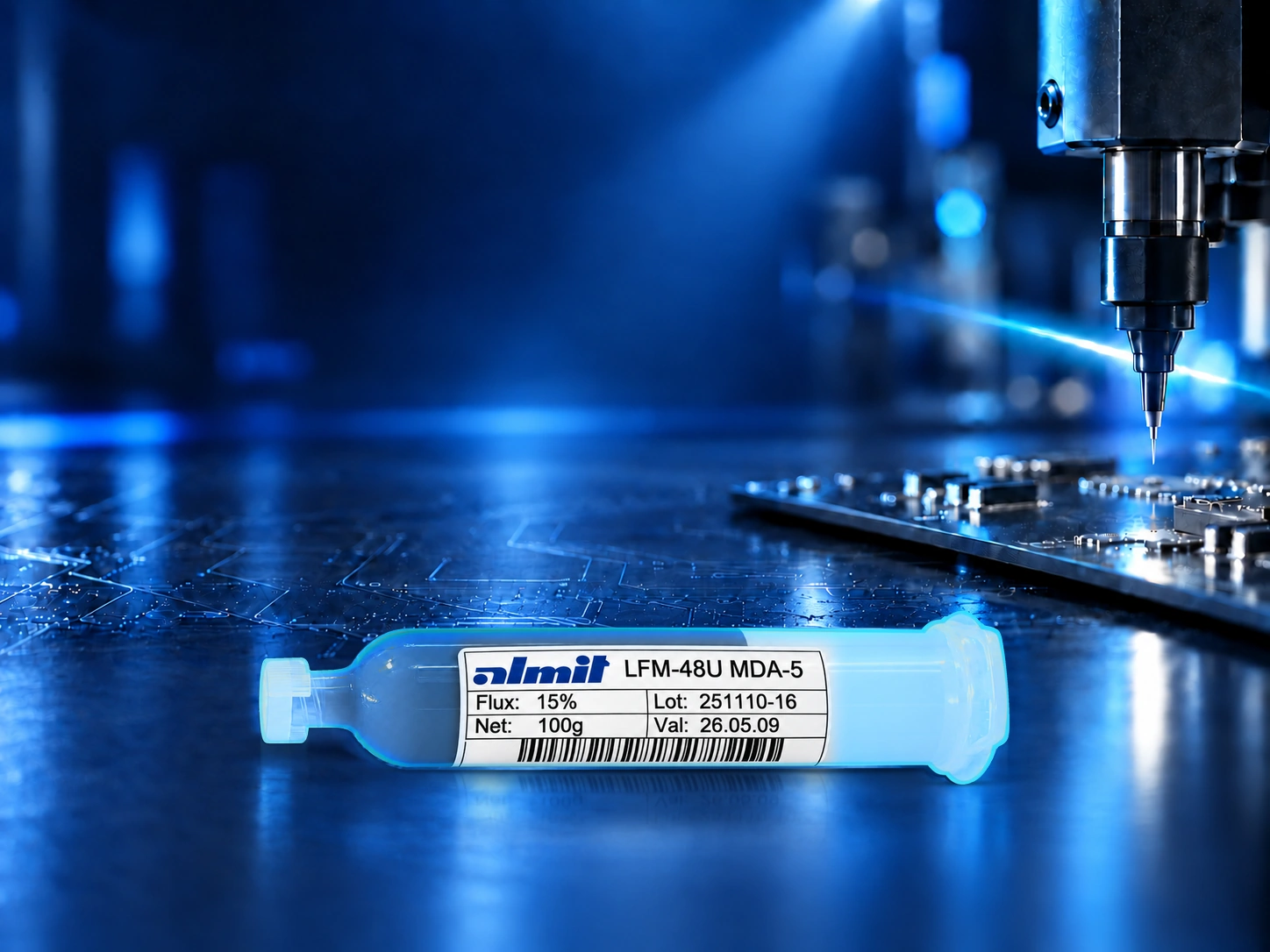 Halogen-free and low-melting
Jet pastes
The halogen-free NH-JLB system is available with LFM-65 (Sn-58Bi, eutectic at 139 °C), LFM-89 and LFM-78.
Find out more
-
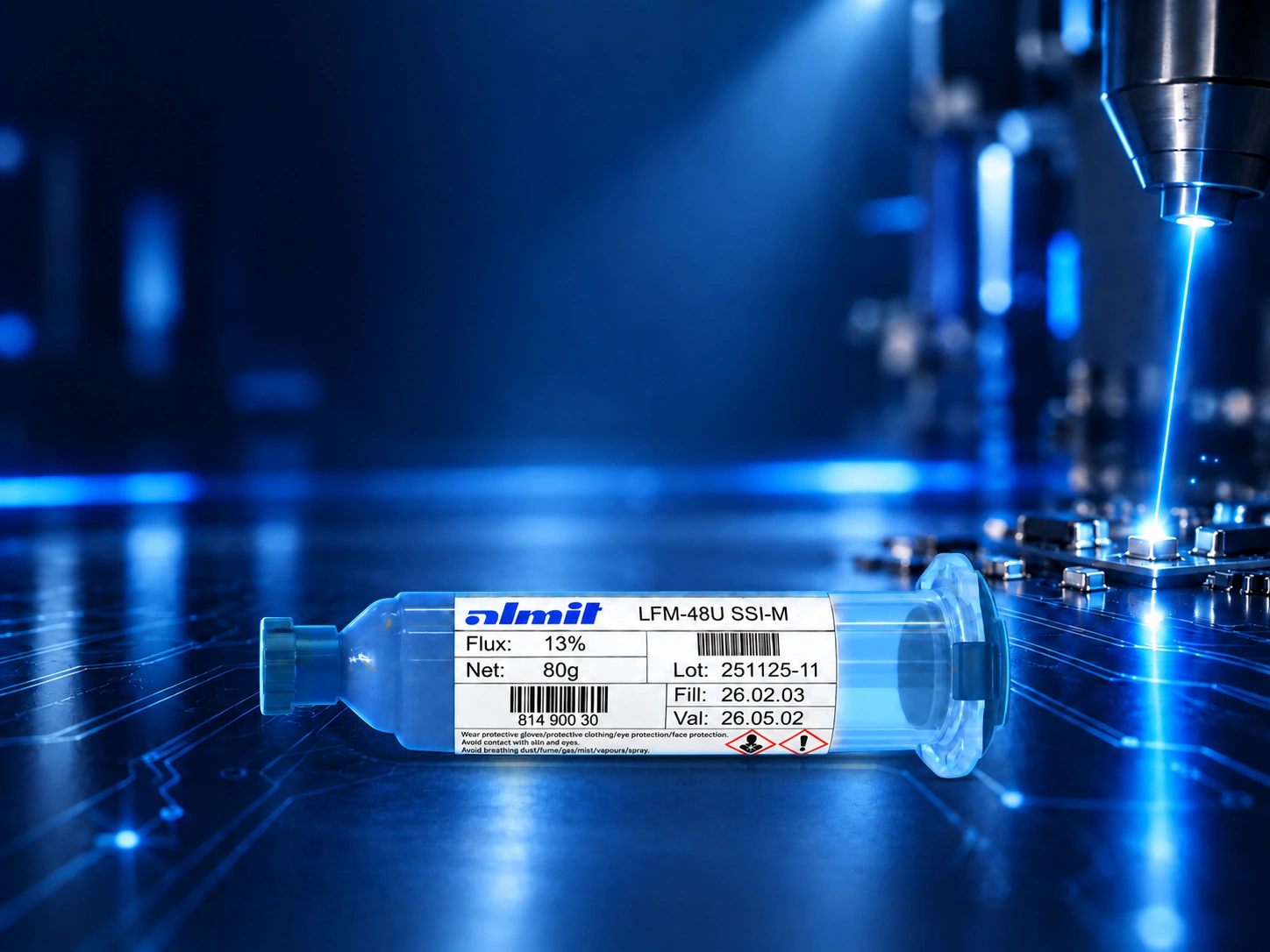 Also available with low-melting-point alloys
Laser pastes
The halogen-free NH-MDL system is available with LFM-89 (Sn-57.6Bi-0.4Ag, 139–141 °C).
Find out more
Why reduce the process temperature?
- Component protection Temperature-sensitive components – displays, plastic housings, sensors, pre-assembled modules – cannot tolerate peak temperatures in the SAC range. With a melting point of 139 °C, the eutectic SnBi alloy protects these components.
- Energy A lower temperature profile means lower energy consumption during the process. In continuous-flow reflow ovens operating in multi-shift mode, this adds up.
- Staged soldering Where several soldering steps are carried out in succession, the second step must not remelt the first. Low-melting-point alloys extend the usable temperature range in this context.
An overview of the alloys
Bismuth alloys – the 139 °C class
| Alloy | Composition | Temperature | Character |
|---|---|---|---|
| LFM-65 | Sn-58Bi | 139 °C | Eutectic – the standard for low process temperatures. Silver-free |
| LFM-89 | Sn-57.6Bi-0.4Ag | 139–141 °C | The addition of silver improves ductility and long-term reliability |
| LFM-78 | Sn-1.0Ag-57.0Bi | 139–204 °C | Low-melting alloy with silver addition, offering long-term reliability at low process temperatures |
With 42 items, LFM-65 is the most widely used low-melting alloy in the Almit range, available in the flux systems A75, A75C(L), NH-JLB, NH-MDL, SBR and TM-HP-Nc.
SABI alloys – medium-indium content
| Alloy | Composition | Temperature | Character |
|---|---|---|---|
| LFM-70 | Sn-3.5Ag-0.5Bi-8.0In | 194–206 °C | 8 % indium, significantly reduced melting range |
| LFM-96 | Sn-3.5Ag-0.5Bi-6.0In | 202–210 °C | 6 % indium, reduced melting range with high reliability |
The indium-containing SABI alloys bridge the gap between SnBi and SAC: they noticeably reduce the process temperature without reaching bismuth levels. Almit has developed its own flux system for these alloys, INP – specifically for indium-based solder pastes. LFM-96 is also available as solder wire with the SR-LA SUPER and GTH-RMA flux systems.
The right flux systems
| System | Class | Alloys | Special feature |
|---|---|---|---|
| NH-JLB | L0 | LFM-65, LFM-89, LFM-78 | 100 % halogen-free, also available as a jet paste |
| NH-MDL | L0 | LFM-65, LFM-89 | Halogen-free, for micro-dispensing and laser soldering |
| TM-HP-Nc | L1 | LFM-65, LFM-89 | A variant of the tried-and-tested TM-HP system, offering stable printing and reflow performance |
| SBR | L1 | LFM-65, LFM-89 | Ideal for bismuth alloys |
| A75C(L) | L1 | LFM-65 | Tried-and-tested paste system for the reflow process |
| INP | L1 | LFM-70, LFM-96 | Specially developed for indium alloys |
| SR-LA SUPER | – | LFM-96 | All-round solder wire |
Where low-melting-point solders are used
The 89 items in this range comprise 73 solder pastes and 16 solder wires – the focus is clearly on SMT processes.
- Reflow soldering and vapour-phase LFM-65 and LFM-89 in all the flux systems mentioned.
- Stencil printing The same systems, grain sizes 10–28, 20–38 and 25–45 µm.
- Jet printing NH-JLB with LFM-65, LFM-89 and LFM-78.
- Dispensing / Metering NH-MDL and TM-HP-Nc with LFM-65, INP with LFM-70.
- Laser soldering / induction NH-MDL with LFM-65 and LFM-89, where the laser melts micro-dispensing deposits.
All low-melting-point systems are no-clean formulations with minimal, non-corrosive residues. Continue to the product ranges: lead-free solder paste, lead-free solder wire, silver-free and low-silver, alloy table.
Low-melting-point solders – a brief answer
What is a low-melting-point solder?
A solder with a significantly lower melting point than standard alloys. The eutectic SnBi alloy Sn-58Bi melts at 139 °C, whilst the standard alloy SAC305 has a melting range of 217–220 °C.
What are the advantages of a lower process temperature?
It protects temperature-sensitive components and reduces the energy consumption during the process.
What does ‘eutectic’ mean?
A eutectic alloy has a defined melting point rather than a melting range. Sn-58Bi is eutectic and melts at 139 °C.
What is the difference between LFM-65 and LFM-89?
LFM-65 (Sn-58Bi) is the eutectic, silver-free variant with a melting point of 139 °C. LFM-89 (Sn-57.6Bi-0.4Ag) contains a silver additive, which improves the ductility and long-term reliability of the SnBi base alloy.
What is a SABI alloy?
An indium-containing alloy of tin, silver, bismuth and indium.
LFM-70 (Sn-3.5Ag-0.5Bi-8.0In) lowers the melting range to 194–206 °C,
whilst LFM-96 (Sn-3.5Ag-0.5Bi-6.0In) reduces it to 202–210 °C.
Are there any halogen-free low-melting-point solder pastes?
Yes. The NH-JLB and NH-MDL systems are classified as L0 and are 100 % halogen-free.
Which flux is suitable for bismuth alloys?
SBR is ideal for bismuth alloys. INP was developed for indium-based alloys.
Are there any low-melting-point solder wires?
Yes. LFM-96 is available as a solder wire with the SR-LA SUPER and GTH-RMA flux systems.
How low can you go with the process temperature?
The component mix, reliability requirements and downstream processes
determine the limit.
Speak to your Almit technical adviser.