
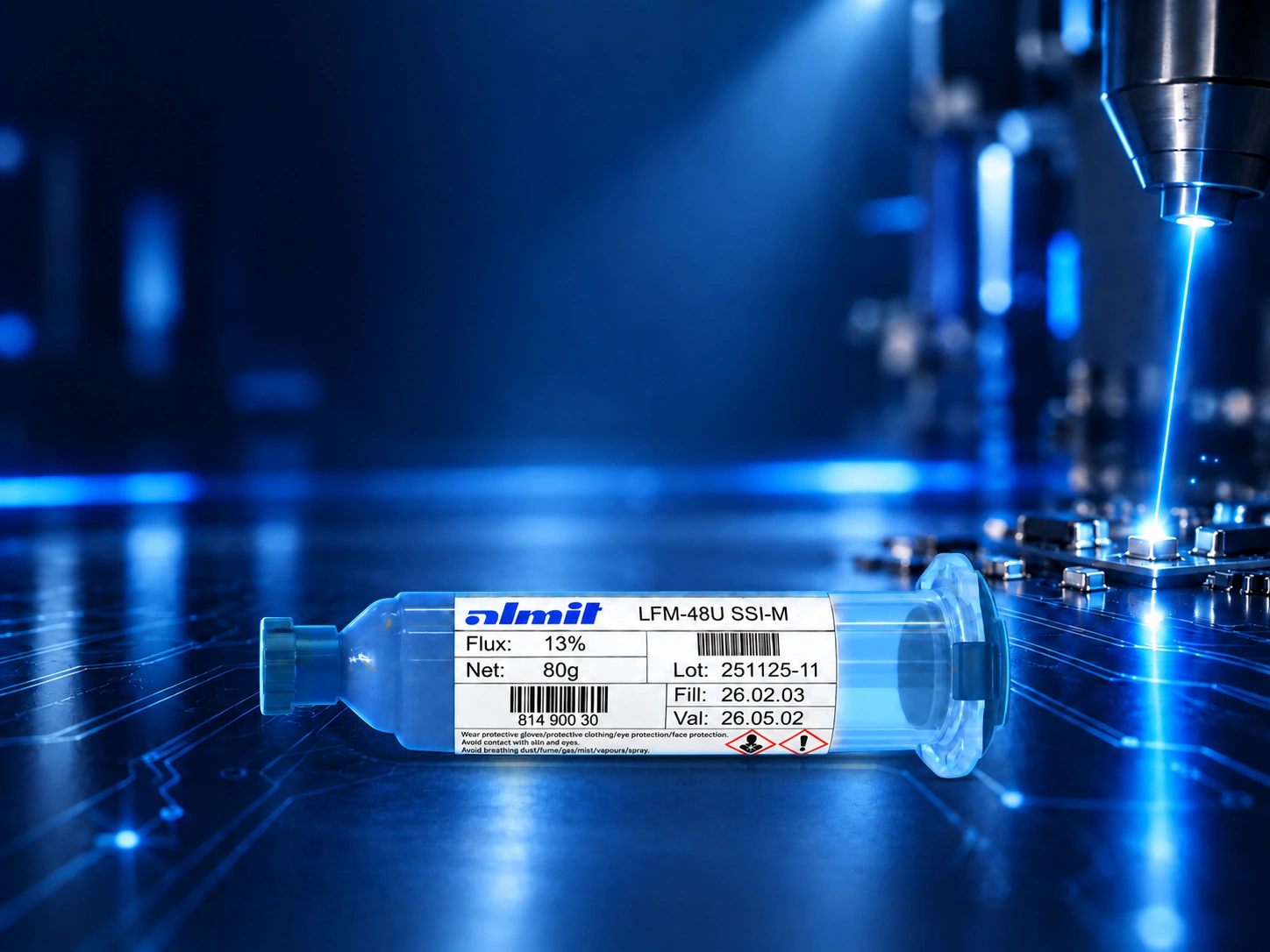
Laser pastes
Specially designed for contactless soldering
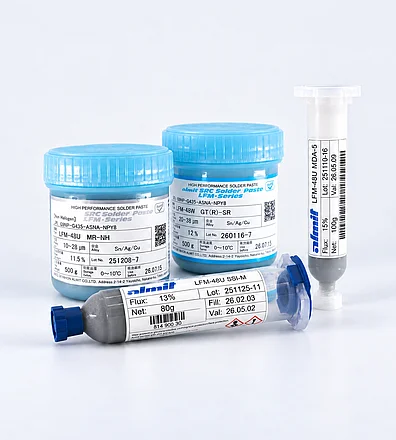
Laser pastes are solder pastes that have been specially developed for contactless soldering – for laser, light and induction systems. Almit offers two systems for this purpose: SSI-M (halogen-activated) and NH-MDL (halogen-free). Both deliver consistent dispensing properties, easy control of the solder paste quantity and reliable solder joints. They are highly versatile and can be easily adapted to any workflow.
- Excellent printing performance for fine-pitch and 0201 components
- Stable viscosity for consistent processes
- Minimal voids & excellent wetting
- Suitable for SMT, jet printing and reflow
-
2Systems for contactless soldering
-
L0 + L1halogen-free and halogen-activated
-
1.5 sec.Soldering time in the diode laser test
-
139 °CLowest melting point in the range
Why contactless soldering requires its own pastes
If you want a bright future, you have to be better than the rest. This is
also true of the SSI-M and NH-MDL solder pastes:
They were developed specifically for
contactless soldering.
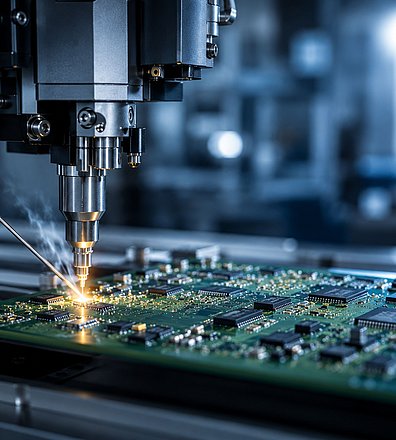
In laser and induction soldering, energy is applied instantaneously. The paste must maintain the exact quantity, melt reliably and, in doing so, form a dependable joint – under conditions for which a conventional reflow paste is not designed.
Today, contactless soldering is primarily used where the finest solder joints must guarantee a stable connection. This is the case in automotive production just as much as in the digital world.
Common characteristics
- Stable dispensing characteristics
- Easy control of solder paste quantity
- Reliable solder joint connections
- RoHS-compliant
SSI-M or NH-MDL?
Both systems are designed for the same processes. They differ in terms of flux class, viscosity and the available alloys.
SSI-M
The halogen-activated solder paste. Excellent wetting properties with consistent dispensing.
- Classification
- ROL1
- Flux content
- 13.0 %
- Viscosity
- 80 Pa·s
- Alloy
- LFM-48
NH-MDL
The halogen-free alternative. High reliability and a uniform print image with stable viscosity – also available with low-melting-point alloys.
- Classification
- ROL0
- Flux content
- 12.0–13.0 %
- Viscosity
- 80–90 Pa·s
- Alloys
- LFM-48 · LFM-89
In the diode laser test
Almit’s products were tested in comparison with a conventional solder paste.
The test proves that SSI-M and NH-MDL have better wetting properties.
Test method
- Diode laser
- Power: 0–30 W
- Soldering time: 1.5 seconds
- Test specimen: Plug, Ø 1.00 mm, through-hole
- Comparison: SSI-M and NH-MDL (both LFM-48 U) versus a competitor’s product
The following was assessed
- Condition before soldering
- Condition after soldering
- Wetting behaviour at the through-hole
The advantages of contactless soldering
Does the future lie with contactless soldering? Today, it is used primarily where the finest solder joints must guarantee a stable connection – in automotive production as well as in the digital world.
- No overheating of components
- Shorter cycle times
- For very fine solder joints
- Also suitable for smaller batch sizes
Technical data
SSI-M · ROL1 halogen-activated
| Alloy | Composition | Grain size | Flux content | Viscosity |
|---|---|---|---|---|
| LFM-48 | Sn-3.0Ag-0.5Cu | W: 20–38 µm · U: 10–28 µm | 13.0 % | 80 Pa·s |
NH-MDL · ROL0 halogen-free
| Alloy | Composition | Grain size | Flux content | Viscosity |
|---|---|---|---|---|
| LFM-48 | Sn-3.0Ag-0.5Cu | U: 10–28 µm | 13.0 % | 90 Pa·s |
| LFM-89 | Sn-57.6Bi-0.4Ag | W: 20–38 µm | 12.0 % | 80 Pa·s |
SSI-M is also listed in the grain size range 25–45 µm. Please contact us if you require this variant.
Which alloy is right for your application?
- LFM-48 · SAC305 Sn-3.0Ag-0.5Cu, 217–220 °C. The industry standard, suitable for universal use. Available for SSI-M and NH-MDL.
- LFM-89 Sn-57.6Bi-0.4Ag, 139–141 °C. Low-melting alloy with added silver for improved ductility and long-term reliability. For NH-MDL only.
Packaging and item numbers
Both systems are supplied in dispensing cartridges – ranging from the small Cartridge 5 cc for individual workstations to the 0.5 kg container for production lines. Availability and ordering via the Almit B2B Shop.
SSI-M · LFM-48 U (10–28 µm)
| Item number | Packaging | Contents |
|---|---|---|
| 81490010 | Cartridge 5 cc | 20 g |
| 81490020 | Cartridge 10 cc | 40 g |
| 81490030 | Cartridge 30 cc | 80 g |
| 81490399 | Cartridge | 0.5 kg |
NH-MDL · LFM-48 U (10–28 µm)
| Item number | Packaging | Contents |
|---|---|---|
| 81830010 | Cartridge 5 cc | 20 g |
| 81830020 | Cartridge 10 cc | 40 g |
| 81830030 | Cartridge 30 cc | 80 g |
| 81830035 | Cartridge 30 cc | 100 g |
| 81830599 | Cartridge | 0.5 kg |
NH-MDL · LFM-89 W (20–38 µm)
| Item number | Packaging | Contents |
|---|---|---|
| 82550010 | Cartridge 5 cc | 20 g |
| 82550020 | Cartridge 10 cc | 40 g |
| 82550030 | Cartridge 30 cc | 80 g |
In addition, customised versions are available with coloured stoppers, as well as other container sizes up to 1.1 kg. Information on storage, temperature control and mixing can be found under Dispensing / Metering as well as in the expert reports ‘Safe storage of solder paste’ and ‘Correct mixing of solder paste’.
Laser pastes – quick answers
What is a laser paste?
A solder paste specially developed for contactless soldering – for example, for laser, light or induction systems. Almit stocks SSI-M and NH-MDL for this purpose.
What is the difference between SSI-M and NH-MDL?
SSI-M is the halogen-activated variant (ROL1) with a 13.0 % flux content and a viscosity of 80 Pa·s. NH-MDL is halogen-free (ROL0) and is available with LFM-48 at 13.0 % and 90 Pa·s, or with LFM-89 at 12.0 % and 80 Pa·s.
For which processes are the pastes suitable?
For contactless soldering in general – specifically mentioned are laser, light and induction systems.
How were the pastes tested?
Using a diode laser at 0–30 W power and a 1.5-second soldering time on a connector with a Ø 1.00 mm through-hole, in comparison with a conventional solder paste. The result: SSI-M and NH-MDL have the better wetting properties.
Is there a low-melting-point variant?
Yes. NH-MDL is available with LFM-89 (Sn-57.6Bi-0.4Ag, 139–141 °C) – a low-melting-point variant with added silver.
What are the advantages of contactless soldering?
No overheating of components, shorter cycle times, suitability for very fine solder joints – and it also works for smaller production runs.
Where is contactless soldering used?
Primarily where the finest solder joints must guarantee a stable connection: in automotive production as well as in the digital world.
In what packaging sizes are the pastes available?
In dispensing cartridges ranging from 5 cc (20 g) through 10 cc (40 g) and 30 cc (80 or 100 g) up to 0.5 kg cartridges. Other sizes and customised versions available on request.
Would you like to find out more?
Tell us your soldering process, your deposit size and the component tolerance – we’ll tell you whether SSI-M or NH-MDL is the right choice. We have the right solution for every application.

Katharina Hein
Customer Service
- 06061 969250
- info@almit.de
-
Almit GmbH
Unterer Hammer 3
64720 Michelstadt
Germany