
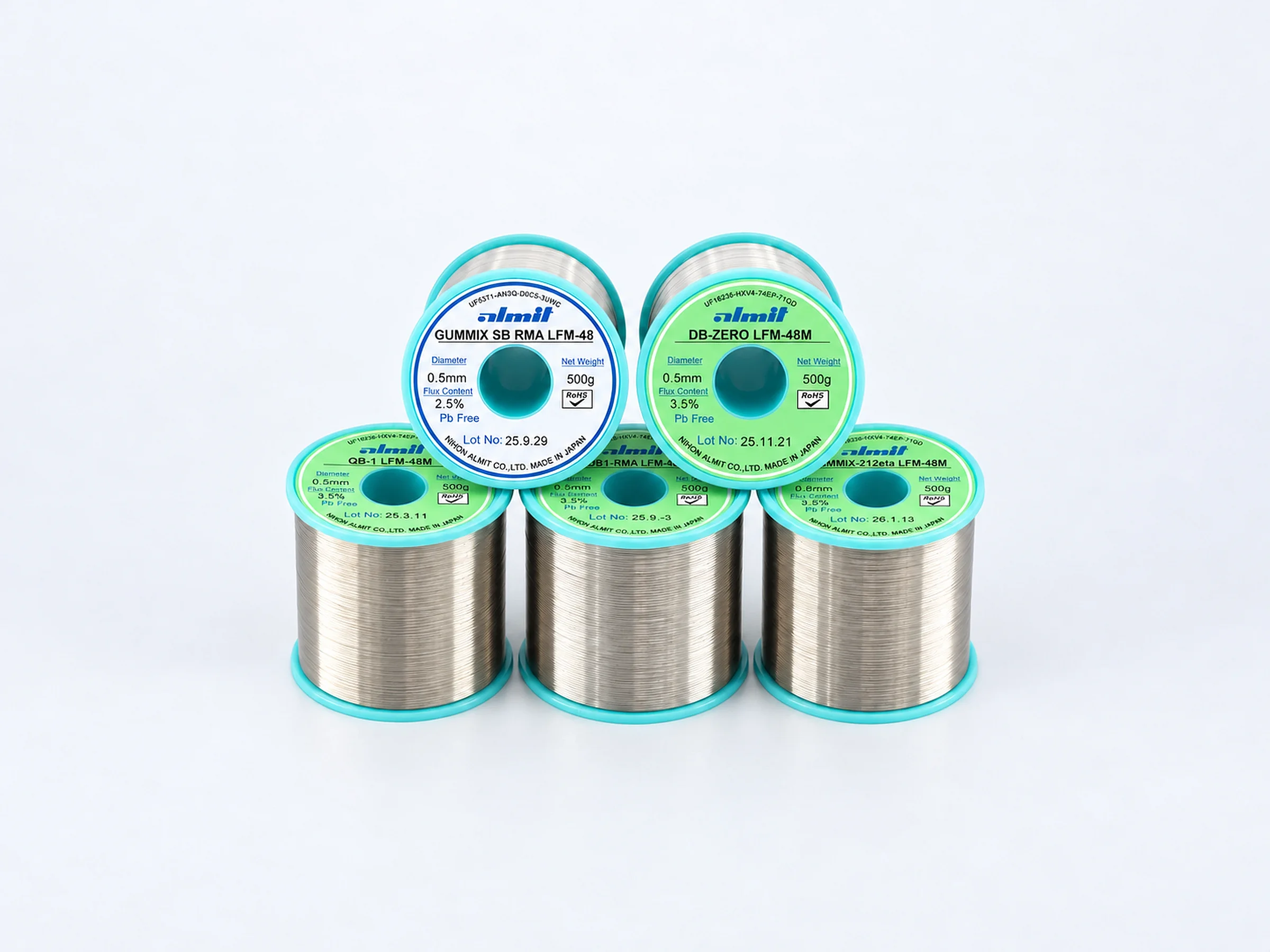
Lead-free solder wire
Precise soldering. Sustainable and reliable.
Almit’s lead-free solder wire delivers consistent quality from start to finish on every reel – produced from the purest materials using patented flux technology. Whether for manual soldering, robot soldering or contactless processes: our lead-free solder wires cover the entire spectrum of modern electronics manufacturing and meet the most stringent quality and environmental requirements.
- Rapid wetting – even on difficult surfaces
- Minimal flux spatter, less rework
- Gentle on soldering tips: up to 5 times longer service life
- For manual, robotic and contactless soldering
Almit’s lead-free solder wires combine high-performance solder alloys with specially formulated fluxes, enabling reliable, reproducible soldering processes.
They are designed to meet modern manufacturing requirements and offer an impressive combination of wetting behaviour, process reliability and joint quality.
Whether for traditional manual soldering applications or demanding industrial processes, Almit offers a range of lead-free solder wires specifically tailored to different applications and requirements.
Top-selling lead-free solder wires
-
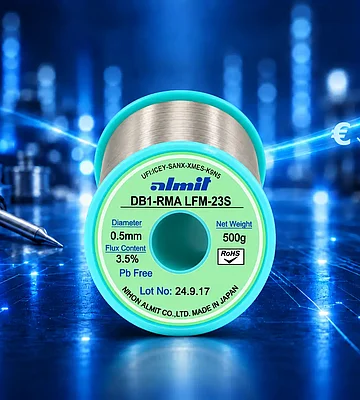
LFM-23 S
5 times longer soldering tip lifetime
- 5 times longer soldering tip lifetime
- 50 % cheaper than SAC305
- Eutectic solder
-
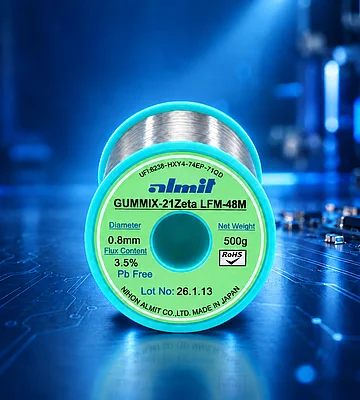
Gummix
Top sellers – and for good reason
- Minimal flux spatter
- No detachment of flux residues
- For contactless soldering
-
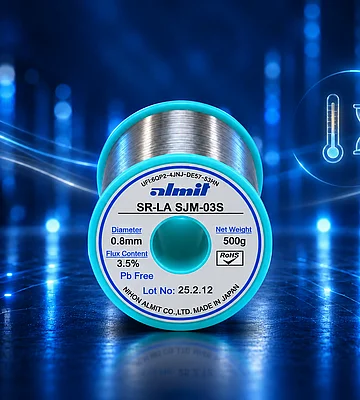
SJM series
Lead-free with perfect strength
- No cracking, even after 2,000 thermal cycles
- Silver content selectable from 0.3 % to 4 %
- Defence-approved
-
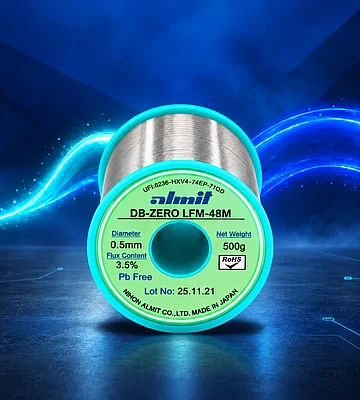
Dual Boost Series
A dual boost for exceptional wetting
- Rapid wetting behaviour
- Shorter process time
- Less flux spatter
-
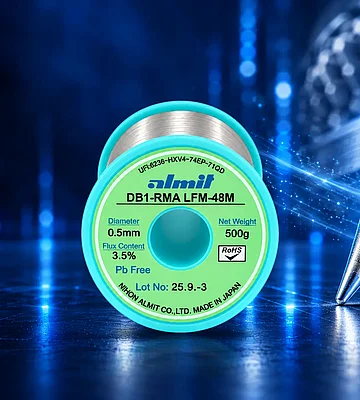
S+M Line
Life insurance for soldering tips
- Lower consumption of soldering tips
- Shorter soldering time and lower labour costs
- Lower consumption of solder = huge cost savings
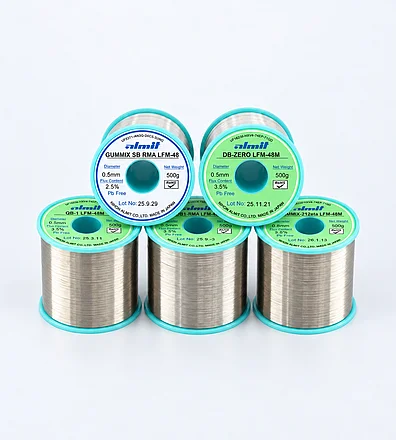
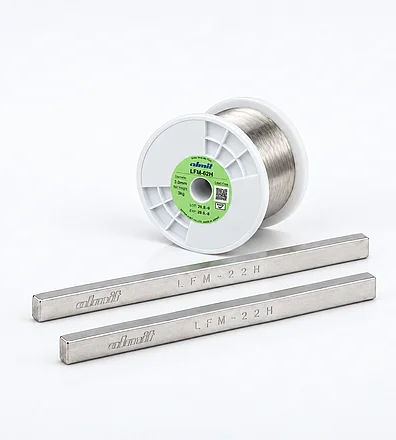
Lead-free solder wire
A lead-free solder wire consists of two components, both of which determine the soldering result: the alloy and the flux contained within it. Almit manufactures both in-house – the solder alloys as well as the flux formulations. The range covers diameters from 0.1 to 2.7 millimetres, with flux content between 1.5 and 4.5 % and classifications from L0 to H0 in accordance with IPC J-STD-004.
The flux core: the invisible quality factor
Conventional solder wires often suffer from the problem that the flux core is interrupted by air pockets. In practice, this leads to a lower quality of the solder joint – the soldering process stalls precisely when an interruption reaches the tip.
Almit solder wires feature a 100 % continuous flux core without any air pockets whatsoever. This is made possible by a production process that is unique worldwide and particularly complex, in which the wires are manufactured under very high pressure. Even wires with a diameter as small as 0.08 millimetres have a continuous core. The average defect rate is 4 ppm – compared with around 400 ppm for a conventional solder wire.
Almit sets itself higher standards than the industry: for a P3 wire, the IPC standard stipulates that the flux content may range between 2.7 and 3.9 %. Almit’s P3 wires achieve a significantly lower variation, ranging from 3.1 to 3.5 %.
The alloy protects the soldering tip
It was previously thought that there was no way to prevent the erosion of the soldering tip. The patented S-Line has proven that using the right alloy greatly minimises soldering tip erosion and can thus significantly extend the life of a soldering tip. What applies to the S-Line and erosion applies even more so to the M-Line with regard to oxidation: it can not only reduce oxidation but almost completely prevent it.
The documented comparison: after 20,000 melting cycles at 380 °C, the micro-alloyed LFM-48 M alloy reduced soldering tip erosion by up to 86 % compared with the standard SAC 305 alloy. When used with high-quality lead-free solder wire, this means that the soldering tip lifetime is almost on a par with that achieved using lead-based solder.
Which alloy is suitable?
LFM-48 (SAC305, Sn-3.0Ag-0.5Cu, 217–221 °C) is the industry standard – qualified worldwide and universally applicable.
SJM-03 (Sn-0.3Ag-0.7Cu-2.0Bi, 210–226 °C) reduces the silver content without compromising the strength of the solder joint. The patented SJM series counteracts the problem of fatigue fractures previously observed in low-silver SAC alloys.
LFM-23 (Sn-0.6Cu-0.05Ni, 228–229 °C) and LFM-22 (Sn-0.7Cu, 227 °C, eutectic) contain no silver at all and significantly reduce material costs.
LFM-41 (Sn-0.3Ag-2.0Cu) minimises copper leaching thanks to its higher copper content and protects fine pads and lead wires.
SJM-40 (Sn-4.0Ag-2.0Bi-3.0Sb, 221–227 °C) is at the other end of the spectrum: it offers the highest long-term reliability and is well established in the aerospace and defence sectors.
Which flux is suitable?
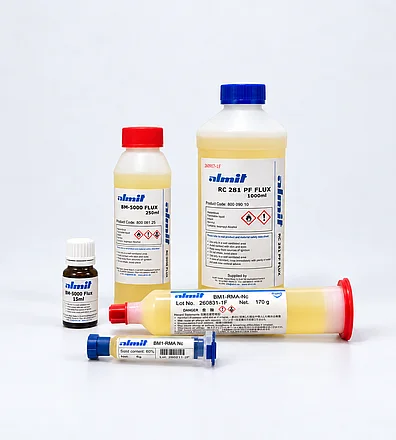
The high-performance systems are designed for automated soldering: DB-1 RMA (L1) combines a fast-acting and a long-lasting activator to create a ‘dual boost’ effect, thereby significantly reducing the process time. QB-1 (M1) reaches peak activation in the shortest possible time thanks to Quick-Boost technology. SRS-ZL (L0) is the halogen-free wire with the properties of an L1 product, whilst DB-ZERO combines dual boost with L0 purity.
Alongside these is the tried-and-tested range: SR-37 as the classic M1, NHR-TH and SRS-RMA-NC for reliable solder penetration in THT applications, SR-LA SUPER for low-spatter melting, KR-19 for surfaces that are difficult to wet, including aluminium and stainless steel, and BT-19 for high requirements regarding surface resistance.
The GUMMIX series is designed for contactless processes: it reduces flux spatter to an absolute minimum and prevents flux residues from detaching – a crucial factor in laser and induction soldering, where spatter contaminates the protective lenses of the optics.
Advice
Surface type, penetration requirements, cycle time and soldering tip costs determine the choice – whether for hand soldering or robotic soldering. Speak to your Almit specialist; we have the right solution for every application.