
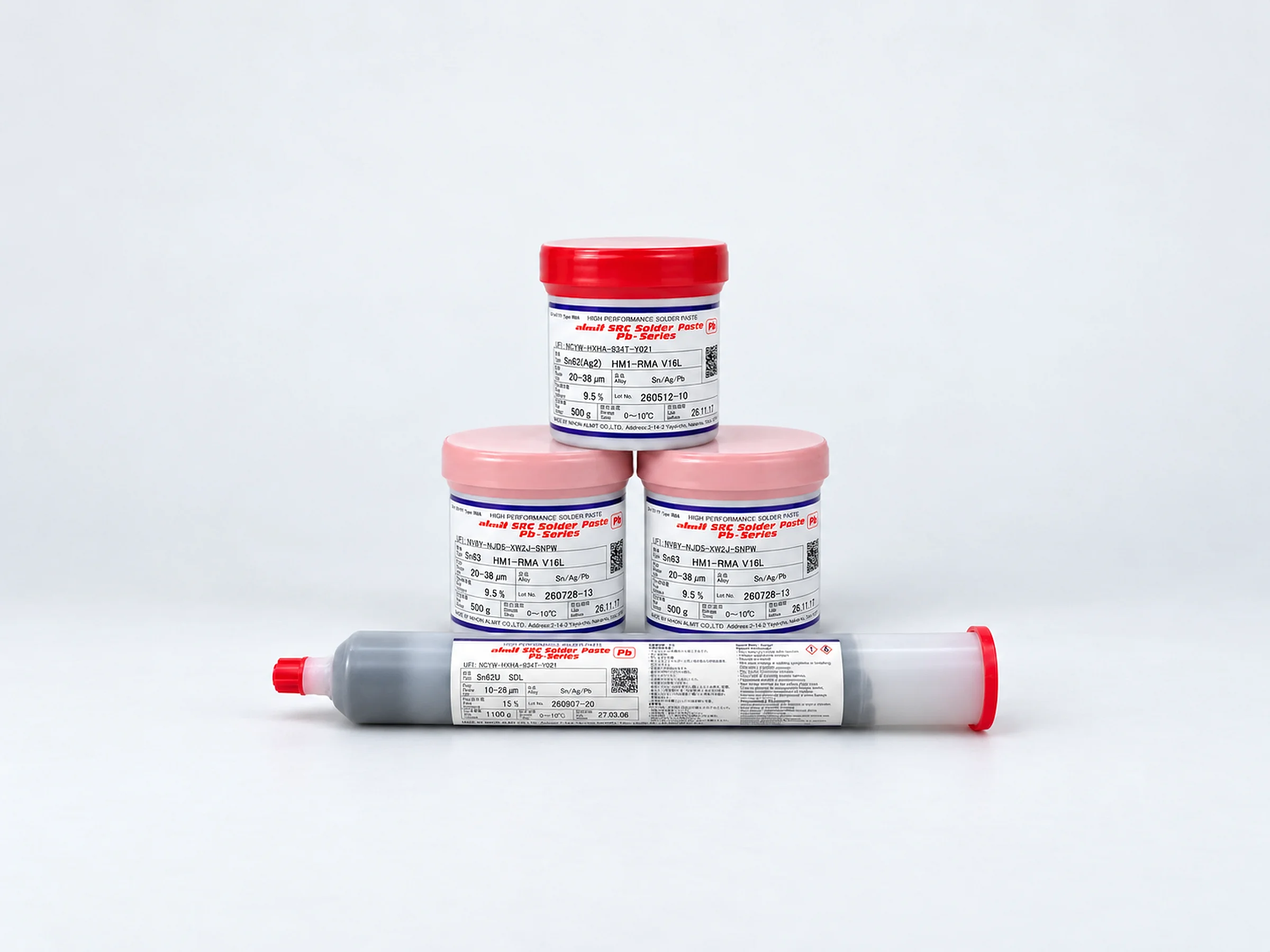
Leaded solder paste
Leaded classics
Almit’s leaded solder paste – maximum reliability for critical applications. Where lead-free solders reach their limits, leaded solder paste remains the first choice. Almit supplies leaded pastes for applications with RoHS exemptions – such as in the aerospace, military electronics or medical technology sectors – with the process reliability demanded by these industries.
- Low melting temperatures
- Excellent wetting and uniform joint formation
- Stable printing and reflow properties
- Suitable for high-reliability applications
Available fluxes for leaded solder pastes
| Flux designation | Classification | Particular advantage | Grain size |
| HM 1-RMA | J-STD-004 1.2: ROL1 | Excellent printing properties | Type 3 (V 14 L) 25–45 μm / Type 4 (V 16 L) 20–38 μm |
| HM 1-RMA T3 | J-STD-004 1.2: ROL1 | Long stencil life | Type 3 (V 14 L) 25–45 μm / Type 4 (V 16 L) 20–38 μm |
| HA 2-RA | J-STD-004 1.2: ROM1 | Easy to clean | Type 3 (V 14 L) 25–45 μm / Type 4 (V 16 L) 20–38 μm |
| SSHA-S | J-STD-004 1.2: ROM1 | Excellent flow properties | Type 3 (V 14 L) 25–45 μm / Type 4 (V 16 L) 20–38 μm |
| SSHA-SJS | J-STD-004 1.2: ROM1 | Low temperature, high strength | Type 3 (V 14 L) 25–45 μm / Type 4 (V 16 L) 20–38 μm |
An overview of leaded solder pastes
| Flux | Alloy | Composition | Melting range | Grain size | Flux content |
| HM 1-RMA HM 1-RMA T3 HA 2-RA SSHA-S | Sn 62 | Sn-2.0Ag-36Pb | 179 – 190 °C | V 14 L, V 16 L | 9.5 |
| HM 1-RMA T3 | Sn 62.8 | Sn-0.4Ag-36.8Pb | 178–183 °C | V 14 L, V 16 L | 9.5 |
| HM 1-RMA HA 2-RA SSHA-SJS | Sn 63 | Sn-37Pb | 183 °C | V 14 L, V 16 L | 9.5 |
| HM 1-RMA HA 2-RA SSHA-S | SJ-7 | Sn-3.0 Ag-0.5 Sb-34.5Pb | 179 – 187 °C | V 14 L, V 16 L | 10 |
| SSHA | SJS | Sn-1.5 Ag-0.5 Sb-38Pb | 171–181 °C | V 14 L, V 16 L | 9.5 |
| HM 1-RMA HA 2-R | SJ-3 Bi | Sn-1.5 Ag-0.5 Sb-3.0 Bi-38 Pb | 171–181 °C | V 14 L, V 16 L | 9.5 |
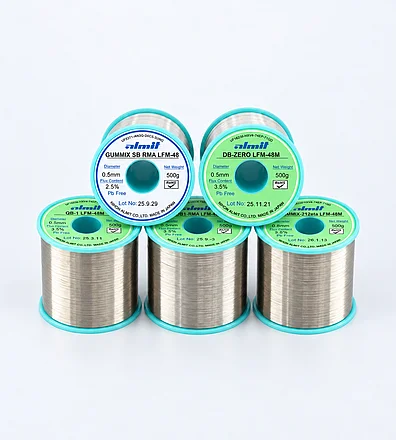
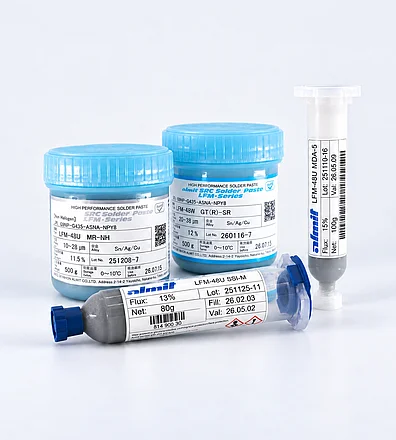
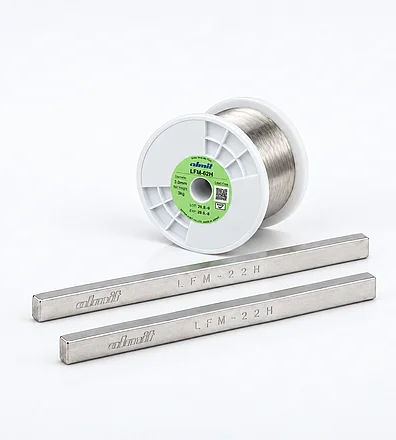
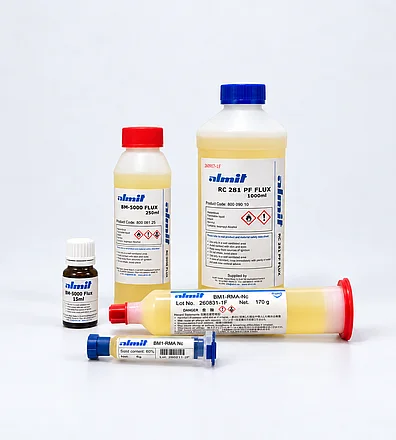
Leaded solder paste
A solder paste consists of two components, both of which determine the soldering result: the solder powder and the flux in which it is suspended. Almit develops and manufactures both in-house. For leaded solder paste, there is a choice of five flux systems and six alloys. All systems are available across the board in Type 3 (V 14 L, 25–45 µm) and Type 4 (V 16 L, 20–38 µm); the flux content is 9.5 %, and 10 % for the SJ-7 alloy. The fluxes are classified in accordance with IPC J-STD-004.
When to use leaded solder paste
Lead-free solder paste is the standard at Almit. We supply leaded solder pastes for applications exempt from the RoHS Directive – such as in the aerospace, military electronics or medical technology sectors. In these sectors, they are still considered suitable, and we supply them with the process reliability demanded by these industries: excellent wetting, uniform joint formation and stable printing and reflow properties.
To put the temperatures into perspective: the eutectic Sn 63 melts at 183 °C, whilst SJS and SJ-3 Bi begin to melt at 171 °C; the lead-free industry standard LFM-48 (SAC305) only begins to melt at 217 °C. However, a low process temperature is no reason to resort to lead: The low-melting-point lead-free alloys LFM-65 (Sn-58.0Bi) and LFM-89 melt at 139 °C and are therefore significantly lower than any leaded paste.
Which alloy is suitable?
Sn 63 (Sn-37Pb, 183 °C) is the classic choice. The alloy is eutectic: the solidus and liquidus coincide at the same point; there is no pasty range. The melt therefore solidifies instantly rather than over a temperature range.
Sn 62 (Sn-2.0Ag-36Pb, 179–190 °C) contains 2 % silver and is compatible with four of the five fluxes – HM 1-RMA, HM 1-RMA T3, HA 2-RA and SSHA-S. Sn 62.8 (Sn-0.4Ag-36.8Pb, 178–183 °C) is the low-silver variant with a particularly narrow melting range.
SJ-7 (Sn-3.0Ag-0.5Sb-34.5Pb, 179–187 °C) combines silver and antimony and is the alloy with the highest flux content in the range.
SJS (Sn-1.5Ag-0.5Sb-38Pb, 171–181 °C) and SJ-3 Bi (Sn-1.5Ag-0.5Sb-3.0Bi-38Pb, 171–181 °C) represent the lower end of the temperature range: low temperature with high strength. SJ-3 Bi corresponds to SJS in terms of melting range and additionally contains 3 % bismuth.
A complete comparison of all flux combinations can be found in the solder paste classification.
Which flux is suitable?
HM 1-RMA (L1) is the flux for excellent printing properties. HM 1-RMA T3 (L1) is designed for a long stencil life – the choice when there are breaks between printing runs or when producing small batch sizes.
HA 2-RA (M1) is easy to clean and is therefore intended for assemblies where flux residues are removed after soldering. SSHA-S (M1) offers excellent flow properties, whilst SSHA-SJS (M1) provides low temperature with high strength.
Type 3 or Type 4?
All five flux systems are available in both grain sizes. Type 3 (V 14 L) with 25–45 µm is the coarser powder, whilst Type 4 (V 16 L) with 20–38 µm is the finer one. The smaller the stencil aperture, the fewer grains can fit side by side – which is why Type 4 is the preferred choice for finer layouts. The grain size does not alter the alloy or the melting range – only the fineness of the print.
Leaded or lead-free?
The decision is made before the process begins, not during it – and it is based on regulatory approval, not on the solder joint itself: if no exemption from the RoHS Directive applies to the assembly, lead-free solder paste is mandatory; Almit offers fourteen flux systems and fourteen alloys in this range, from 139 to 258 °C. If an exemption applies, leaded paste remains available for use in the processes qualified for this purpose. The alloy table provides a comparison of all alloys for solder paste, solder wire, solder bar and solid wire.
In short
Is leaded solder paste still permitted at all?
Yes – in applications covered by an exemption from the RoHS Directive, such as in aerospace, military electronics or medical technology.
Which alloys does Almit offer for leaded solder paste?
Six: Sn 63 (Sn-37Pb, 183 °C), Sn 62 (Sn-2.0Ag-36Pb, 179–190 °C), Sn 62.8 (Sn-0.4Ag-36.8Pb, 178–183 °C), SJ-7 (Sn-3.0Ag-0.5Sb-34.5Pb, 179–187 °C), SJS (Sn-1.5Ag-0.5Sb-38Pb, 171–181 °C) and SJ-3 Bi (Sn-1.5Ag-0.5Sb-3.0Bi-38Pb, 171–181 °C).
Which leaded solder paste has the lowest melting point?
SJS and SJ-3 Bi. Both begin to melt at 171 °C and are completely liquid at 181 °C. The lead-free alloys LFM-65 and LFM-89 have an even lower melting point of 139 °C.
Which flux stays on the stencil for the longest?
HM 1-RMA T3. It is specifically designed for a long stencil life.
Which leaded solder paste is easy to clean?
HA 2-RA. This M1-grade flux is designed for easy cleaning.
What is the flux content of leaded solder pastes?
9.5 %; for the SJ-7 alloy, 10 %.
What do Type 3 and Type 4 mean in relation to solder paste?
The grain size of the solder powder. Type 3 (V 14 L) corresponds to 25–45 µm, Type 4 (V 16 L) corresponds to 20–38 µm.
Advice
Approval status, temperature range, stencil geometry and cleaning requirements determine the choice – in stencil printing just as much as in reflow soldering. Speak to your Almit specialist; we have the right solution for every application.