
Dispensing / Metering
Dispensing refers to the application of solder paste to the areas to be soldered using a syringe, rather than printing it onto the printed circuit board. This is also known as dot dispensing. The advantage over stencil printing is that this method is easier to adapt. Whereas a stencil has to be remade every time the layout changes, with dispensing, you simply modify the programme. The paste itself – its rheology, grain size and handling properties – is crucial for achieving a consistent result.
Dispensing refers to the application of solder paste using a
syringe to the areas to be soldered, rather than printing it onto the printed circuit board.
This is also referred to as dot dispensing. The
advantage over stencil printing is that
the method is easier to adapt. Whereas a stencil has to be remade every time
the layout changes, with dispensing, one simply modifies the
programme. The paste itself is crucial for a consistent result –
its rheology, grain size and handling.
What is dispensing – and when is it worthwhile?
In dispensing, the solder paste is applied with pinpoint accuracy via a needle or nozzle exactly where it is needed. This makes the process particularly suitable wherever a stencil is uneconomical or technically impractical.
- Small batches and prototypes No stencil costs; changes made purely via the software.
- Populated or uneven assemblies Wherever a stencil cannot lie flat.
- Repair and rework For example, when placing individual components.
- Pin-in-paste / THR When through-hole components are soldered during the reflow process.
- Preparation for contactless soldering The dispensed paste is then melted using a laser.
Almit offers the following for the application area of dispensing / dosing lead-free and leaded solder pastes as well as dispensable flux gels – mainly in cartridges, supplemented by bottles, tins and canisters.
Almit’s best-sellers for dispensing and metering
The Almit application overview lists these three products for dispensing and metering.
-
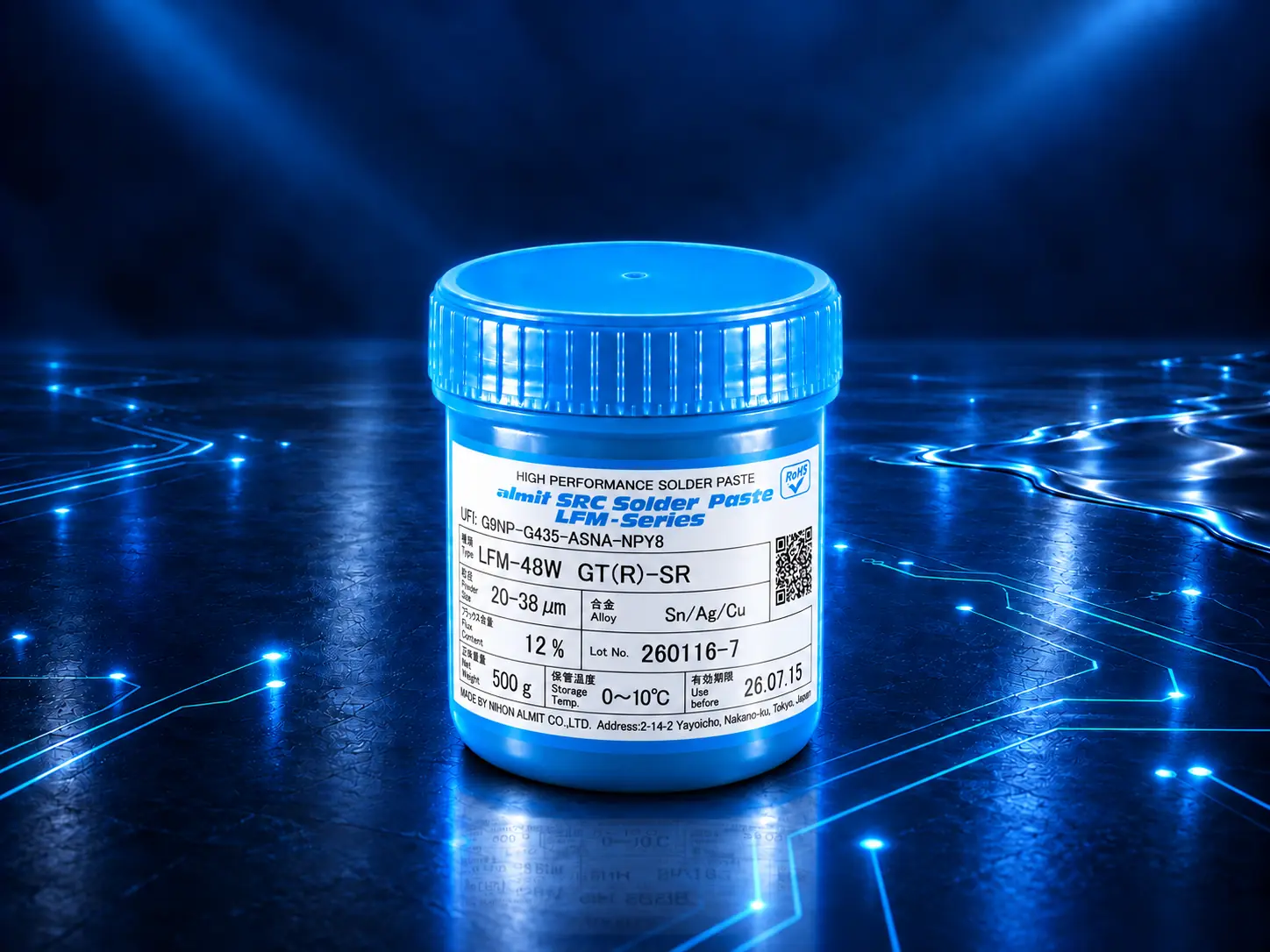 The L1 all-rounder among Almit solder pastes
GT(R)-SR
Optimal wetting on surfaces that are difficult to wet and excellent printing on the smallest structures.
Find out more
-
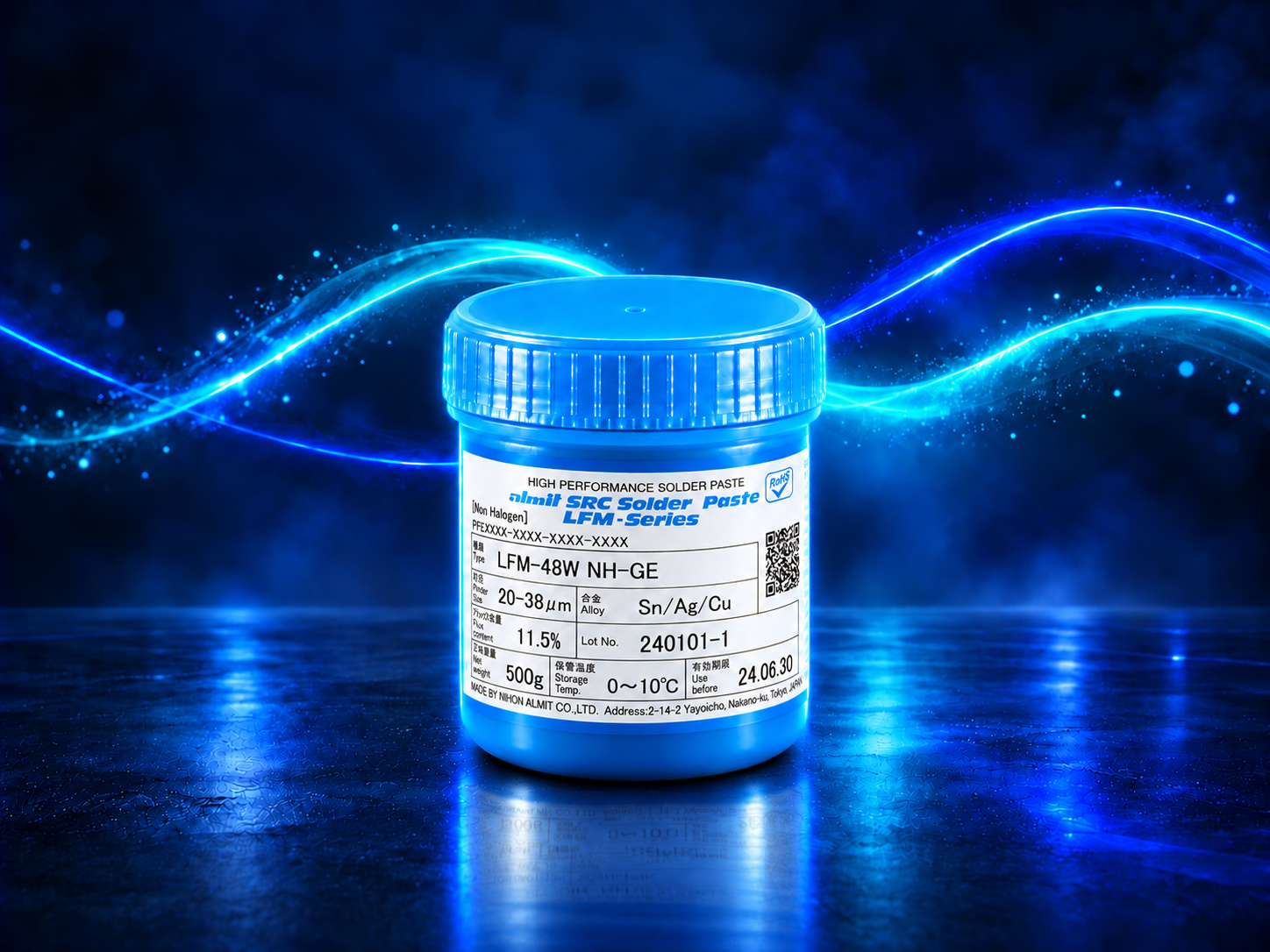 Halogen-free classic
NH-GE
Dual boost flux with two activators – can be used with the same soldering profile as a halogen-activated paste.
Find out more
-
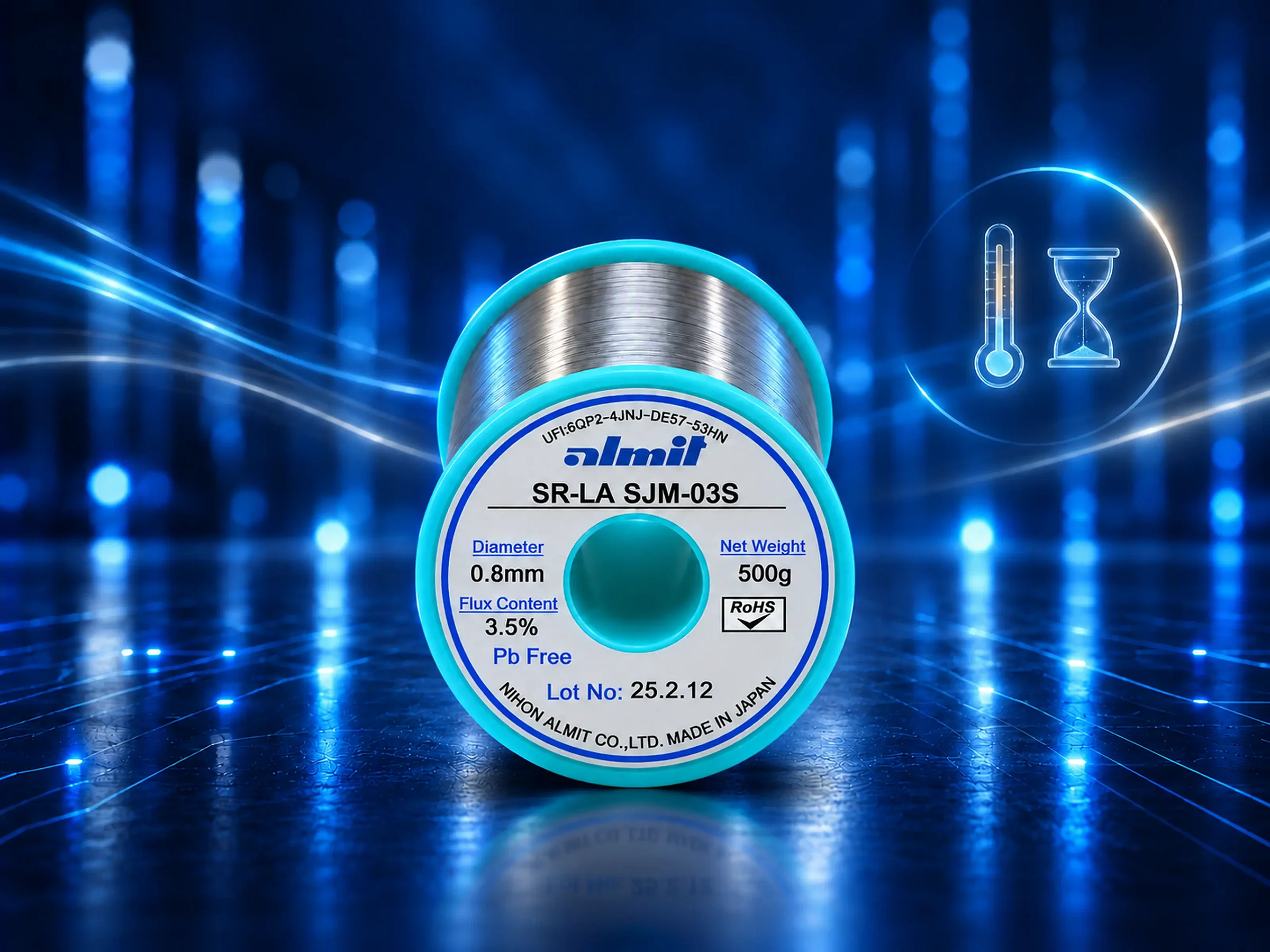 Lead-free with perfect strength
SJM series
SJM-40 shows no cracking even after 2,000 thermal cycles; the silver content can be selected from 0.3 to 4 %.
Find out more
Dispensing or stencil printing?
Stencil printing
The paste is printed onto the pads across the entire surface through a stencil – the most commonly used printing technique.
Characteristics
- A new stencil is required for every layout change
- Requires a flat contact surface
Dispensing
The paste is deposited with pinpoint accuracy via a needle – dot dispensing.
Characteristics
- changes can be made purely via the programme
- even on populated and uneven assemblies
- without stencil costs, even for small production runs
Grain size
The grain size of the solder powder determines how precisely it can be dispensed and how reliably the paste flows through the needle.
Finer powders are suitable for the smallest structures and fine needles, whilst coarser powders are suitable for larger deposits.
Viscosity and thixotropy
Viscosity describes the flowability of a fluid, expressed in centipoise (cP) or pascal-seconds (Pa·s). The lower the viscosity, the better a fluid flows.
When it comes to dispensing, the same trade-off applies as with printing: the viscosity must be low enough to ensure the paste dispenses cleanly – and high enough to ensure that the deposit retains its shape after the needle is lifted. Achieving this balance is one of the major challenges in the development of solder pastes.
Added to this is thixotropy: solder pastes reduce their viscosity under sustained external stress and return to their original viscosity once the stress ceases – much like ketchup, which only becomes runny when shaken. For dispensing, this means: the paste must flow under pressure and then hold its shape immediately afterwards.
Logarithmic representation. The target viscosity of a dispensing paste lies between these extremes – the exact value depends on the needle, deposit size and process.
Flux classification
Almit dispensing pastes are classified according to IPC J-STD-004. All systems mentioned here are no-clean formulations with minimal, non-corrosive residues.
- L0 – halogen-free
- L1
- M1
Almit dispensing pastes at a glance
Lead-free standard alloy SAC305 · Sn-3.0Ag-0.5Cu · 217–220 °C
| Flux system | Class | Grain sizes | Flux content | Special feature |
|---|---|---|---|---|
| TM-HP | L1 | 4–24 / 10–28 / 20–38 / 25–45 µm | 14 % | A tried-and-tested classic with a long track record, offering consistent processing behaviour |
| SSI-M | L1 | 10–28 / 20–38 / 25–45 µm | 13 / 14 % | Specially designed for contactless soldering, consistent dispensing performance |
| NH-MDL | L0 | 10–28 µm | 13 % | Halogen-free, optimised for dispensing followed by laser soldering |
| NH E | L0 | 10–28 / 20–38 µm | 13 % | Halogen-free, reliable and consistent dispensing performance |
| GT(R)-S | L1 | 10–28 / 20–38 µm | 13 % | For pin-in-paste / THR, performs well on fine structures |
| NH IMT | L0 | 20–38 µm | 11.5 % | Halogen-free with the wetting behaviour of an L1 paste, suitable for THR |
| SUC-UI | L1 | 10–28 / 20–38 µm | 13 % | Particularly low voiding |
| GT | L1 | 20–38 µm | 12 % | Fine-pitch printing formulation, optimum wetting of the smallest structures |
Low-melting-point alloys
| Paste | Alloy | Composition | Melting point | Class |
|---|---|---|---|---|
| NH-MDL | LFM-65 | Sn-58Bi (eutectic) | 139 °C | L0, 12 % |
| TM-HP-Nc | LFM-65 | Sn-58Bi (eutectic) | 139 °C | L1, 10.5 % |
| A75C(L) | LFM-65 | Sn-58Bi (eutectic) | 139 °C | L1, 12 % |
| NH-MDL | LFM-89 | Sn-57.6Bi-0.4Ag | 139–141 °C | L0, 12 % |
| INP | LFM-70 | Sn-3.5Ag-0.5Bi-8.0In | 194–206 °C | L1, 14 % |
With its melting point of 139 °C, the eutectic SnBi alloy protects temperature-sensitive components and reduces energy consumption during the process. In LFM-89, the addition of silver further improves ductility and long-term reliability. The indium-containing SABI alloy LFM-70 reduces the melting range to 194–206 °C – suitable for temperature-critical assemblies. All alloys can be found in the alloy table.
Leaded
HM1 RMA
The tried-and-tested all-rounder for leaded processes, featuring the silver-containing
Sn62 alloy
(Sn-2.0Ag-36.0Pb, 179–190 °C, 12 %, grain sizes 20–38 and
25–45 µm). The silver content reduces silver leaching on
silver-plated surfaces.
Dispensable fluxes
Not every dispensing task requires solder paste. For BGA assembly, flip-chip and rework, Almit supplies dispensable flux gels.
BM-1 RMA
‘No-clean’ flux gel, ideal for BGA and flip-chip assembly as well as rework. Applied via stencil or dispenser, either by machine or manually.
- Solids content
- 60.0 %
- Relative density
- 1.081
- Cartridges
- 5 · 10 · 30 ccm
BM-1 AH
The higher-activity variant for demanding rework tasks on difficult surfaces.
All Almit fluxes are developed and manufactured in-house and are tailored to the company’s solder wires and solder pastes – easy to use, with excellent performance and no crystallisation.
How to maintain consistent dispensing quality
The performance and service life of a solder paste diminish when it is exposed to heat, frost or moisture. Excessive heat can cause the flux to detach from the paste matrix, whilst freezing can lead to precipitation of the paste activators – which reduces wetting ability.
-
1
Storage
Store immediately upon arrival, preferably in a fridge at 0–12 °C. No-clean solder pastes have a shelf life of up to one year under controlled conditions, whilst water-soluble pastes last three to six months.
Store cartridges and tins upright, with cartridges tip pointing downwards – if stored horizontally, the plunger may move, allowing air to enter the paste. If this is not possible, rotate the containers regularly by 180°. FIFO ensures that the oldest paste is used first.
-
2
Tempering
Never use paste straight from the fridge. It usually takes four to eight hours to reach room temperature.
A 500-g container that has been chilled to 5 °C takes around 60 minutes. It is best to take the paste out one shift or the night before use.
-
3
Mixing
When stored in the cold, an inhomogeneous mixture of solder powder and flux forms. Careful mixing restores homogeneity – but only once room temperature has been reached.
Stir slowly by hand with a spatula to minimise the introduction of air – too much air expands during reflow and leads to solder beads. Stirring for too long reduces the viscosity. When mixing by machine, three to five minutes is standard, depending on the paste type and equipment.
Never mix straight from cold storage
This can easily cause the ‘stick-slip’ effect: The metal particles rub against one another, causing localised intense heating of over 1000 degrees, causing the flux to separate. Leaded pastes are particularly prone to this.
Accessories from Almit
- ESD-safe solder paste spatula (Item No. 89590599)
- Solder paste mixing device Solder Paste Softener (Item No. 89581000) – SPS-1 for one tin, SPS-2 for two tins, SPS-5 for two cartridges
Mixing in a sealed container results in less oxidation and fewer air bubbles – and the paste is prepared a good ten times faster than with manual mixing. Find out more in the expert reports ‘Safe storage of solder paste’ and ‘Correct mixing of solder paste’.
Dispensing and metering – quick answers
What does ‘dispensing’ mean in soldering?
Dispensing refers to the application of solder paste using a
syringe onto the areas to be soldered, rather than printing it onto the printed circuit board.
This is also known as dot dispensing.
What is the difference between dispensing and stencil printing?
In stencil printing, the paste is printed over a wide area onto the pads through a stencil. In dispensing, it is deposited with pinpoint accuracy via a needle. Dispensing is easier to adapt than the commonly used printing technique, as there is no need to manufacture a new stencil.
What grain size do I need for my dispensing application?
Almit dispensing pastes are available in 4–24 µm, 5–15 µm, 10–28 µm, 20–38 µm and 25–45 µm. Finer powders are suitable for very small structures and fine needles, whilst coarser ones are suitable for larger deposits.
Are there any halogen-free dispensing pastes?
Yes. NH E, NH IMT and NH-MDL are classified as L0 and are 100 % halogen-free. NH IMT offers the wetting behaviour of an L1 paste.
Which paste is suitable for pin-in-paste or THR?
GT(R)-S and NH IMT are suitable for pin-in-paste and THR. For new projects, Almit recommends the GT(R)-SR system as the successor to GT(R)-S.
How should solder paste be stored?
Ideally in the fridge at 0–12 °C, stored upright and, in the case of cartridges, with the tip pointing downwards. Under controlled conditions, no-clean solder pastes have a shelf life of up to one year.
How long does solder paste need to be left to come to room temperature before use?
Usually four to eight hours. A 500 g container that has been
chilled to 5 °C reaches room temperature in around 60 minutes.
Do not mix the paste straight from the fridge.
Can I dispense flux?
Yes. BM-1 RMA is a flux gel for BGA and flip-chip assembly as well as rework, and can be applied via a stencil or dispenser, either by machine or manually.
Which solder paste is suitable for your process?
Needle diameter, deposit size, component tolerance and the subsequent soldering process determine the choice of grain size, flux system and alloy. Please speak to your Almit technical adviser.