
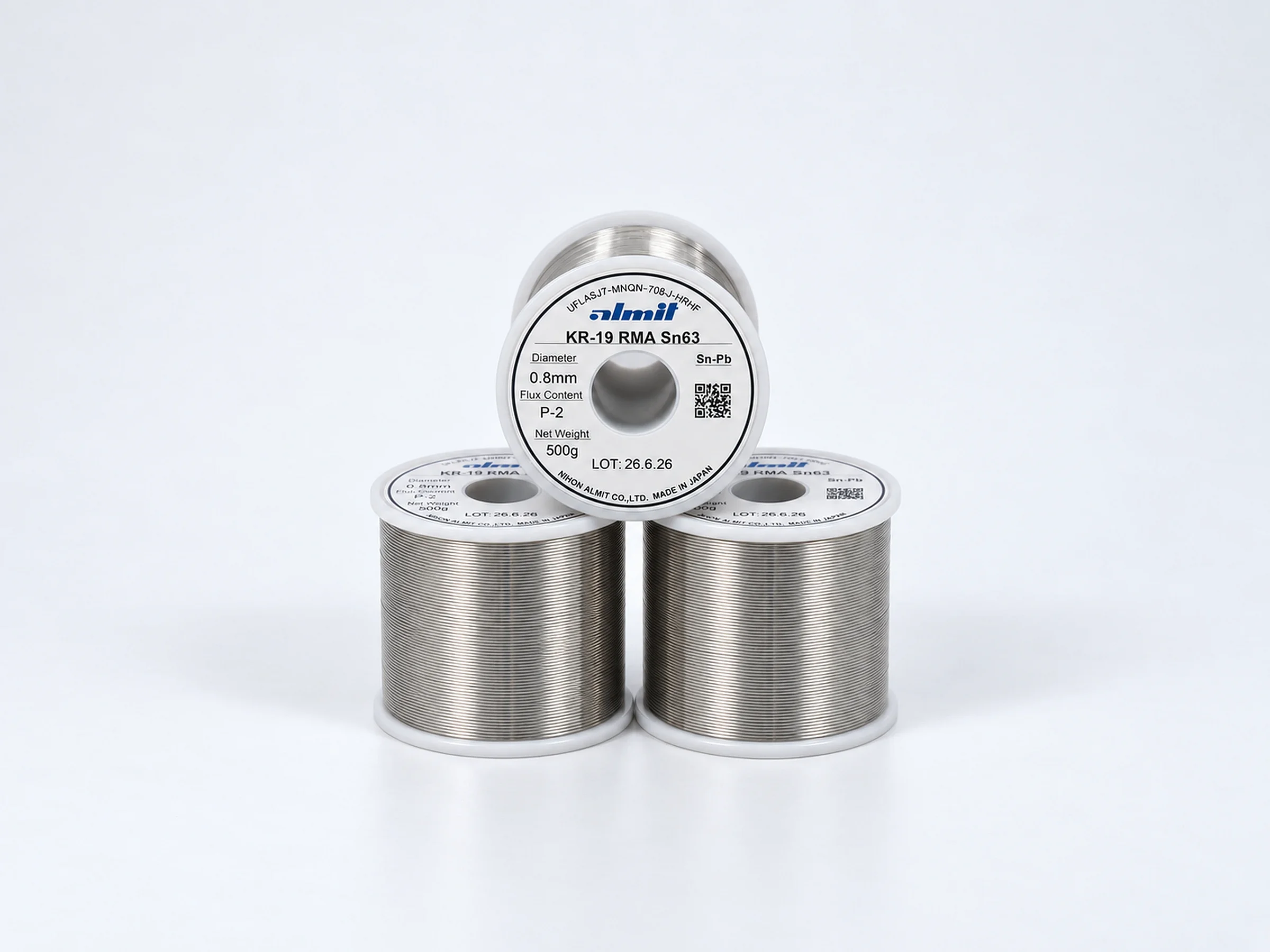
Leaded solder wire
Leaded classics
Almit’s leaded solder wires are tried-and-tested classics designed to meet the most demanding requirements. With alloys such as Sn60 and Sn62, they offer reliable soldering performance and excellent process reliability – proven in decades of industrial use. A prime example of this is our KR-19, which was approved for the NASA Space Shuttle project in 1982 and thus epitomises the standard of quality that characterises all Almit products.
- Tried-and-tested alloys for reproducible soldering results
- Excellent wetting properties
- Approved for aerospace and defence
- Consistent quality from start to finish on every reel
- A range of alloys, fluxes and diameters
Available fluxes for leaded solder wires
| Flux designation | Flux classification | Application |
| GUMMIX-19 | J-STD-004 1.2: RE M1 | Laser soldering, iron soldering, induction soldering |
| GUMMIX-SB RMA | J-STD-004 1.2: RE L1 | Laser soldering, iron soldering, induction soldering |
| HR-19 | J-STD-004 1.2: RE M1 | Iron soldering, induction soldering |
| KR-15 | J-STD-004 1.2: RE M1 | Iron soldering, induction soldering |
| KR-19 | J-STD-004 1.2: RE M1 | Iron soldering, induction soldering |
| KR-19 SH RMA | J-STD-004 1.2: RE L1 | Iron soldering, induction soldering |
| KR-28 | J-STD-004 1.2: RE M1 | Iron soldering, induction soldering |
An overview of leaded solder wires
| Flux | Alloy | Composition | Melting range | Application example | Classification |
| Gummix-19 | 60A | Sn-40Pb | 183 – 190 °C | Robotic applications | J-STD-004 1.2: RE M1 |
| Gummix SB RMA | 60A | Sn-40Pb | 183 – 190 °C | Robotic applications | J-STD-004 1.2: RE L1 |
| HR-19 | 60A | Sn-40Pb | 183 – 190 °C | General components | J-STD-004 1.2: RE M1 |
| KR-15 | KR-15 | Sn-57Pb-14Bi | 135 – 165 °C | Low-temperature application | J-STD-004 1.2: RE M1 |
| KR-19 | 60A | Sn-40Pb | 183 – 190 °C | Ni surface | J-STD-004 1.2: RE M1 |
| KR-19 SH RMA | 60A | Sn-40Pb | 183 – 190 °C | General components | J-STD-004 1.2: RE L1 |
| KR-19 SH RMA | Ag2 | Sn-36Pb-2.0Ag | 179 – 182 °C | Higher long-term reliability | J-STD-004 1.2: RE L1 |
| KR-19 SH RMA | SJ-7 | Sn-35Pb-1.5Ag-1.0Bi | 177 – 199 °C | Military and medical technology and particularly high strength | J-STD-004 1.2: RE L1 |
| KR-28 | Sn8 | Sn-92Pb | 280 – 305 °C | High-temperature application | J-STD-004 1.2: RE M1 |
Leaded solder wire
Leaded classics
View in the shop now
Leaded solder wire
A leaded solder wire consists of two components, both of which determine the soldering result: the alloy and the flux contained within it. Almit manufactures both in-house – the solder alloys as well as the flux formulations. For leaded wires, there is a choice of five alloys and seven fluxes: ranging from the classic Sn-40Pb with a melting point of 183 to 190 °C, through variants containing silver and bismuth, to the high-temperature Sn-92Pb with a melting point of 280 to 305 °C. The fluxes are classified in accordance with IPC J-STD-004.
Tried-and-tested classics – and where they stand today
Lead-free solder wire is the standard at Almit. We stock leaded wires for applications exempt from the RoHS Directive. They have been tried and tested in decades of industrial use, deliver reproducible soldering results and excellent wetting properties – and are appropriately qualified for those applications where the exemption applies.
Almit’s leaded solder wires are approved for use in the aerospace and defence sectors. KR-19 is a prime example of this: the flux was approved in 1982 for the NASA Space Shuttle project and thus epitomises the high standard of quality that characterises all Almit products. The SJ-7 alloy is specifically designated for military and medical applications, as well as for applications requiring particularly high strength.
The flux core makes all the difference
What makes a tubular solder wire what it is is not just its alloy, but the flux core inside it. In conventional wires, this core is often interrupted by air pockets. If such a gap reaches the soldering tip, the process stalls at precisely the moment the flux is needed – and the solder joint turns out poorly.
Almit manufactures its solder wires using a globally unique, particularly complex process under very high pressure. The result is a 100 % continuous flux core without any air pockets whatsoever – even in wires as small as 0.08 millimetres in diameter. The average defect rate is 4 ppm; for a conventional solder wire, it is around 400 ppm. This applies equally to lead-free and leaded wires, as does the consistent quality from start to finish of every reel.
Which alloy is suitable?
60A (Sn-40Pb, 183–190 °C) is the standard alloy in the leaded range. It covers the vast majority of applications – from robotic applications through to general components and nickel surfaces – and differs in these cases only in terms of the flux used.
Ag2 (Sn-36Pb-2.0Ag) supplements the tin-lead solder with 2 % silver and is specified for higher long-term reliability.
SJ-7 (Sn-35Pb-1.5Ag-1.0Bi) combines silver and bismuth. The alloy is intended for military and medical technology and for applications requiring particularly high strength.
KR-15 (Sn-57Pb-14Bi, 135–165 °C) lowers the onset of melting to 135 °C due to its high bismuth content, making it the ideal choice for low-temperature applications – such as temperature-sensitive components.
Sn8 (Sn-92Pb, 280–305 °C) is at the other end of the scale: the high-temperature solder in the range, specified for high-temperature applications.
All alloy data can be found in the solder wire classification.
Which flux is suitable?
The GUMMIX series is designed for contactless processes. GUMMIX-19 and GUMMIX-SB RMA (L1) are approved for laser soldering, iron soldering and induction soldering. This series reduces flux spatter to an absolute minimum and prevents flux residues from detaching – a crucial factor in laser and induction soldering, as spatter would otherwise contaminate the protective lenses of the optics.
For iron soldering and induction soldering, the tried-and-tested KR and HR ranges are available. KR-19 (M1) is the flux for surfaces that are difficult to wet – such as nickel and stainless steel – and is also the one with NASA approval dating from 1982. KR-19 SH RMA (L1) is the low-residue RMA variant for general components and is also listed with the Ag2 and SJ-7 alloys. HR-19 (M1) is suitable for general components.
KR-15 (M1) belongs to the low-temperature alloy of the same name, whilst KR-28 (M1) is used with the high-temperature solder Sn8. Both fluxes are tailored to their respective melting ranges.
Leaded or lead-free?
The decision is determined by the approval, not by the solder joint: if the assembly is subject to the RoHS Directive without exception, lead-free solder wire must be used. If an exception applies, leaded wire remains available for use in the processes qualified for this purpose.
Regarding temperature ranges: Sn-40Pb begins to melt at 183 °C, whilst the lead-free industry standard LFM-48 (SAC305) only begins to melt at 217 °C. Those requiring a lower process temperature for lead-free soldering will find it in LFM-96 (Sn-3.5Ag-0.5Bi-6.0In), which has a melting point of 200 to 210 °C. The alloy table provides a comparison of all alloys for solder wire, solder paste, solder bar and solid wire.
In short
Which leaded solder wire alloys does Almit supply?
Five: 60A (Sn-40Pb, 183–190 °C), Ag2 (Sn-36Pb-2.0Ag), SJ-7 (Sn-35Pb-1.5Ag-1.0Bi), KR-15 (Sn-57Pb-14Bi, 135–165 °C) and Sn8 (Sn-92Pb, 280–305 °C).
Is leaded solder still permitted at all?
Yes – in applications covered by an exemption from the RoHS Directive. Almit’s leaded solder wires are approved for use in the aerospace and defence sectors; the SJ-7 alloy is designated for military and medical technology.
Which leaded solder wire is suitable for nickel or stainless steel?
KR-19. The flux, which has an activity level of M1, is designed for surfaces that are difficult to wet, such as nickel and stainless steel.
Which solder wire is suitable for temperature-sensitive components?
KR-15 with the alloy of the same name, Sn-57Pb-14Bi. It melts between 135 and 165 °C, which is around 48 Kelvin below the initial melting point of Sn-40Pb.
Which leaded solder wire is suitable for laser soldering?
The GUMMIX fluxes GUMMIX-19 and GUMMIX-SB RMA. They are approved for laser soldering, iron soldering and induction soldering, and minimise flux spatter.
How thin can an Almit solder wire be without the flux core breaking off?
Even at a diameter of 0.08 millimetres, the core remains intact. The average defect rate is 4 ppm, compared with around 400 ppm for a conventional solder wire.
Advice
The surface, temperature range, cleaning requirements and approval status determine the choice – whether for hand soldering or robotic soldering. Speak to your Almit specialist; we have the right solution for every application.