
Silver-free / Low in silver
Silver is the most expensive component in a traditional SAC alloy – and the first to be cut back on. However, previous low-silver SAC alloys were not a solution: they were prone to fatigue fractures in the solder joints. With its patented SJM series, Almit has developed a lead-free family of alloys that specifically addresses this issue and remains reliable even under extreme temperature fluctuations. In addition, there are completely silver-free SnCu and SnCuNi alloys for processes in which every gram of silver counts.
Silver is the most expensive component of a traditional SAC alloy – and the first one where cost-cutting takes place. However, previous low-silver SAC alloys were not a solution: they were prone to fatigue fractures in the solder joints. With its patented SJM series, Almit has developed a family of lead-free alloys that specifically addresses this issue and remains reliable even under extreme temperature fluctuations. In addition, there are completely silver-free SnCu and SnCuNi alloys for processes in which every gram of silver counts.
Why low-silver – and why it didn’t work for so long
The evaluation of low-silver alloys is gaining ground due to high metal prices. However, the obvious approach – simply reducing the silver content in an SAC alloy – led to a well-known problem: fatigue fractures in the solder joints.
Are fatigue fractures an inevitable consequence of low-silver alloys? Almit’s answer is no. The SJM series is a patented lead-free alloy that guarantees absolute reliability and high strength even under high thermal cycling.
Almit’s bestsellers for silver-free and low-silver processes
The Almit application overview lists these seven products for silver-free and low-silver processes.
-
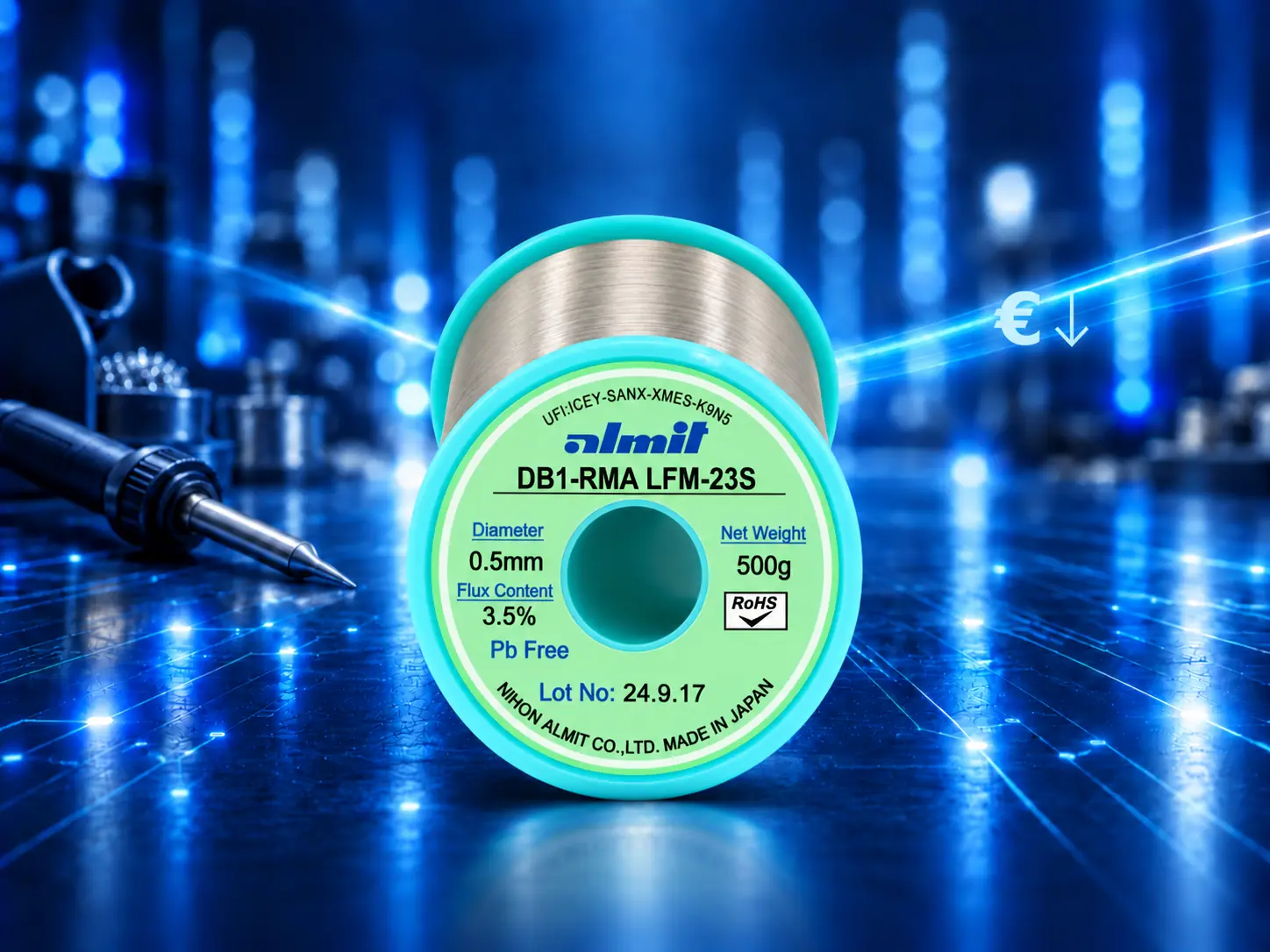 Eutectic solder, 0 % silver content
LFM-23 S
The silver-free SnCuNi alloy, eutectic at 228 °C – regardless of the price of silver.
Find out more
-
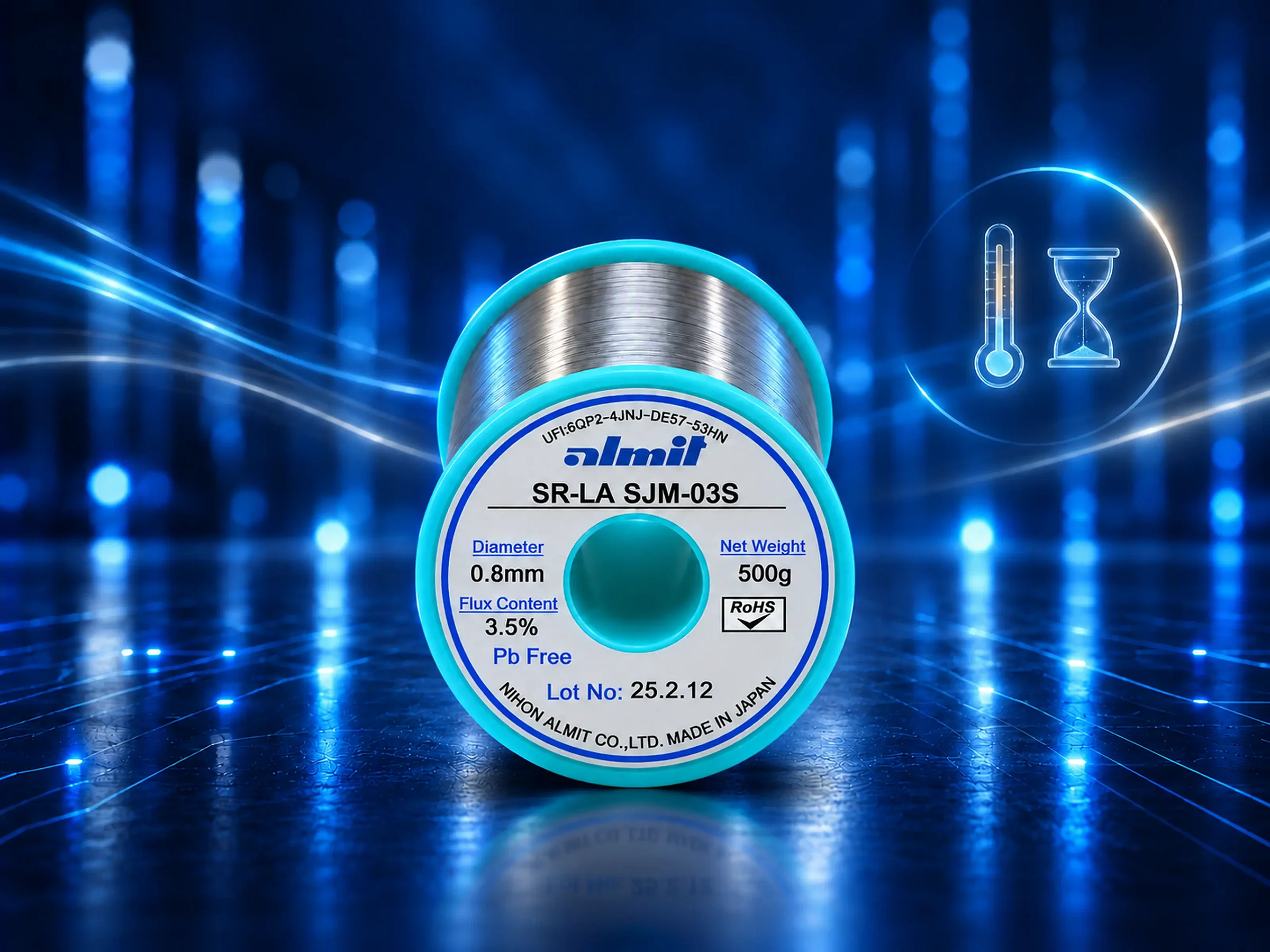 Lead-free with excellent strength
SJM series
The silver content can be selected from 0.3 % to 4 % – SJM-03 S contains 0.3 % instead of 3.0 % as in SAC305.
Find out more
-
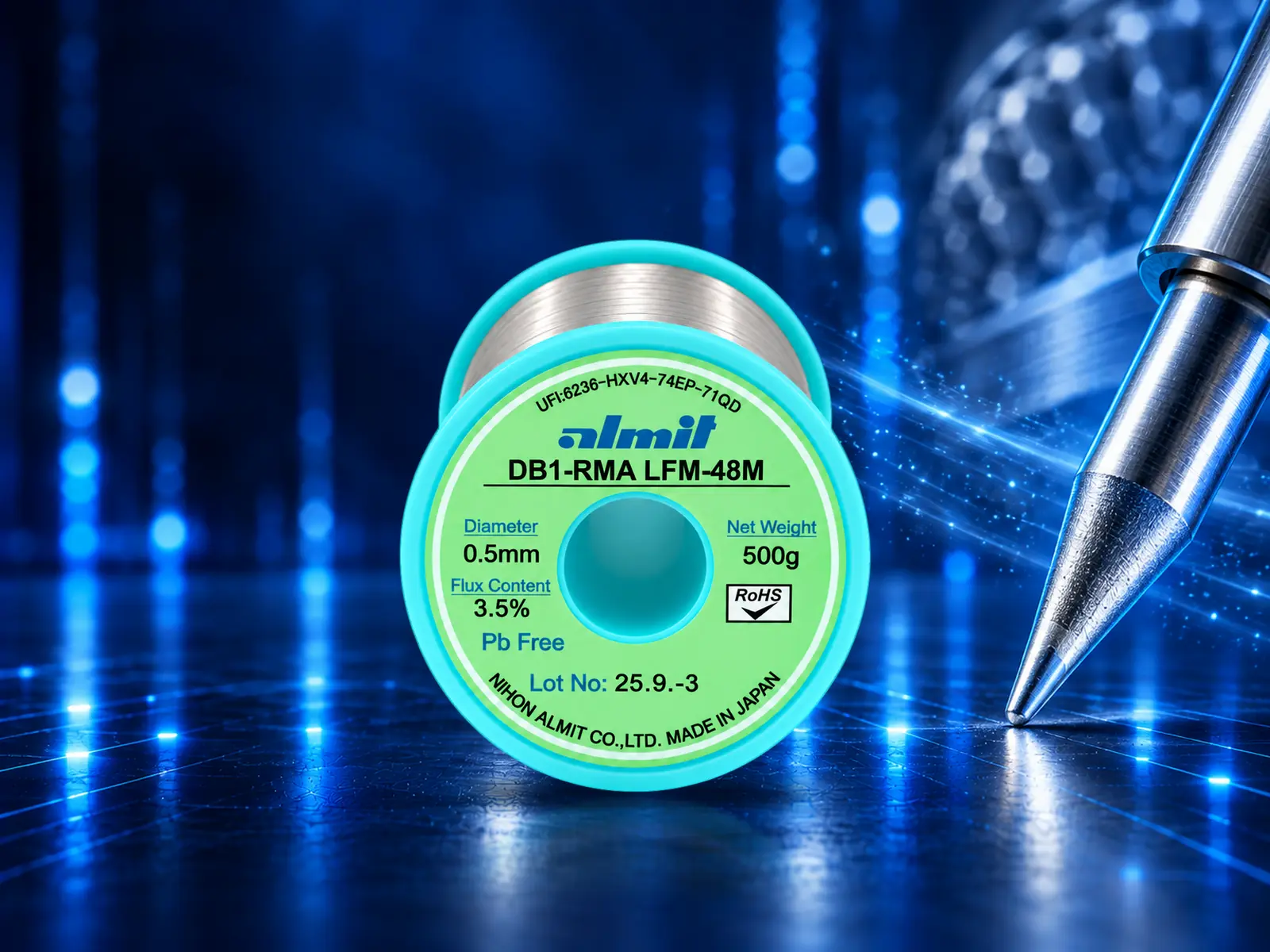 Life insurance for soldering tips
S+M Line
The patented micro-alloy minimises iron erosion from the soldering tip, whilst the M-line also minimises oxidation.
Find out more
-
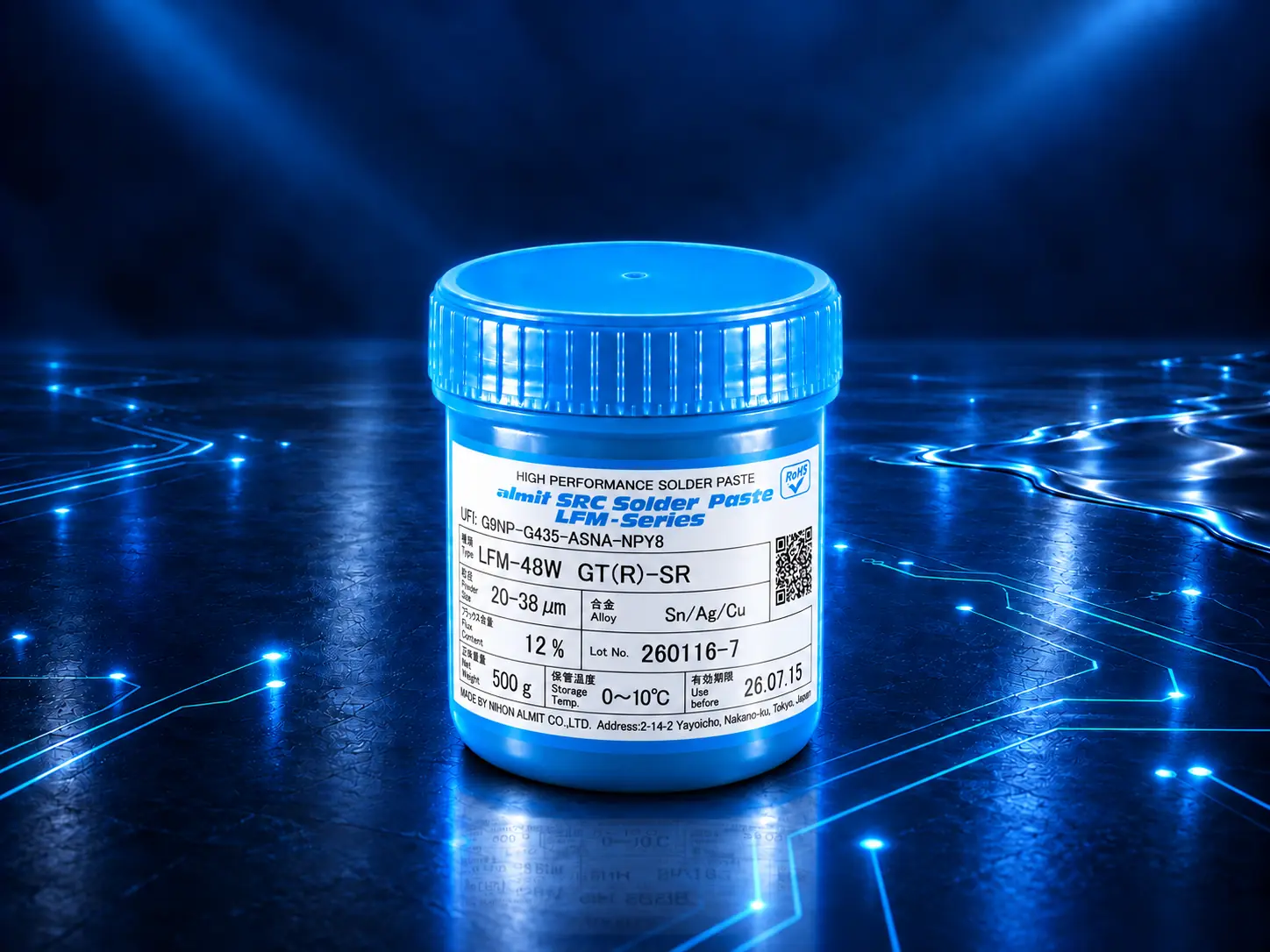 The L1 all-rounder among Almit solder pastes
GT(R)-SR
Optimal wetting on surfaces that are difficult to wet and excellent printing on the smallest structures.
Find out more
-
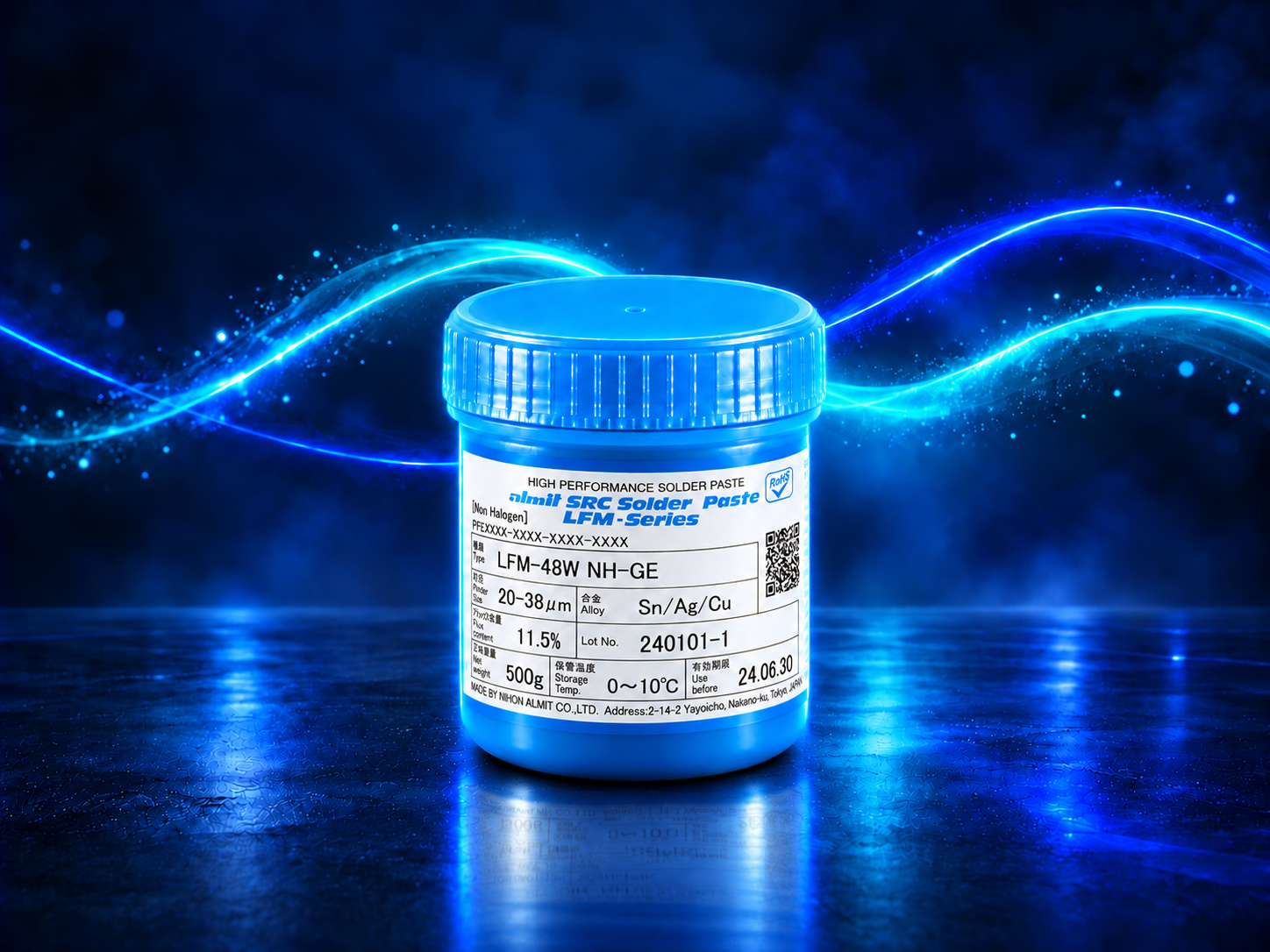 Halogen-free classic
NH-GE
Dual boost flux with two activators – can be used with the same soldering profile as a halogen-activated paste.
Find out more
-
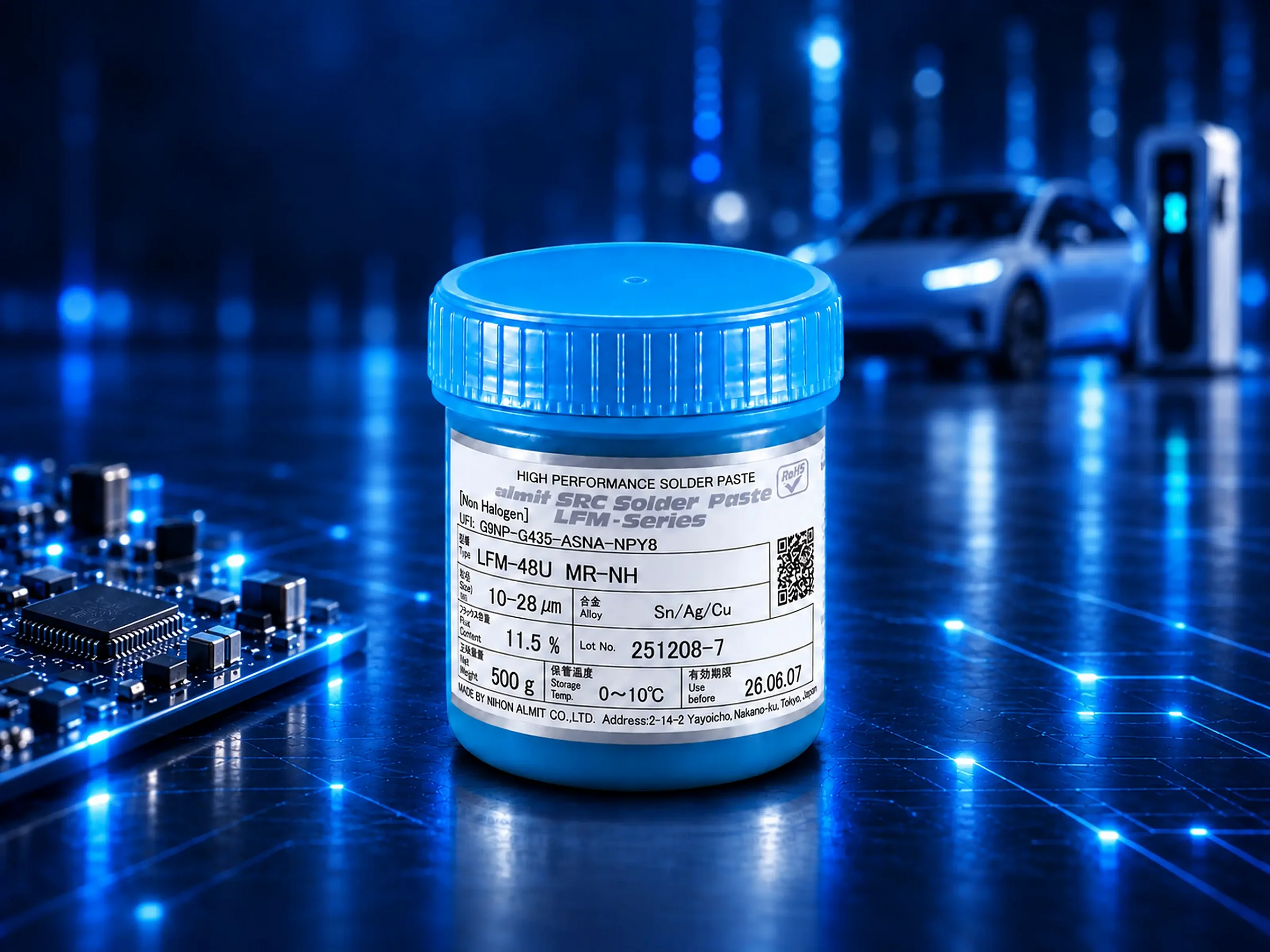 Small area ratio, big performance
MR-NH
The halogen-free paste for high-performance stencil printing – even with an area ratio below 0.6.
Find out more
-
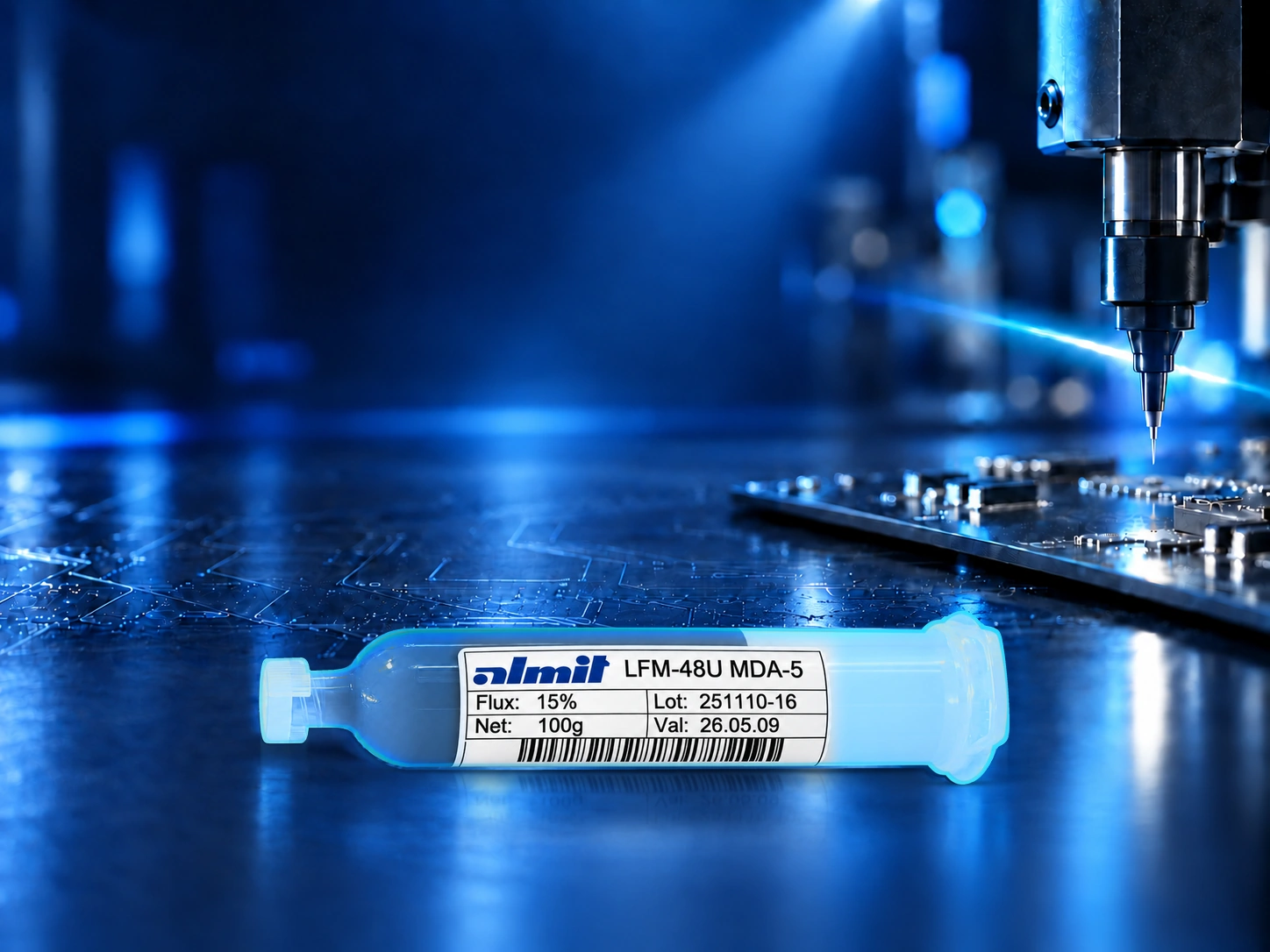 Precise jet printing for maximum process reliability
Jet pastes
For stencil-free application: piezo printing technology ejects the paste onto the printed circuit board without making contact.
Find out more
How much silver is in it?
From completely silver-free to high-silver – the alloys in this range plotted on a single axis. SAC305 shown as a reference point in grey.
SJM-40 is deliberately included in the chart: it is the high-silver counterpart in the same patented series and demonstrates that the silver content within the SJM family can be freely selected – not that it is itself a low-silver option.
The SJM series put to the test
The SJM-03 S, SAC 305 and SACX 0307 were compared.
Standard alloys
crackingIn the temperature cycling test from −40 to +85 °C with a 30-minute dwell time using a 1206 chip resistor, standard alloys exhibited cracking.
SJM-03
1,500 cyclesHigh strength and perfectly reliable even after 1,500 cycles under the same conditions.
| Initial condition | After 2,000 cycles | |
|---|---|---|
| SJM-03 S | 106 | 135 |
| Standard alloys | 100 | 100 |
The presentation is deliberately relative: absolute shear strength values are not available in the sources, only the percentage differences. SJM-03 S stands out as a low-silver alloy with extremely high shear strength.
An overview of the SJM alloys
| Alloy | Composition | Melting range | Availability |
|---|---|---|---|
| SJM-03 | Sn-0.3Ag-0.7Cu-2.0Bi | 210–225 °C | Range |
| SJM-10 | Sn-1.0Ag-0.7Cu-2.0Bi | 212–224 °C | Range |
| SJM-30 | Sn-3.0Ag-2.0Bi-1.0Sb | 216–224 °C | On request |
| SJM-35 | Sn-3.5Ag-2.0Bi | 216–220 °C | On request |
| SJM-40 | Sn-4.0Ag-2.0Bi-3.0Sb | 221–227 °C | Range |
SJM-03 – the core of the range
Low silver content combined with high joint strength – the cost-effective alternative to SAC305. In the Almit range, SJM-03 is, with 203 items, the most widely used low-silver alloy and is available in almost all flux systems, including DB1-RMA, GT(R)-SR, GUMMIX-21 Zeta, NH IMT, QB-1, SR-LA, SRS-ZL and NH(LVA).
SJM-40 – the other end of the spectrum
High silver content, very high joint strength, developed for maximum long-term reliability and established in aerospace and defence applications.
Completely silver-free alloys
Where even the residual silver content is to be eliminated, Almit offers pure SnCu and SnCuNi systems.
| Alloy | Composition | Temperature | Positioning |
|---|---|---|---|
| LFM-22 | Sn-0.7Cu | 227 °C | Silver-free and eutectic – the cost-effective standard solution |
| LFM-23 | Sn-0.6Cu-0.05Ni | 228 °C | Silver-free SnCuNi alloy, significantly reduced material costs |
| LFM-59 | Sn-3.0Cu | 227–312 °C | Copper-rich, anti-copper leaching |
| LFM-62H | Sn-3.0Cu-0.5Ni | 228–394 °C | Copper-rich SnCuNi alloy, anti-copper leaching |
| LFM-57 | Sn-5Sb | 235–240 °C | High temperature, for thermally stressed joints |
| LFM-74 | Sn-10Sb | 246–258 °C | High temperature, for joints subject to high thermal stress |
LFM-23 is, with 185 items, the second most common alloy in this range, whilst LFM-22, with 132 items is the third.
Low-silver SAC variants
| Alloy | Composition | Temperature | Character |
|---|---|---|---|
| LFM-86 (SAC0307) | Sn-0.3Ag-0.7Cu | 217–228 °C | Cost-optimised SAC alternative |
| LFM-90 (SAC107) | Sn-1.0Ag-0.7Cu | 217–221 °C | Low silver content with good wetting; recommended by JEITA |
| LFM-41 | Sn-0.3Ag-2.0Cu | 217–270 °C | Low-silver with increased copper content to counteract copper leaching |
Low-silver does not mean compromising
Those who save on silver need not make concessions elsewhere. The low-silver alloys are available across Almit’s entire range.
The page answers the next logical question: alloy surcharge.
- Solder wires in all flux systems from L0 to M1 – featuring the patented S+M Line, which enables up to five times longer soldering tip lifetime
- Solder pastes for reflow, stencil printing, dispensing and THR
- Solder bars and solid wires for wave, flood and selective soldering systems with high metal purity to minimise dross formation
- Low-melting-point systems such as LFM-65 (Sn-58Bi) are, by their very nature, silver-free
Silver-free and low-silver – a brief answer
Do low-silver alloys lead to fatigue fractures?
Not necessarily. Previous low-silver SAC alloys exhibited this problem; Almit’s patented SJM series specifically counteracts the issue of fatigue fractures.
How does SJM-03 perform in reliability testing?
In a test ranging from −40 to +85 °C with a dwell time of 30 minutes using a 1206 chip resistor, SJM-03 shows no cracking even after 1,500 cycles, whilst standard alloys exhibit cracks.
What is the shear strength of SJM-03 S?
In its initial state, it is around 6 % higher, and after 2,000 cycles, around 35 % higher than that of standard alloys.
Which Almit alloys are completely silver-free?
LFM-22 (Sn-0.7Cu), LFM-23 (Sn-0.6Cu-0.05Ni), LFM-59 (Sn-3.0Cu), LFM-62H (Sn-3.0Cu-0.5Ni) and the antimony alloys LFM-57 (Sn-5Sb) and LFM-74 (Sn-10Sb).
What is the difference between SJM-03 and SJM-40?
SJM-03 (Sn-0.3Ag-0.7Cu-2.0Bi, 210–225 °C) has a low silver content combined with high joint strength. SJM-40 (Sn-4.0Ag-2.0Bi-3.0Sb, 221–227 °C) has a high silver content and very high joint strength; it is well established in the aerospace and defence sectors.
What does the abbreviation SJM stand for?
SJM stands for Strong Joint Metal. LFM stands for Lead-free Metal.
Is SJM patented?
Yes. The SJM series is a patented lead-free alloy; SJM-40 is patented.
How much silver can you save?
The answer depends on the component mix, thermal cycling and the process. Speak to your Almit specialist – we’ll work out the figures for your specific case.