
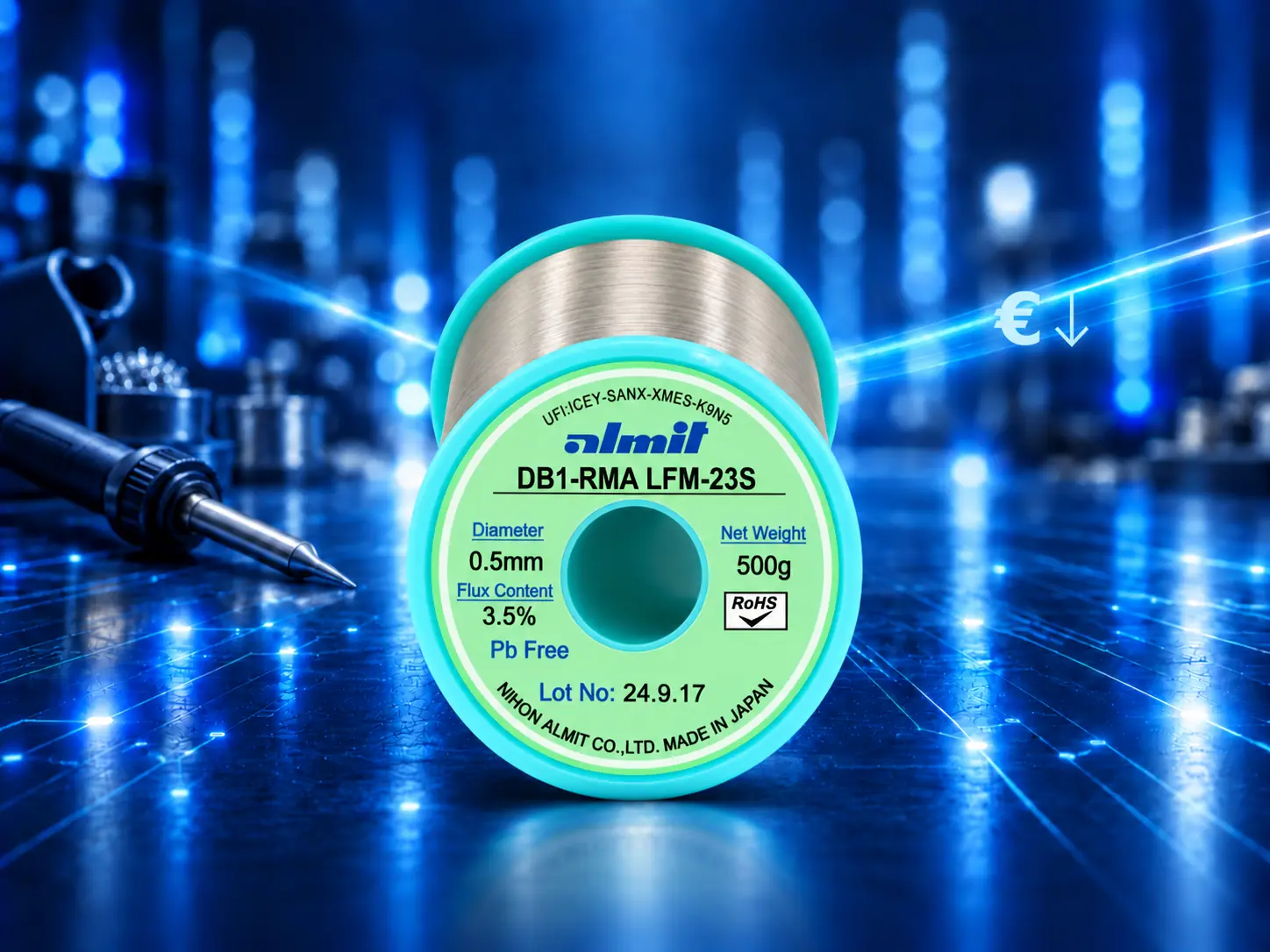
LFM-23 S
5 times longer soldering tip lifetime
With a soldering tip lifetime up to 5 times longer, LFM-23 S can play a key role in keeping costs under control in electronics manufacturing.
- 5 times longer soldering tip lifetime
- 50 % cheaper than SAC305
- Eutectic solder
-
up to 5×longer soldering tip lifetime
-
50 µmiron erosion instead of 250 µm
-
0 %Silver content
-
228 °CSolidus & Liquidus
Patented microalloy
An integral part of LFM-23 S is a patented microalloy – the additives denoted as α and β in the composition. It reduces oxidation and minimises iron erosion at the soldering tip. The soldering tip can therefore be used up to five times longer than with a conventional alloy.
The cost-effective standard solution
LFM-23 S is the silver-free SnCuNi alloy for applications where unit costs are a key consideration: significantly reduced material costs, eutectic melting behaviour and a long service life for the soldering tip. As it contains no silver, it is also independent of the price of silver.
Where, on the other hand, maximum long-term strength is required, the SJM series offers a dedicated range – patented and designed to withstand thermal cycling.
One-fifth of the iron erosion
After 20,000 solder joints, the LFM-23 S soldering tip shows significantly less iron erosion than a conventional SnCuNi alloy.
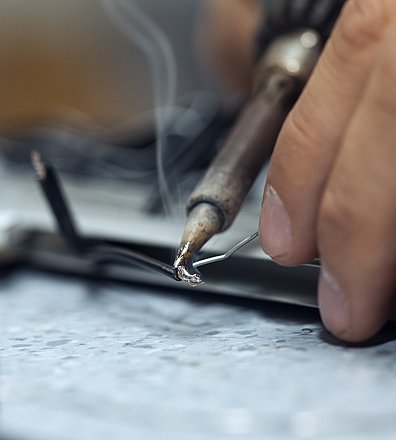
Why this matters: The copper core of a soldering tip is coated with a layer of iron which protects it from corrosion caused by the flux and from migration caused by the solder alloy. Lead-free solder contains over 95 % tin, and tin gradually erodes this layer. Once it has been worn away, the soldering tip has reached the end of its service life – as indicated by the formation of holes in the copper core. This is precisely where the microalloy in LFM-23 S comes into play: it slows down the dealloying process, and the tip lasts up to five times longer.
For production, this means one thing above all: less frequent replacement. In automated soldering systems, the soldering tip is the consumable that determines the cycle time – every replacement costs set-up time.
Iron erosion from the soldering tip after 20,000 solder joints – the LFM-23 S is at one-fifth of the reference value. For information on how soldering tips wear out and the influence of operating temperature, see Iron Soldering.
What an alloy without silver saves
In terms of metal content, LFM-23 S costs around half the price of a SAC305 alloy. The reason lies in the composition: silver is the most expensive component of a classic SAC alloy, and LFM-23 S does without it entirely.
This can be verified by looking at our own alloy surcharge. It reflects the metal quotations, is reset monthly and is precisely the part of the price that differs between the alloys. Most recently, LFM-23 stood at 47.67 per kilogram and LFM-48 – the SAC305 alloy – at 103.39. More than half less, as can be checked month after month.
The benefit is twofold. Firstly, it affects the purchase price per kilogram – and secondly, it improves predictability, as the price of silver fluctuates significantly. A silver-free alloy is not affected by these fluctuations at all. Combined with up to five times the soldering tip lifetime, LFM-23 S thus reduces two major cost components of production simultaneously: the solder and the consumables.
Alloy surcharge per kilogram, as per the most recently published figures. The current values can be found under Alloy surcharge, where they are also listed in US dollars or euros. The overview under Silver-free / Low-silver shows how much silver is contained in the other Almit alloys, ranging from silver-free to 4 %.
| Composition | Solidus | Liquidus |
|---|---|---|
| Sn-0.6Cu-0.05Ni-α-β | 228 °C | 228 °C |
| Classification | Designation |
|---|---|
| M1 | SR-LA Super |
| L1 | GUMMIX 21 Zeta |
| L0 | NHR-TH |
Discover the LFM-23 S now
Up to five times longer soldering tip lifetime – at around half the material cost of an SAC305 alloy.
Katharina Hein
Customer Service
- 06061 969250
- info@almit.de
-
Almit GmbH
Unterer Hammer 3
64720 Michelstadt
Germany