

MR-NH
Small area ratio, high performance
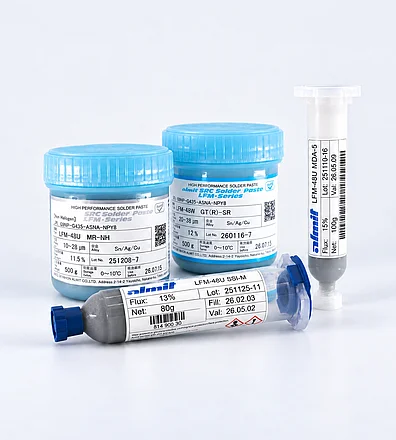
MR-NH is a halogen-free, lead-free solder paste for high-performance stencil printing. The name stands for Motor Vehicle Rosin Non-Halogen. It is suitable even for applications with an area ratio of less than 0.6 – in other words, where standard pastes already fail when being released from the stencil. It offers an excellent print image, outstanding release behaviour and optimum contour stability. Suitable for almost all stencils.
- Excellent print image
- Outstanding release behaviour
- Optimal contour stability
-
0.43Smallest area ratio tested
-
ROL0halogen-free in accordance with IPC J-STD-004
-
up to +20 %Yield increase in customer testing
-
4orders of magnitude above the IPC standard for surface resistance
When the area ratio becomes too small
Miniaturization results in ever-smaller stencil apertures. This causes the ratio of aperture area to wall area to deteriorate – and the solder paste gets trapped in the stencil when it is lifted.
The IPC guidelines recommend that the area ratio should be greater than 0.66 in order to achieve good release behaviour. Experience has shown that with an area ratio of less than 0.66, the solder paste print quality and release behaviour deteriorate. However, in many applications, the area ratio is already outside the recommended range. The decisive factor is never the component alone, but rather its aperture in conjunction with the stencil thickness: a 0201 chip with an aperture of 240 µm × 280 µm results in an area ratio of 0.43 when used with a 150-µm stencil – well below the recommended value. This is precisely where MR-NH comes in.
How the area ratio is calculated
The area ratio describes the ratio of the area of the stencil aperture to the wall area of the aperture. a and b are the aperture dimensions, t is the stencil thickness.
What sets MR-NH apart
The outstanding performance of MR-NH is demonstrated by the results of various tests in which MR-NH was compared with a standard solder paste. All print tests were carried out on a 150 µm stencil – at the 0201 aperture, this corresponds to an area ratio of 0.43, which is precisely the range in which solder paste printing deteriorates when using conventional pastes.
-
Release behaviour With uniform, identically shaped solder deposits, MR-NH demonstrates its release properties. During a printing process, significantly less solder paste adheres to the stencil than with a standard solder paste.
Photron FASTCAM Mini high-speed camera · Separation speed 7.5 mm/s for both pastes
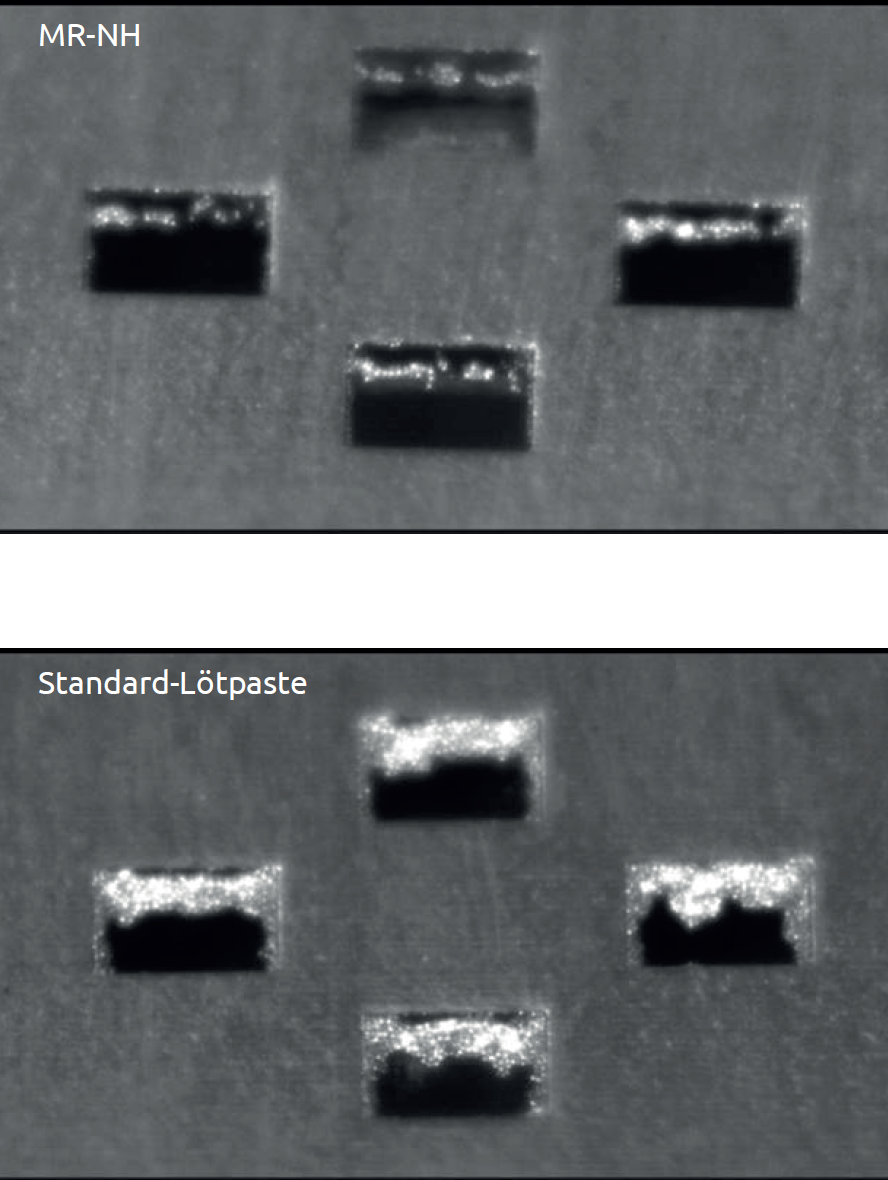
Stencil apertures after release – MR-NH at the top, standard solder paste at the bottom. -
Print contours A comparison of the print contours clearly shows a uniform, stable contour with MR-NH.
HIROX Micro Digital Scope KH-7700 · Separation speed: MR-NH 7.5 mm/s, standard solder paste 3.0 mm/s
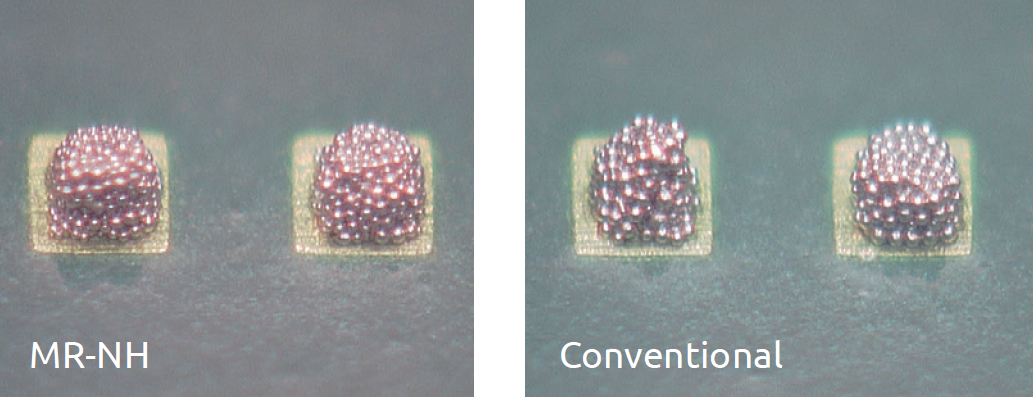
MR-NH on the left, standard solder paste on the right. -
Volume rate Even with a stencil thickness of t = 150 µm, MR-NH achieves a very high volume rate. Measured at the 0201 aperture with dimensions of 240 µm × 280 µm, i.e. with an area ratio of 0.43.
Visual Inspection CKD VP-6000 · Separation speed: MR-NH 7.5 mm/s, standard solder paste 3.0 mm/s · 0201 aperture 240 µm × 280 µm at t = 150 µm
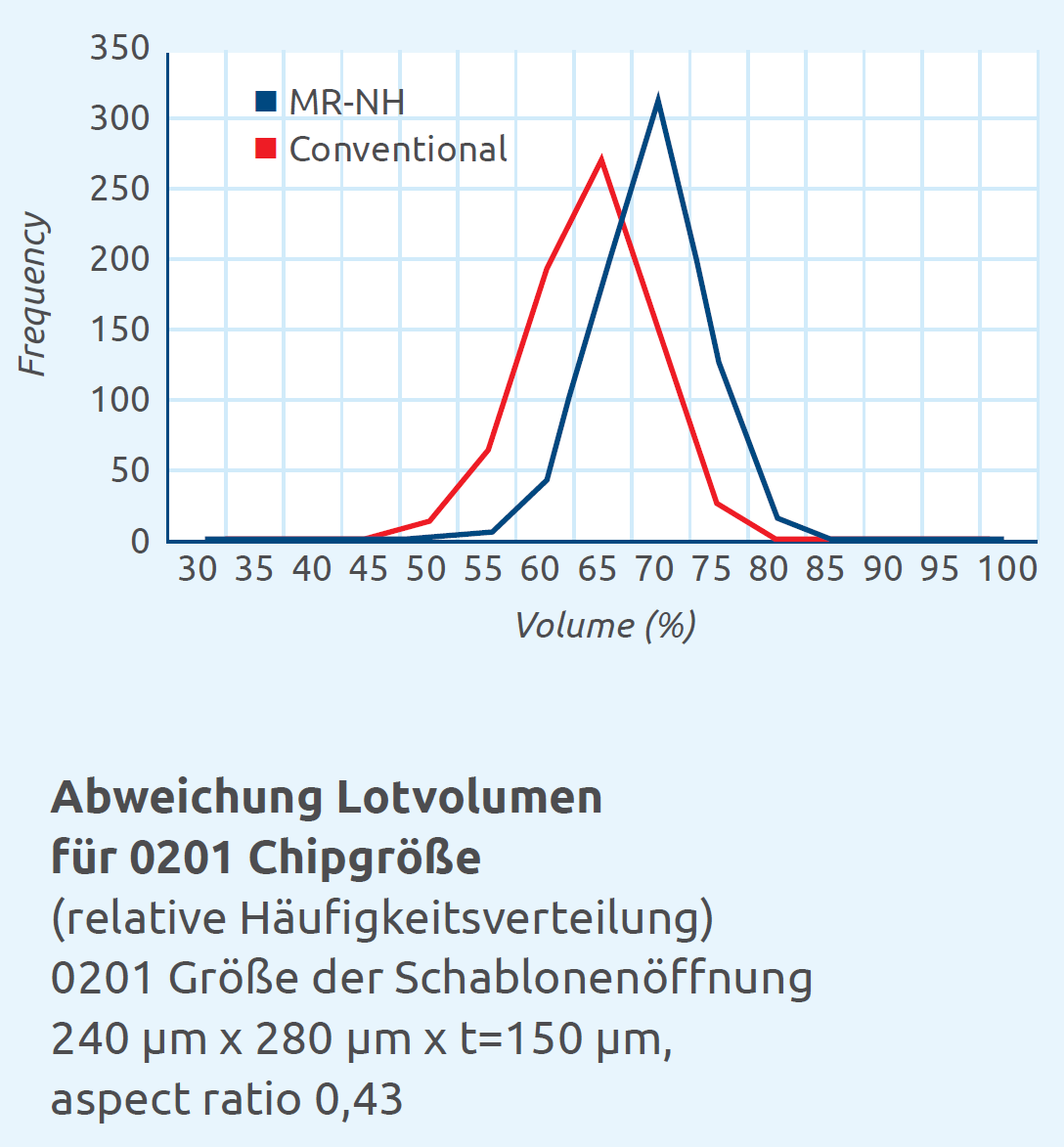
Deviation in solder volume for the 0201 chip size. The MR-NH curve lies further to the right – more paste on the pad. -
Wetting This performance is also evident in the wetting properties. The images were taken in the reflow simulator.
Reflow simulator
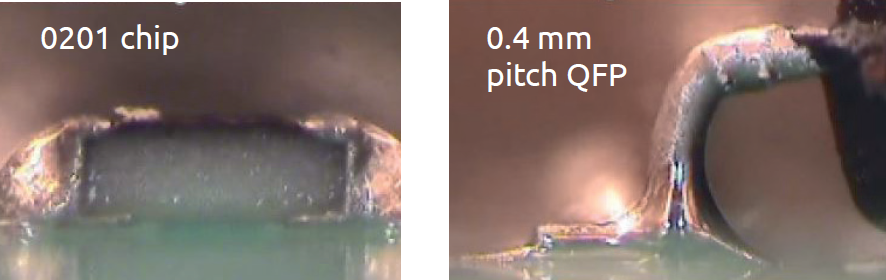
Two areas soldered with MR-NH: on the left, a 0201 chip; on the right, a QFP with a 0.4 mm pitch.
- Surface resistance MR-NH ensures a significantly higher surface resistance, which is four orders of magnitude above the IPC standard.
- Yield Initial customer tests show an increase of up to 20 %, as the excellent release behaviour significantly increases the paste volume on the solder pads – see the diagram below.
Test conditions for all print tests
Printing parameters
- Printer: Panasonic SP60P-M
- Stencil thickness: 150 µm
- Squeegee: metal
- Squeegee speed: 50 mm/s
- Printing force: 25 × 10⁻² N/mm
- Clearance: −0.4 mm
Separation and test specimen
- Separation speed: see the relevant test
- 0201 stencil aperture: 240 µm × 280 µm at t = 150 µm
- Hence the area ratio: 0.43
| Yield | |
|---|---|
| Comparative product | 85 |
| MR-NH | 98 |
A single, unnamed customer case study from the Almit customer magazine. The achievable increase depends on the layout, stencil and process parameters.
MR-NH at a glance
| Designation | Alloy | Composition | Melting range | Grain size | Flux content | Classification |
|---|---|---|---|---|---|---|
| LFM-48 Type 4 MR-NH | LFM-48 | Sn-3.0Ag-0.5Cu | 217–220 °C | Type 4 · 20–38 µm (W) | 11.5 % | ROL0 |
| LFM-48 Type 5 MR-NH | LFM-48 | Sn-3.0Ag-0.5Cu | 217–220 °C | Type 5 · 10–28 µm (U) | 11.5 % | ROL0 |
Your benefits at a glance
- Area ratio < 0.6 – for almost all stencils
- ROL0 halogen-free
- Excellent print image and outstanding release behaviour
- Optimal contour stability
- No-Clean: minimal, non-corrosive residues – cleaning is generally not required
- Industry standard SAC305 – globally qualified and universally applicable
MR-NH is an innovation from the Almit R&D department and is particularly suitable for high-performance stencil printing. All alloy data can be found in the alloy table; the flux classes are listed under Classification.
Packaging and item numbers
| Item number | Description | Grain size | Packaging | Contents |
|---|---|---|---|---|
| 82770099 | LFM-48U MR-NH Flux 11.5 % | 10–28 µm (U) | Jar | 0.5 kg |
| 82770599 | LFM-48U MR-NH Flux 11.5 % | 10–28 µm (U) | Cartridge | 0.5 kg |
| 82681099 | LFM-48W MR-NH Flux 11.5 % | 20–38 µm (W) | Cartridge | 1.0 kg |
| 82680099 | LFM-48W MR-NH Flux 11.5 % | 20–38 µm (W) | Jar | 0.5 kg |
Shelf life according to the product master: 6 months. Information on storage, temperature control and mixing can be found under Dispensing / Metering and in the expert reports ‘Safe storage of solder paste’ and ‘Correct mixing of solder paste’.
Where MR-NH is used
MR-NH is approved for stencil printing and reflow soldering – and is the first choice wherever the area ratio becomes a limiting factor.
- Ultra-fine printing and fine-pitch
- 0201 chips and smaller components on thick stencils
- Residue-critical applications (L0)
MR-NH – quick answers
What does the name MR-NH stand for?
MR-NH stands for Motor Vehicle Rosin Non-Halogen.
Up to what area ratio does MR-NH work?
MR-NH is suitable for applications with an area ratio of less than 0.66. In documented tests, the paste is compatible down to an area ratio of 0.43, thereby enabling its use with virtually all stencil and component combinations.
Is MR-NH halogen-free?
Yes. MR-NH is classified as ROL0 according to IPC J-STD-004 – the 0 stands for halogen-free.
In which grain sizes is MR-NH available?
In two grain sizes: Type 4 with 20–38 µm and Type 5 with 10–28 µm.
What is the alloy composition of MR-NH?
LFM-48, i.e. the industry standard SAC305 (Sn-3.0Ag-0.5Cu) with a melting range of 217–220 °C. The flux content is 11.5 %.
Does cleaning need to be carried out after soldering with MR-NH?
No. MR-NH is a no-clean formulation with minimal, non- corrosive residues. The surface resistance is four orders of magnitude above the IPC standard.
How much does MR-NH increase yield?
Initial customer tests show an increase of up to 20 %, as the excellent release behaviour significantly increases the volume of solder paste on the solder pads. One customer, who had previously achieved a yield of 85 % with a comparable product, reported an increase to 98 %.
For which soldering processes is MR-NH approved?
For stencil printing and reflow soldering.
Critical area ratio in your layout?
Send us your aperture dimensions and the stencil thickness – we’ll tell
you whether MR-NH will release cleanly in those areas.
Speak to your
Almit specialist advisor.

Katharina Hein
Customer Service
- 06061 969250
- info@almit.de
-
Almit GmbH
Unterer Hammer 3
64720 Michelstadt
Germany