
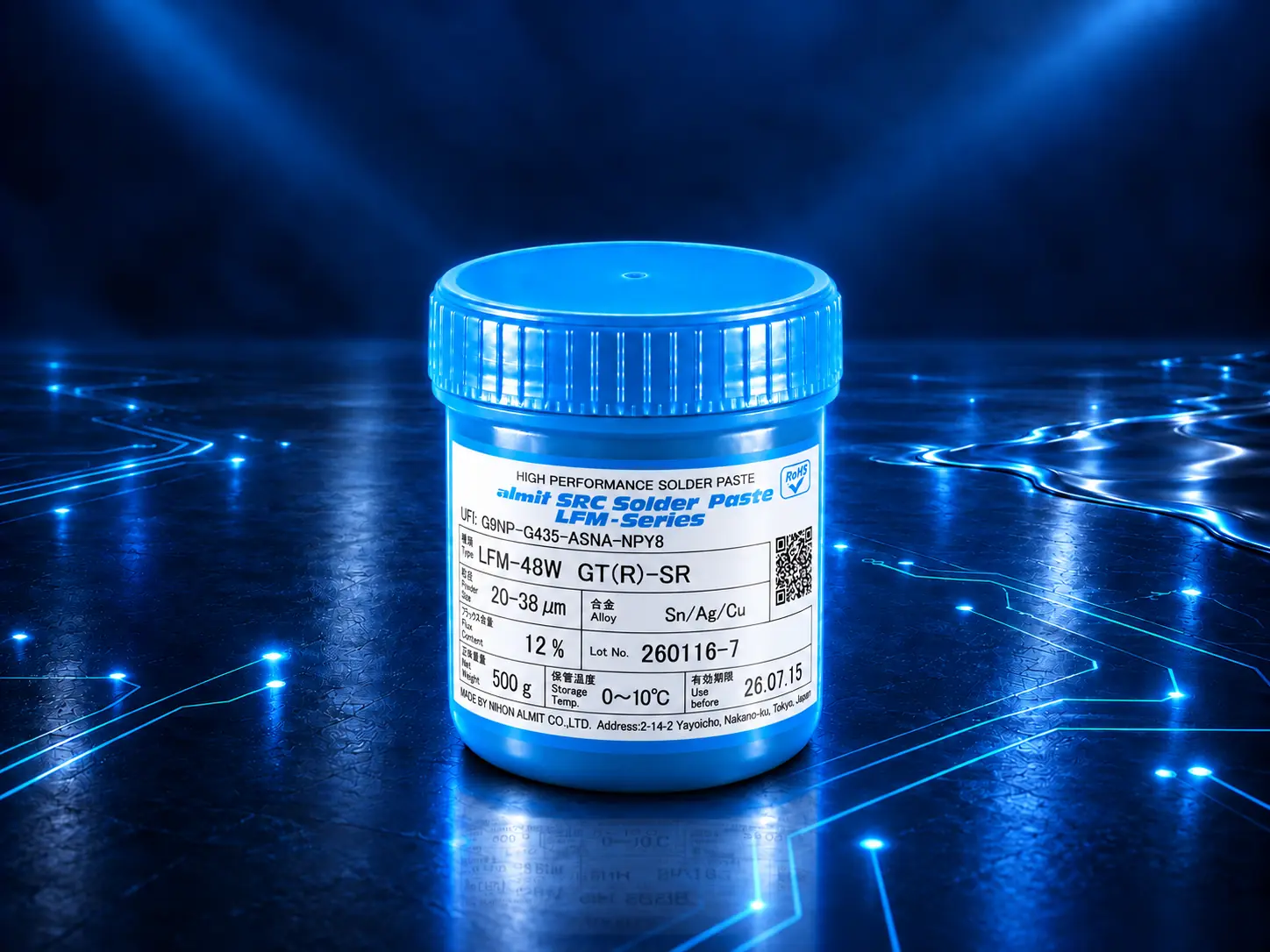
GT(R)-SR
The L1 all-rounder among Almit solder pastes
GT(R)-SR is a lead-free solder paste for surfaces that are difficult to wet. It guarantees optimum wetting on a wide variety of surface materials and maintains high output by minimising soldering defects. Suitable for copper, nickel, brass and phosphor bronze, amongst others – and specifically designed for pin-in-paste and THR applications. Currently Almit’s best-selling lead-free solder paste.
- optimal wetting
- designed for PIP/THR
- RoHS-compliant
-
ROL1flux classification
-
12 %Flux content
-
170±30 Pa·sViscosity
-
3Alloys available
Soldering defects in the SMT process are preventable
Do you think soldering defects in the SMT process cannot be avoided? No, that is not true.
GT(R)-SR guarantees optimum wetting on a wide variety of surface materials and maintains high yield by minimising soldering defects. This is particularly true where standard pastes reach their limits: on nickel, brass, phosphor bronze and nickel silver.
- Optimal wetting
- Very wide range of applications
- Designed for PIP and THR
- Excellent printing on the finest structures
- RoHS-compliant
GT(R)-SR on surfaces that are difficult to wet
In a documented comparative test, the solder paste was printed onto various metal surfaces and heated. The result demonstrates the wetting properties of GT(R)-SR even where a standard paste beads up.
-
Nickel
GT(R)-SR wets Standard paste: does not wet
-
Phosphor bronze
GT(R)-SR wets Standard paste: does not wet
-
Brass
GT(R)-SR wets Standard paste: does not wet
-
Nickel silver
GT(R)-SR wets Standard paste: does not wet
Test conditions: surfaces
- Printing the solder paste onto the respective metal surface
- Heating to 255 °C for 5 seconds
- Stencil thickness 200 µm
- Aperture 6.5 mm Ø
- Tested with GT(R)-SR / LFM-48 U
Test conditions: wetting test
- Printer: Panasonic SP 60 P-M
- Stencil: SUS laser, t = 100 µm
- Reflow profile: 190 °C / 120 seconds
- Peak: 240 °C
- Evaluated: Cohesion properties after reflow, JIS Type 1, grid line printing
No solder beads
In the wetting test, GT(R)-SR shows no solder beads after reflow, both for the JIS Type 1 pattern and for the grid line print.
Two grain sizes
Both grain sizes are available for all three alloys.
The product master data also lists grain size X (25–45 µm) with the LFM-48 alloy.
GT(R)-SR at a glance
| Alloy | Composition | Melting range | Grain size | Flux content | Viscosity |
|---|---|---|---|---|---|
| LFM-48 | Sn-3.0Ag-0.5Cu | 217–220 °C | W: 20–38 µm · U: 10–28 µm | 12 % | 170 ± 30 Pa·s |
| SJM-03 | Sn-0.3Ag-0.7Cu-2.0Bi | 210–225 °C | W: 20–38 µm · U: 10–28 µm | 12 % | 170 ± 30 Pa·s |
| SJM-40 | Sn-4.0Ag-2.0Bi-3.0Sb | 221–227 °C | W: 20–38 µm · U: 10–28 µm | 12 % | 170 ± 30 Pa·s |
Flux classification ROL1. The alloys SJM-03 and SJM-40 are patented. All alloy data can be found in the alloy table; the flux classes are listed under Classification.
Three alloys, one flux
The same GT(R)-SR flux system is available with three alloys – ranging from the industry standard, through the low-silver SJM-03, to the high-performance alloy SJM-40.
- LFM-48 – SAC305, suitable for universal use
- SJM-03 – low-silver, long-term reliability
- SJM-40 – highest long-term reliability
Packaging and item numbers
Availability and ordering via the Almit B2B shop.
| Item number | Designation | Alloy | Grain size | Packaging | Contents |
|---|---|---|---|---|---|
| 83040099 | LFM-48W GT(R)-SR Flux 12 % | LFM-48 | 20–38 µm (W) | Jar | 0.5 kg |
| 83050099 | LFM-48U GT(R)-SR Flux 12 % | LFM-48 | 10–28 µm (U) | Jar | 0.5 kg |
| 83050599 | LFM-48U GT(R)-SR Flux 12 % | LFM-48 | 10–28 µm (U) | Cartridge | 0.5 kg |
| 83030099 | LFM-48X GT(R)-SR Flux 12 % | LFM-48 | 25–45 µm (X) | Jar | 0.5 kg |
| 83190099 | SJM-03W GT(R)-SR Flux 12 % | SJM-03 | 20–38 µm (W) | Jar | 0.5 kg |
| 83190599 | SJM-03W GT(R)-SR Flux 12 % | SJM-03 | 20–38 µm (W) | Cartridge | 0.5 kg |
| 83191099 | SJM-03W GT(R)-SR Flux 12 % | SJM-03 | 20–38 µm (W) | Cartridge | 1.0 kg |
| 83230099 | SJM-40W GT(R)-SR Flux 12 % | SJM-40 | 20–38 µm (W) | Jar | 0.5 kg |
Information on storage, temperature control and mixing can be found under Dispensing / Metering as well as in the expert reports ‘Safe Storage of Solder Paste’ and ‘Correct Mixing of Solder Paste’.
Successors to GT(R) and GT(R)-S
GT(R) and GT(R)-S are the predecessor systems. For new projects, Almit recommends GT(R)-SR. Existing processes using the predecessor systems will continue to run – please speak to your technical adviser regarding a changeover.
GT(R)-SR or NH-GE?
Both pastes are designed for surfaces that are difficult to wet – GT(R)-SR is halogen-activated, whilst NH-GE is halogen-free. In tests, GT(R)-SR wets four surfaces on which a standard paste beads up; NH-GE demonstrates better wetting behaviour than a halogen-activated standard paste on five tested surfaces.
GT(R)-SR
The halogen-activated solder paste for surfaces that are difficult to wet – available in three alloys and two grain sizes.
- Classification
- ROL1
- Flux content
- 12 %
- Alloys
- LFM-48 · SJM-03 · SJM-40
NH-GE
The halogen-free dual boost solder paste – with two complementary activators instead of one. In a comparative test against a standard halogen-activated paste, it demonstrated a better print image, less graping and better wetting on all five surfaces tested.
- Classification
- L0
- Flux content
- 11.5 %
- Alloys
- LFM-48 · SJM-40
GT(R)-SR – quick answers
Which surfaces is GT(R)-SR suitable for?
Amongst others, for copper, nickel, brass and phosphor bronze. In the documented test, GT(R)-SR achieved wetting of nickel, phosphor bronze, brass and nickel silver, whilst the standard paste did not achieve wetting of these surfaces.
Is GT(R)-SR suitable for Pin-in-Paste and THR?
Yes, GT(R)-SR was specifically designed for PIP and THR.
What is the flux classification of GT(R)-SR?
ROL1 according to IPC J-STD-004, with a flux content of 12 %.
Which alloys are available?
Three: LFM-48 (Sn-3.0Ag-0.5Cu, 217–220 °C), SJM-03 (Sn-0.3Ag-0.7Cu-2.0Bi, 210–225 °C) and SJM-40 (Sn-4.0Ag-2.0Bi-3.0Sb, 221–227 °C).
What grain sizes are available?
W with 20–38 µm and U with 10–28 µm, for all three alloys. The product catalogue also lists X with 25–45 µm for LFM-48.
What is the viscosity?
170 ± 30 Pa·s – identical for all three alloys.
What is the difference compared to NH-GE?
GT(R)-SR is halogen-activated (ROL1) with a 12 % flux content and is available in three alloys: LFM-48, SJM-03 and SJM-40. NH-GE is the halogen-free dual boost solder paste (L0) with 11.5 % flux content, available with LFM-48 and SJM-40.
How does it differ from GT(R) and GT(R)-S?
GT(R) and GT(R)-S are the predecessor systems. For new projects, Almit recommends the successor, GT(R)-SR.
Are the alloys patented?
Yes. The SJM-03 and SJM-40 alloys are patented.
Do you have a challenging surface in your process?
Tell us your surface material and component sizes – we’ll advise you whether GT(R)-SR or the halogen-free NH-GE is the right choice. Speak to your Almit specialist.



Katharina Hein
Customer Service
- 06061 969250
- info@almit.de
-
Almit GmbH
Unterer Hammer 3
64720 Michelstadt
Germany