
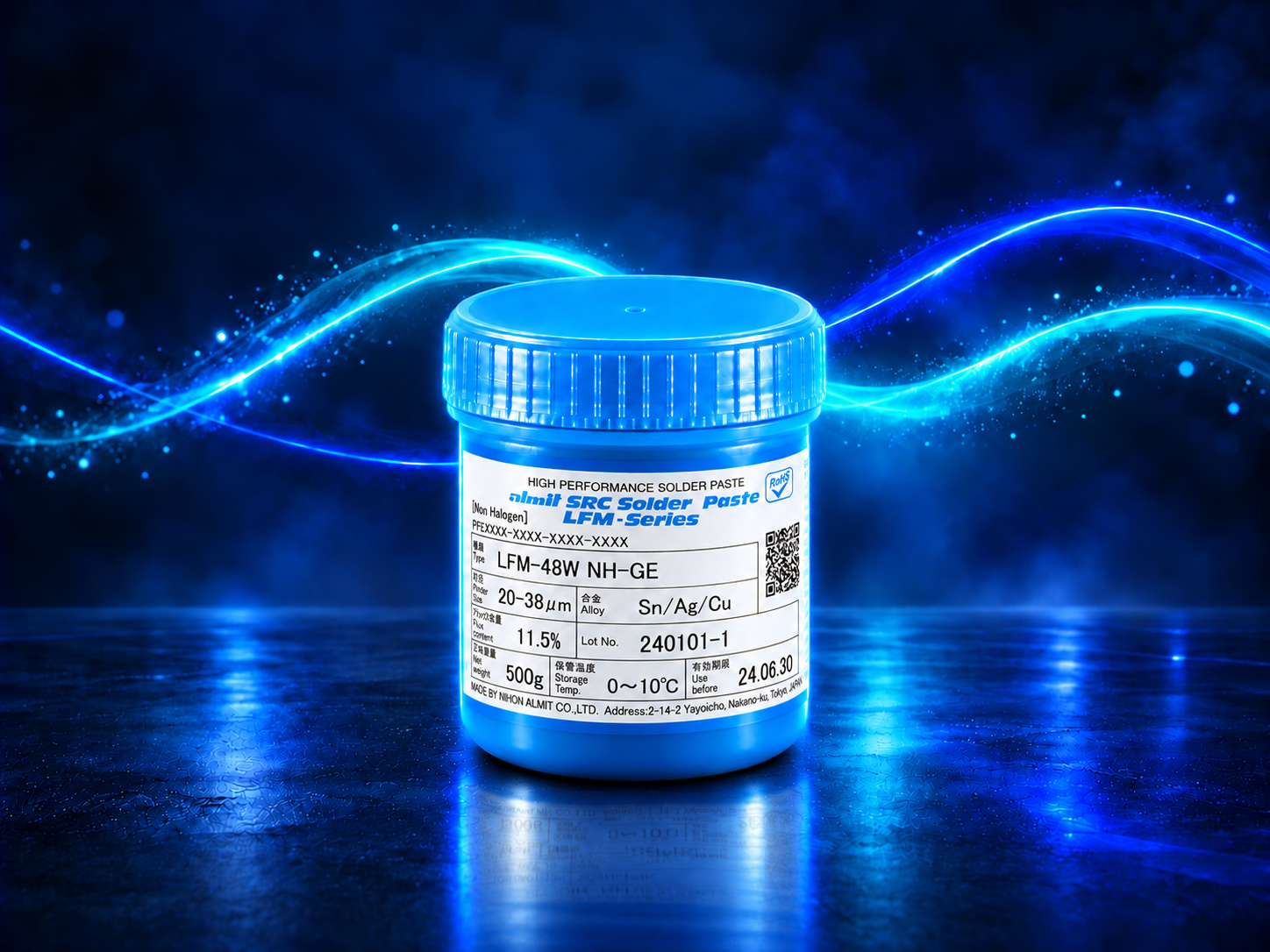
NH-GE
A halogen-free classic
NH-GE is a halogen-free, lead-free solder paste with a dual boost flux. Two activators – one fast-acting and one long-lasting – work together to achieve a wetting behaviour that halogen-free solder pastes have not previously been able to match. NH-GE can be used with the same soldering profile as a halogen-activated solder paste. It is currently Almit’s top recommendation amongst halogen-free solder pastes.
- Same soldering profile as halogen-activated pastes
- Minimised graping
- Improved coalescence on small apertures
- Dual boost flux (ROL0)
-
L0100 % halogen-free
-
2Activators in the dual boost system
-
0.3 mmPitch passed in the heat slump test
-
5substrate surfaces tested
Why NH-GE exists
Almit’s research and development experts are committed to anticipating customers’ requirements for solder pastes and proactively developing innovative solutions.
In doing so, Almit has found that most of the L0 and L1 solder pastes available on the market deliver substandard results in terms of coalescence and wetting ability on various substrates. This provided the impetus for a further innovation in the dual boost family: the halogen-free solder paste NH-GE.
It was announced at productronica 2023, with the official product launch taking place at the Nepcon trade fair in Tokyo.
NH-GE sets a new halogen-free standard that has not yet even been achieved by halogen-activated solder pastes.
Two activators instead of one
With a balanced combination of speed and endurance, more can be achieved – this principle forms the basis of the dual boost products.
Booster 1 – the fast activator. It reaches the peak of activation in the shortest possible time and ensures rapid initial wetting.
Booster 2 – the long-lasting activator. It maintains activation throughout the entire soldering process. This is crucial for challenging reflow profiles and for wetting on difficult surfaces.
The DB-1 RMA solder wire marked the start of the dual boost family – according to Almit, the first product on the market worldwide to contain a dual boost activator. NH-GE is applying this principle for the first time to a halogen-free solder paste.
NH-GE versus a halogen-activated standard paste
In the following product tests, NH-GE was compared with a standard paste from Almit, which has the L1 flux classification.
-
Coalescence
NH-GE demonstrates significantly improved coalescence at small
apertures – better results in the test with Ø 0.2 mm deposits.
Tested at Ø 0.20 mm and Ø 0.26 mm · stencil thickness t = 120 µm
-
Solderability
Despite being a halogen-free flux, NH-GE shows similar results to
the halogen-activated standard paste.
Profile 190 °C / 90 seconds, peak 240 °C · Test Board 4
-
Voiding
In the standard profile with a peak of 240 °C, NH-GE exhibits comparable
voiding to the standard paste.
On an LGA256 · standard profile with a peak at 240 °C
- Graping The standard paste exhibits a negative contact angle and serious graping issues. NH-GE performs well with a shallow contact angle and minimised graping.
-
Printability
NH-GE produces a more uniform print result and a higher
print volume than the L1 standard paste – even after a 60-minute pause.
25 °C and 50 % relative humidity · printing speed 50 mm/s · second test after a 60-minute pause
-
Wetting on five surfaces
Tested on copper, nickel, brass, nickel silver and phosphor bronze:
NH-GE demonstrates better wetting behaviour on all substrates.
Stencil t = 200 µm, Ø 6.5 mm · Heating plate 250 °C
All test conditions in detail
Solderability, coalescence and voids
- Profile: 190 °C, 90 seconds, peak 240 °C
- Substrate: Test Board 4
- Stencil: t = 120 µm
- Coalescence tested at Ø 0.20 mm and Ø 0.26 mm
- Wetting on a 2 × 3 mm sample, retraction and transverse pressure of the solder ball
- Voiding on an LGA256
Printability
- Substrate: Test Board 4, stencil t = 120 µm
- Environment: 25 °C, 50 % relative humidity
- Printing speed: 50 mm/s
- Squeegee pressure: 25 × 10⁻² N/mm
- Separation speed: constant 5 mm/s
- Clearance: −0.4 mm (contact printing)
- Procedure: print, check volume – 60-minute break – print and check again
Wetting on various surfaces
- Substrates: copper, nickel, brass, phosphor bronze, nickel silver
- Stencil: t = 200 µm, Ø 6.5 mm
- Heating on a hotplate at 250 °C
Heat slump resistance (JIS Z 3284)
- Printing paste onto a test board using a 200 µm stencil
- Laminated copper board
- Heating plate at 150 °C, 60 seconds
- Minimum clear distance: 0.3 mm
Heat slump resistance according to JIS Z 3284
In a product comparison, NH-GE achieves better heat slump resistance, which enables significantly better processability. NH-GE passed the test with a clearance of 0.3 mm.
Test method: Print paste onto a test board, using a 200 µm stencil and a laminated copper plate, then heat on a hot plate at 150 °C for 60 seconds.
Why ‘graping’ is a problem
With lead-free solder, there is often an uneven distribution of solder balls on the soldering surface – known as ‘graping’. This compromises the strength of the solder joint and increases the risk of poor thermal and electrical conductivity.
- Occurs particularly with very small components
- A flux is required that solders all the metal balls
- Demonstrated in a test on a 0201 microchip
What sets NH-GE apart from a standard halogen-activated paste
- The halogen-free solder paste can be used with the same soldering profile as the halogen-activated paste
- Comparably few voids
- Minimised graping
- Significantly improved coalescence on small apertures
- A more consistent printing result and a higher print volume
- Dual boost flux for superior wetting behaviour on different surfaces
- Improved heat slump resistance, resulting in significantly better processability
NH-GE at a glance
| Flux | Alloy | Composition | Melting range | Flux content | Grain size | Classification |
|---|---|---|---|---|---|---|
| NH-GE | LFM-48 | Sn-3.0Ag-0.5Cu-α | 217–220 °C | 11.5 % | 10–28 µm (U) | L0 |
| NH-GE | LFM-48 | Sn-3.0Ag-0.5Cu-α | 217–220 °C | 11.5 % | 20–38 µm (W) | L0 |
NH-GE is currently listed in the grain size range 20–38 µm (W). The finer grain size of 10–28 µm (U) is listed in the packaging table below only as NH-GE(H). Please contact us if you require NH-GE in U.
Variants
NH-GE(H)
The variant with increased viscosity – for applications requiring a particularly stable print image.
- Alloy
- LFM-48 (SAC305)
- Grain size
- 20–38 µm (W) · 10–28 µm (U)
- Flux
- 11.5 % (W) · 12 % (U)
NH-GE with SJM-40
The same dual boost flux with the high-performance alloy SJM-40, developed for maximum long-term reliability and established in the aerospace and defence sectors.
- Composition
- Sn-4.0Ag-2.0Bi-3.0Sb
- Melting range
- 221–227 °C
- Grain size
- 20–38 µm (W)
All alloy data can be found in the alloy table; the flux classes are listed under Classification. NH-GE is approved for stencil printing and reflow soldering, including vapour phase.
Packaging and item numbers
| Item number | Description | Grain size | Packaging | Contents |
|---|---|---|---|---|
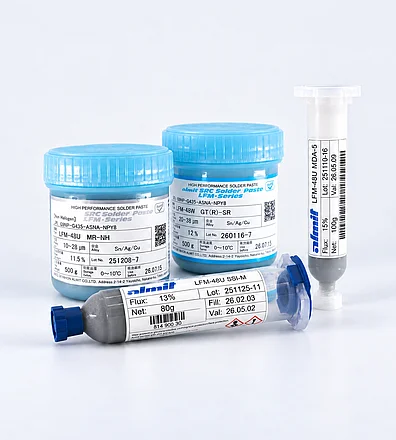
| 83240099 | LFM-48W NH-GE Flux 11.5 % | 20–38 µm (W) | Jar | 0.5 kg |
| 83240599 | LFM-48W NH-GE Flux 11.5 % | 20–38 µm (W) | Cartridge | 0.5 kg |
| 83241099 | LFM-48W NH-GE Flux 11.5 % | 20–38 µm (W) | Cartridge | 1.0 kg |
| 83410099 | LFM-48W NH-GE(H) Flux 11.5 % | 20–38 µm (W) | Jar | 0.5 kg |
| 83260099 | LFM-48U NH-GE(H) Flux 12 % | 10–28 µm (U) | Jar | 0.5 kg |
| 83250099 | SJM-40W NH-GE Flux 11.5 % | 20–38 µm (W) | Jar | 0.5 kg |
For information on storage, temperature control and mixing, see Dispensing / Metering as well as the expert reports ‘Safe Storage of Solder Paste’ and ‘Correct Mixing of Solder Paste’.
The dual boost family
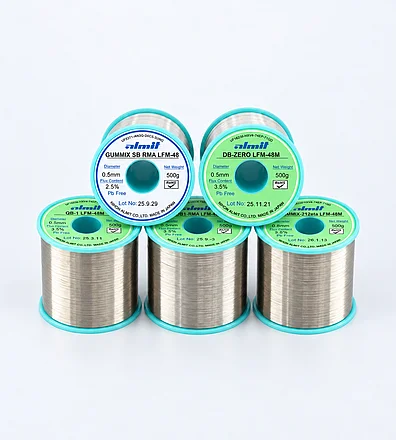
NH-GE is the solder paste in this family. Among the solder wires, two further systems operate on the same principle.
NH-GE
The halogen-free dual boost solder paste. Currently the top recommendation amongst halogen-free solder pastes.
DB-1 RMA
The solder wire that started it all – according to Almit, the world’s first product with a dual boost activator.
QB-1
With Quick-Boost technology: reaches peak activation in no time at all.
DB-ZERO
The halogen-free dual boost solder wire: L0 purity with low-spatter soldering behaviour.
NH-GE – quick answers
What makes NH-GE special?
NH-GE is a halogen-free solder paste with dual boost flux: A fast-acting and a long-lasting activator work together. As a result, the paste achieves wetting and coalescence properties that halogen-free pastes have not previously been able to achieve.
Do I need to change my reflow profile for NH-GE?
No. The halogen-free solder paste can be used with the same soldering profile as a halogen-activated paste.
How does NH-GE perform in terms of voiding?
In a comparative test, NH-GE showed a similar level of voiding to the standard halogen-activated paste – tested using the standard profile with a peak of 240 °C on an LGA256.
Does NH-GE help prevent graping?
Yes. In a product test on a 0201 microchip, the standard paste exhibited a negative contact angle and severe graping issues, whilst NH-GE performed well with a flat contact angle and minimised graping.
On which surfaces was NH-GE tested?
On copper, nickel, brass, phosphor bronze and nickel silver. NH-GE demonstrated better wetting behaviour on all substrates than the standard paste.
How good is the heat slump resistance?
In the heat slump test in accordance with JIS Z 3284, NH-GE passed the test with a gap of 0.3 mm, thereby achieving better heat slump resistance than the standard paste.
In which grain sizes is NH-GE available?
NH-GE is listed in the grain size range 20–38 µm (W) with 11.5 % flux content and the LFM-48 (SAC305) alloy. In the 10–28 µm (U) range, the packaging table lists NH-GE(H) with a 12 % flux content.
What is the difference between NH-GE and NH-GE(H)?
NH-GE(H) is the variant with increased viscosity – for applications requiring a particularly stable print image.
Is NH-GE part of a product family?
Yes, it belongs to Almit’s dual boost family. This also includes the solder wires DB-1 RMA, QB-1 and DB-ZERO.
Would you like some samples?
For detailed advice or if you’re interested in samples, please contact your Almit technical adviser or email us at technicalsupport@almit.de.

Katharina Hein
Customer Service
- 06061 969250
- info@almit.de
-
Almit GmbH
Unterer Hammer 3
64720 Michelstadt
Germany