
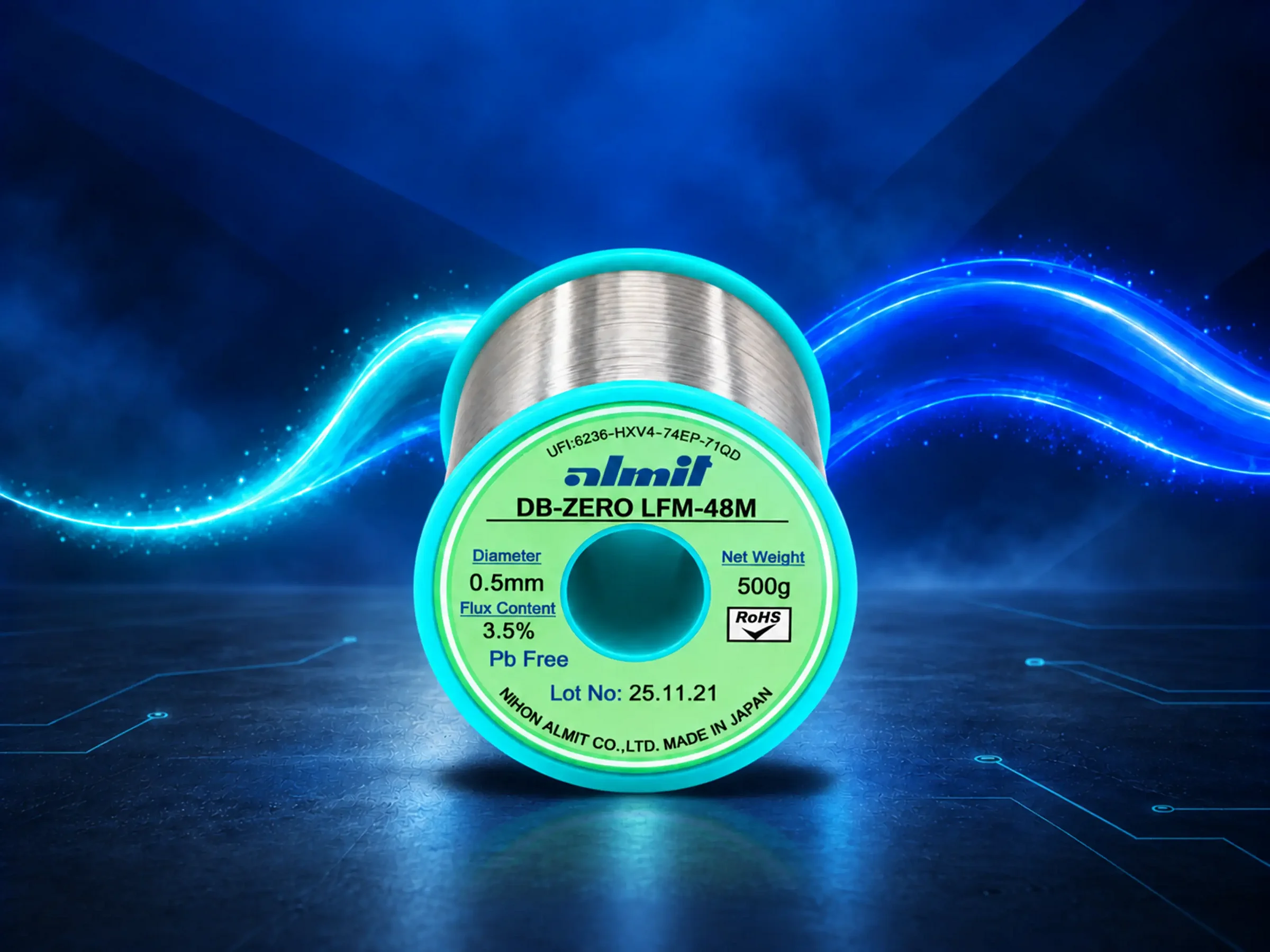
Dual Boost Series
A dual boost for exceptional wetting
With two complementary activators, the dual boost series takes wetting to a whole new level. The solder flows immediately into the plated-through hole, and no bridges form during drag soldering – whilst the process time is noticeably reduced.
- Rapid wetting behaviour
- Shorter process time
- Less flux spatter
-
2Activators in the flux
-
3Flux classes: ROL0, ROL1 and ROM1
-
Up to 30 %higher process speed
-
Top speedFastest solder wire in the Almit range
Two activators that complement each other
DB-1 RMA is an innovation from Almit’s research department: the unique combination of two different, complementary activators.
How the dual boost works
The first activator ensures rapid initial wetting. In the second step, this is complemented by the long-lasting activator. Wetting occurs faster and more effectively – resulting in a soldering finish of outstanding quality.
- Two activators
- The range comprising ROL0, ROL1 and ROM1
- RoHS-compliant
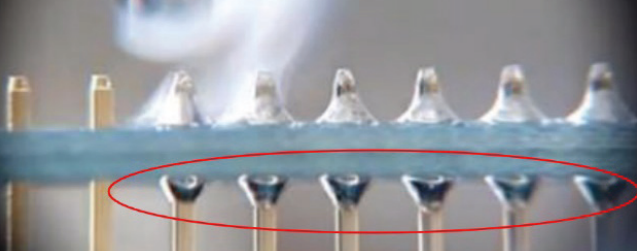
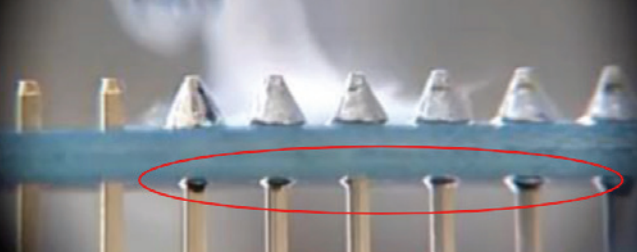
The solder flows immediately into the plated-through hole
Under the influence of the first activator, the solder flows immediately into the plated-through hole, whilst the second activator promotes through-hole wetting and workability. With a conventional solder wire, wetting is insufficient and the solder only flows in partially.
Test conditions
- 380 °C soldering iron tip temperature
- 0 s preheating
- 6 mm feed length
- 20 mm/s feed rate
- 1.4 / 1.0 s post-heating
DB-1 RMA is particularly suitable for
- Oxidised printed circuit boards following the reflow process
- Printed circuit boards with high thermal capacities
Anti-bridge effect: no more bridges
DB-1 RMA also promotes the ‘anti-bridge effect’. During drag soldering, this prevents bridges from forming between adjacent connections.

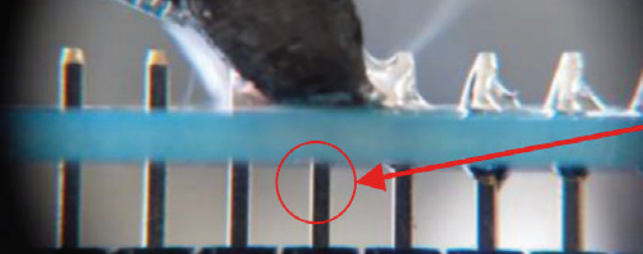
Test conditions: 380 °C soldering iron tip temperature, 2 mm/s soldering iron speed.
Lower soldering temperature, shorter soldering time
Even in challenging applications, DB-1 RMA is an excellent solution: Solderability during through-hole soldering of oxidised printed circuit boards increases significantly after the reflow process, whilst wetting of the plated-through holes improves considerably. Conventional solder wire would require a much higher soldering temperature and a much longer soldering time to achieve this.
- Unique wetting
- Particularly effective for plated-through hole connections and THR applications
- Anti-bridge effect during drag soldering
Flux spatter reduced to a minimum
In a comparative test with a conventional solder wire, at three soldering iron temperatures.
| 320 °C | 350 °C | 380 °C | |
|---|---|---|---|
| DB-1 RMA | 10 | 7 | 1 |
| Standard product | 100 | 16 | 11 |
Note on the scale: The original diagram does not have a numerical axis. The values above are derived from the bar lengths and are therefore given as relative values – the proportions are correct, but the absolute spatter counts are missing. As soon as the original measured values are available, they can be entered into the table; the diagram will follow automatically. This shows: around 90 % less spatter at 320 °C, around 56 % at 350 °C and around 91 % at 380 °C.
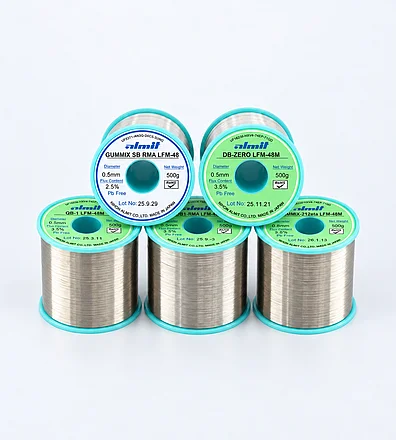
The three dual boost solder wires
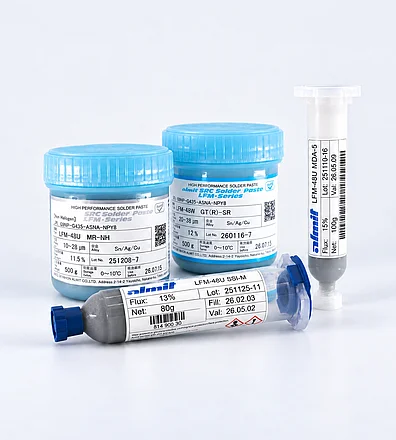
The same operating principle across three flux classes: DB-1 RMA as ROL1, QB-1 with Quick-Boost technology as ROM1 and DB-ZERO as a halogen-free ROL0 – each available in several alloys and diameters. Added to this is NH-GE, the solder paste in the range.
| Flux | Classification | Alloy | Composition | Melting range | Flux content | Diameter |
|---|---|---|---|---|---|---|
| DB-1 RMA | ROL1 | LFM-48M | Sn-3.0Ag-0.5Cu-α-β | 217–221 °C | 3.5 % | 0.3 · 0.38 · 0.5 · 0.65 · 0.8 · 1.0 · 1.2 · 1.6 mm |
| DB-1 RMA | ROL1 | LFM-23S | Sn-0.6Cu-0.05Ni-α | 228–229 °C | 3.5 % | 0.3 · 0.5 · 0.8 mm |
| DB-1 RMA | ROL1 | SJM-03S | Sn-0.3Ag-0.7Cu-2.0Bi-α | 210–226 °C | 3.5 % | 0.5 mm |
| QB-1 | ROM1 | LFM-48M | Sn-3.0Ag-0.5Cu-α-β | 217–221 °C | 3.5 % | 0.3 · 0.38 · 0.5 · 0.65 · 0.8 · 1.0 · 1.2 · 1.6 mm |
| QB-1 | ROM1 | LFM-23S | Sn-0.6Cu-0.05Ni-α | 228–229 °C | 3.5 % | 0.3 · 0.38 · 0.5 · 0.65 · 0.8 · 1.0 · 1.2 · 1.6 mm |
| QB-1 | ROM1 | SJM-03S | Sn-0.3Ag-0.7Cu-2.0Bi-α | 210–226 °C | 3.5 % | 0.3 · 0.5 · 0.8 · 1.0 · 1.2 mm |
| DB-ZERO | ROL0 | LFM-48M | Sn-3.0Ag-0.5Cu-α-β | 217–221 °C | — | 0.5 · 0.65 · 0.8 · 1.0 mm |
| DB-ZERO | ROL0 | LFM-48 | Sn-3.0Ag-0.5Cu | 217–220 °C | 3.5 % | 0.5 · 0.65 · 0.8 mm |
DB-ZERO is the halogen-free wire in the L0-purity series with low-spatter soldering behaviour. The classification of all flux classes can be found under Solder Wire Classification.
Discover the dual boost series
Dual boost for unique wetting – ideal for plated-through holes and THR applications, with no bridging during drag soldering.




Katharina Hein
Customer Service
- 06061 969250
- info@almit.de
-
Almit GmbH
Unterer Hammer 3
64720 Michelstadt
Germany