
Whisker
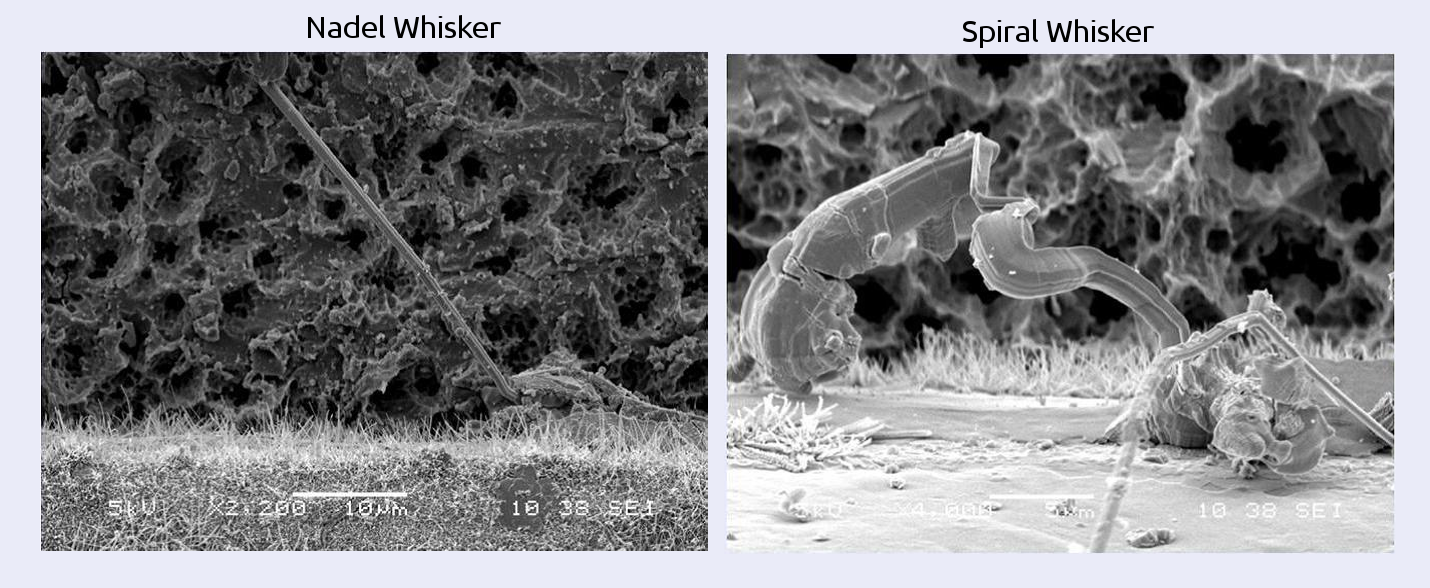
A ‘whisker’ refers to a crystal in which the atoms form a homogeneous crystal lattice without any defects. This phenomenon first came to public attention following a disruption to the New York telephone network caused by a short circuit in a telephone line. Under the influence of electrical resistance heat (I²R), a high-purity, needle-shaped tin crystal had grown within the tin sheath of the copper cable, piercing the outer wall of the cable and destroying its insulation.
Due to their needle-like growth, such crystals are called whiskers. As this anecdote illustrates, such a whisker is strong enough to pierce a cable. In theory, it would be possible to use such crystals to manufacture, for example, suspension cables for bridges that would be much finer than conventional suspension systems. However, the production of whiskers has so far been limited to the crystallisation of dissolved substances from saturated aqueous solutions and other experimental methods, and is not expected to be ready for mass production in the foreseeable future. The commercial term ‘gypsum whisker’, which is sometimes encountered, is misleading and is intended merely to suggest a particularly strong fibre.