
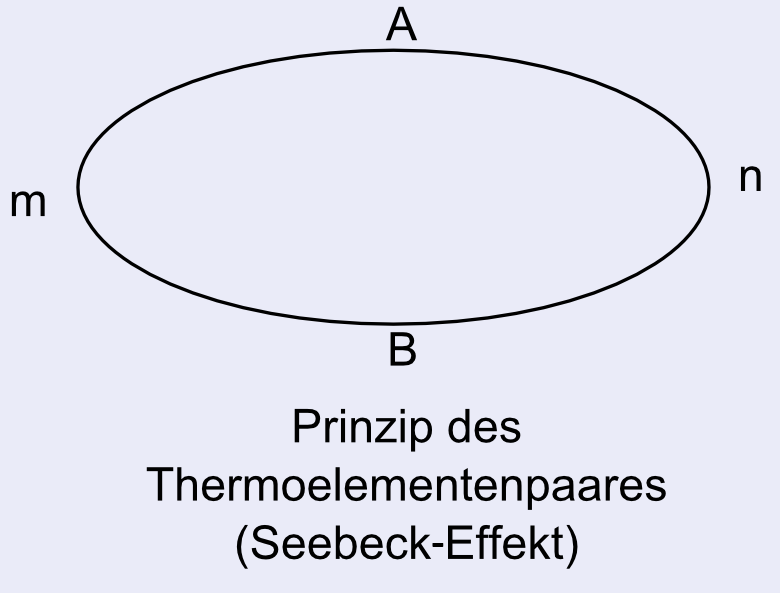
Thermocouple pair (thermocouple)
If, as shown, two different metallic conductors, A and B, are connected to one another and different temperatures prevail at the contact points m and n, a potential difference arises within this circuit and a direct current flows. This phenomenon is known as the Seebeck effect. If point m is at room temperature and point n is exposed to a higher temperature, the temperature at point n can be calculated from the current measured in the circuit. Conversely, a temperature difference arises between points m and n when a current is applied to the circuit; this is known as the Peltier effect. The metal pair is referred to here as a thermocouple pair. Depending on the temperature to be measured, the pairs listed in the table below are used.
For temperature measurement during soldering, the Ni-Cu pairs (Constantan/copper or Constantan/iron) are sufficient; however, in view of the risk of corrosion at high temperatures, Alumel/Chromel is more commonly used.
This pair is also widely used for temperature measurements in SMT reflow ovens or when melting solder alloys.
Composition and operating temperature of thermocouple pairs (: denotes pair)
Measurement temperature (°C) 0–400 400–900 900–1400
Thermocouple pairs and their chemical composition Cu : Constantan
Fe: Constantan Alumel (Ni94; Al2; Si1; Fe0.5; Mn2.5) : Chromel (Ni89; Cr9.8; Fe1; Mn0.2) Pt : Pt-Rh(10)
Composition and operating temperature of thermocouple pairs (: denotes a pair)