
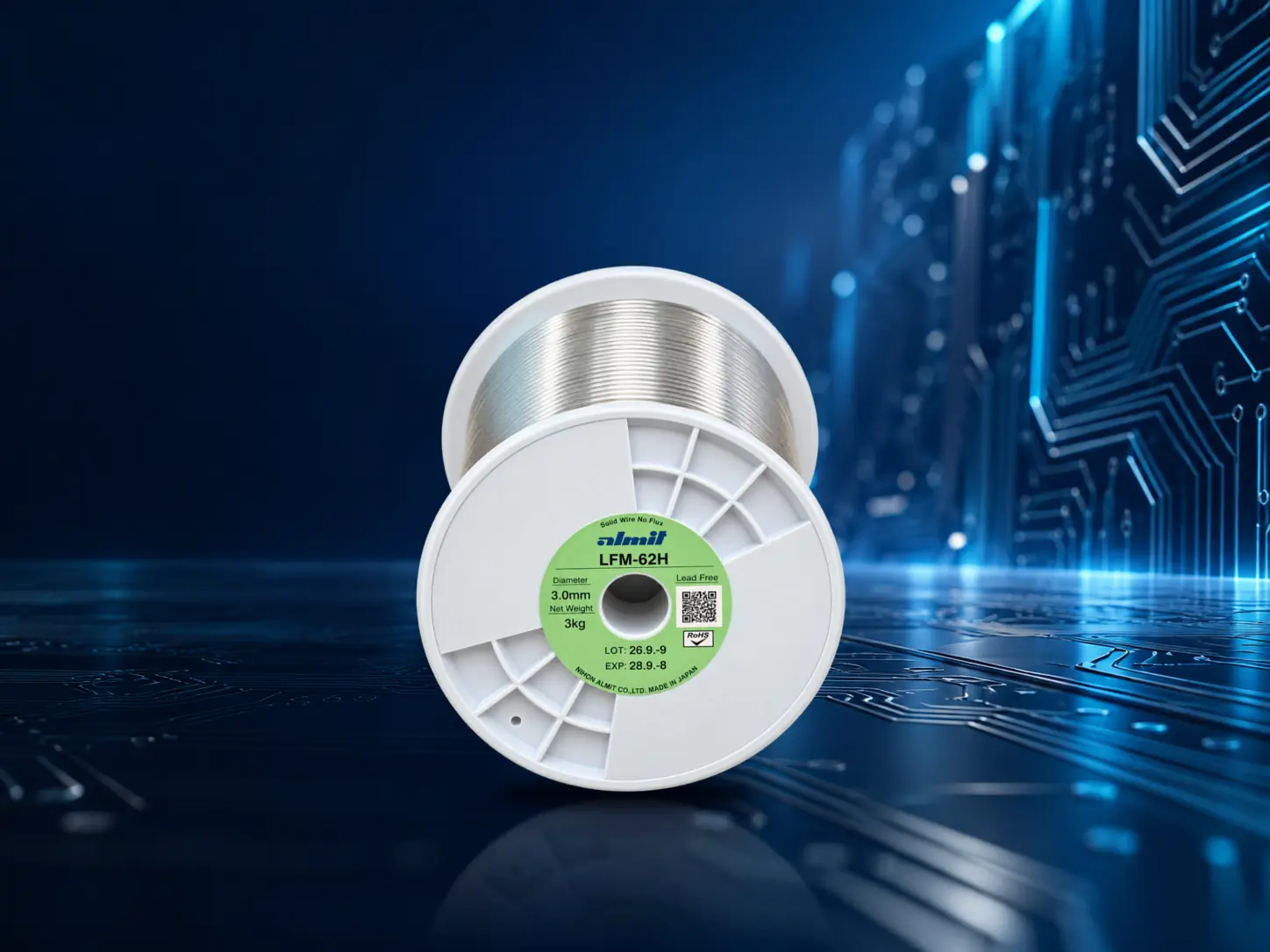
LFM-62
The 3-metal alloy against copper leaching
LFM-62 is a lead-free, silver-free solder bar made from the copper-rich SnCuNi alloy Sn-3.0Cu-0.5Ni. It offers the highest level of protection against copper leaching in the Almit range: In a dip-soldering comparison at 400 °C, 83.4 % of the copper wire remained intact – compared with 27.3 % for the standard alloy Sn-3.0Ag-0.5Cu. LFM-62 also contains an anti-oxidant. Ideal for fine copper wires and pads.
- Minimises copper leaching
- Special 3-metal alloy with nickel content
- Contains an antioxidant
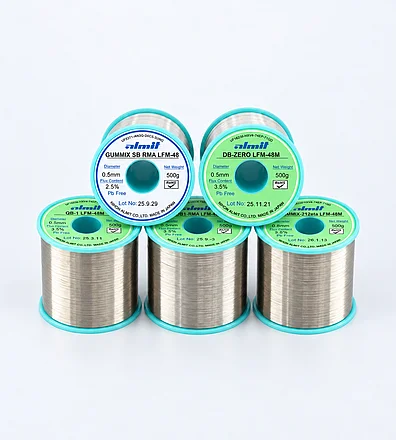
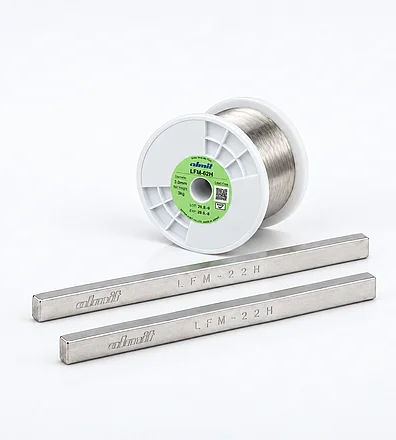
- Available as solder bars and solid wire
-
83.4 %remaining copper content at 400 °C
-
0.5 % NiNickel content alongside 3.0 % copper
-
228–394 °CMelting range
-
0 %Silver content
What happens during copper leaching
The phenomenon of copper leaching poses major problems for developers and manufacturers.
During the soldering process, the base copper material dissolves in the molten solder. The problem becomes even more acute when using lead-free solder.
The extent of copper leaching depends on three factors: the solder alloy, the soldering temperature and the soldering duration.
The situation becomes particularly critical with fine copper wires and pads – where the material cross-section is so small that any loss of material immediately jeopardises the connection.
Illustration from the Almit product leaflet. It shows how significantly the soldering time affects material loss.
LFM-62 in an alloy comparison
Almit has compared the alloys specially developed to combat copper leaching with conventional alloys. Measurements were taken of how much of the copper wire remains after dip soldering – the more that remains, the better.
Amount of copper remaining after dip soldering at 400 °C
Blue bars: Almit alloys designed to prevent copper migration. Grey bars: conventional alloys for comparison.
An overview of both measurement temperatures
| Alloy | At 350 °C | At 400 °C |
|---|---|---|
| LFM-62 | – | 83.4 % |
| LFM-59 | – | 78.5 % |
| LFM-41 | 66.5 % | 45.1 % |
| Sn-37Pb | 63.6 % | 47.1 % |
| Sn-3.0Ag-0.5Cu | 56.0 % | 27.3 % |
| Sn-0.7Cu | 52.2 % | 33.9 % |
| Sn-3.5Ag-0.7Cu | 46.6 % | 24.0 % |
Test conditions
- Dip soldering of a 150 µm copper wire
- Immersion time: 2 seconds
- Flux is applied before immersion
- Preparation of micrographs
- Measured: remaining amount of the copper wire
How to read the table
- Higher values indicate less copper loss
- For LFM-59 and LFM-62, the leaflet only shows the 400 °C measurement
- Two melting temperatures were compared
Less residue during high-temperature dip soldering
LFM-59 and LFM-62 contain anti-oxidants, which minimise the residues produced during high-temperature dip soldering. This reduces the consumption of flux.
- Minimised residues
- Lower flux consumption
- Low dross formation, long bath life
LFM-62 at a glance
- Composition
- Sn-3.0Cu-0.5Ni – tin with 3.0 % copper and 0.5 % nickel, silver-free and lead-free
- Melting range
- 228–394 °C according to the product leaflet
- Special feature
- Contains anti-oxidants for high-temperature dip soldering
- Product type
- Solder bars and solid wire, lead-free
- Application
- Wave, splash and selective soldering systems; ideal for fine copper wires and pads
- Shelf life
- 36 months according to the product master
You can find a comparison of all alloy data in the alloy table. Regarding the process: wave soldering (solder bath / selective). Regarding the alloy group: Anti-copper leaching and silver-free / low-silver.
Three alloys to prevent copper leaching
LFM-41, LFM-59 and LFM-62 are based on a special 3-metal alloy that minimises copper leaching. Compatible fluxes are available for all three solders.
LFM-41
Sn-0.3Ag-2.0Cu. Low-silver with an increased copper content – the entry-level alloy in the family, with the lowest melting range. Also available as solder wire with the fluxes SR-37, SR-LA and SRS-UL.
LFM-59
Sn-3.0Cu. Silver-free and copper-rich, with an anti-oxidant. 78.5 % copper content remaining at 400 °C.
LFM-62
Sn-3.0Cu-0.5Ni. The addition of nickel further enhances the protection: 83.4 % copper remaining at 400 °C – the best result in the test. Also contains an anti-oxidant.
Packaging and item numbers
Solder bar
| Item number | Description | Packaging | Weight |
|---|---|---|---|
| 80002002 | LFM-62H Solder bar | Carton | 1.0 kg |
Solid wire · without flux core
| Item number | Diameter | Packaging | Weight |
|---|---|---|---|
| 80002915 | 1.6 mm | Spool | 0.8 kg |
| 80002910 | 2.0 mm | Spool | 1.6 kg |
| 80002930 | 3.0 mm | Spool | 3.0 kg |
Other pack sizes available on request. Handling solder waste from the bath: Recycling of solder.
LFM-62 – quick answers
What is copper leaching?
During the soldering process, the base material copper dissolves in the liquid solder. With lead-free solder, the problem is even greater. The extent of copper leaching depends on the solder alloy, the soldering temperature and the duration of soldering.
How effective is LFM-62 at preventing copper leaching?
In a dip-soldering comparison at 400 °C, 83.4 % of the copper wire remained intact – the best result of all the alloys compared. By way of comparison: for Sn-3.0Ag-0.5Cu the figure was 27.3 %, for Sn-0.7Cu 33.9 % and for Sn-3.5Ag-0.7Cu 24.0 %.
What is the composition of LFM-62?
Sn-3.0Cu-0.5Ni – tin with 3.0 % copper and 0.5 % nickel. The alloy is lead-free and silver-free.
What is the difference between this and LFM-59?
LFM-59 is Sn-3.0Cu without nickel, with a melting range of 227–312 °C and 78.5 % remaining copper content in the test. LFM-62 contains an additional 0.5 % nickel, has a melting range of 228–394 °C and achieves 83.4 %.
What is the purpose of the anti-oxidant?
LFM-59 and LFM-62 contain anti-oxidants which minimise the residues produced during high-temperature dip soldering. This reduces the consumption of flux.
How was the comparative test carried out?
By dip-soldering a 150 µm copper wire for 2 seconds with various alloys. Flux is applied before dipping, after which cross-sections are prepared to measure the remaining amount of the copper wire.
In what diameters is the solid wire available?
In 1.6 mm, 2.0 mm and 3.0 mm – on spools weighing from 0.8 kg to 3.0 kg.
For which processes is LFM-62 suitable?
For wave, splash and selective soldering systems. Particularly suitable for fine copper wires and pads.
Fine copper structures in your process?
The soldering temperature, soldering time and wire diameter determine how critical the copper leaching becomes – and which of the three alloys is suitable. Please speak to your Almit specialist advisor.

Katharina Hein
Customer Service
- 06061 969250
- info@almit.de
-
Almit GmbH
Unterer Hammer 3
64720 Michelstadt
Germany