
Superconductor (super conductor, supra conductor)
Normally, the electrical resistance of metals increases as the temperature rises. Conversely, it decreases as the temperature falls. As the temperature approaches absolute zero, i.e. –273 °C, the resistance of some materials also approaches zero. The temperature beyond which the resistance suddenly decreases sharply is known as the critical temperature Tc.
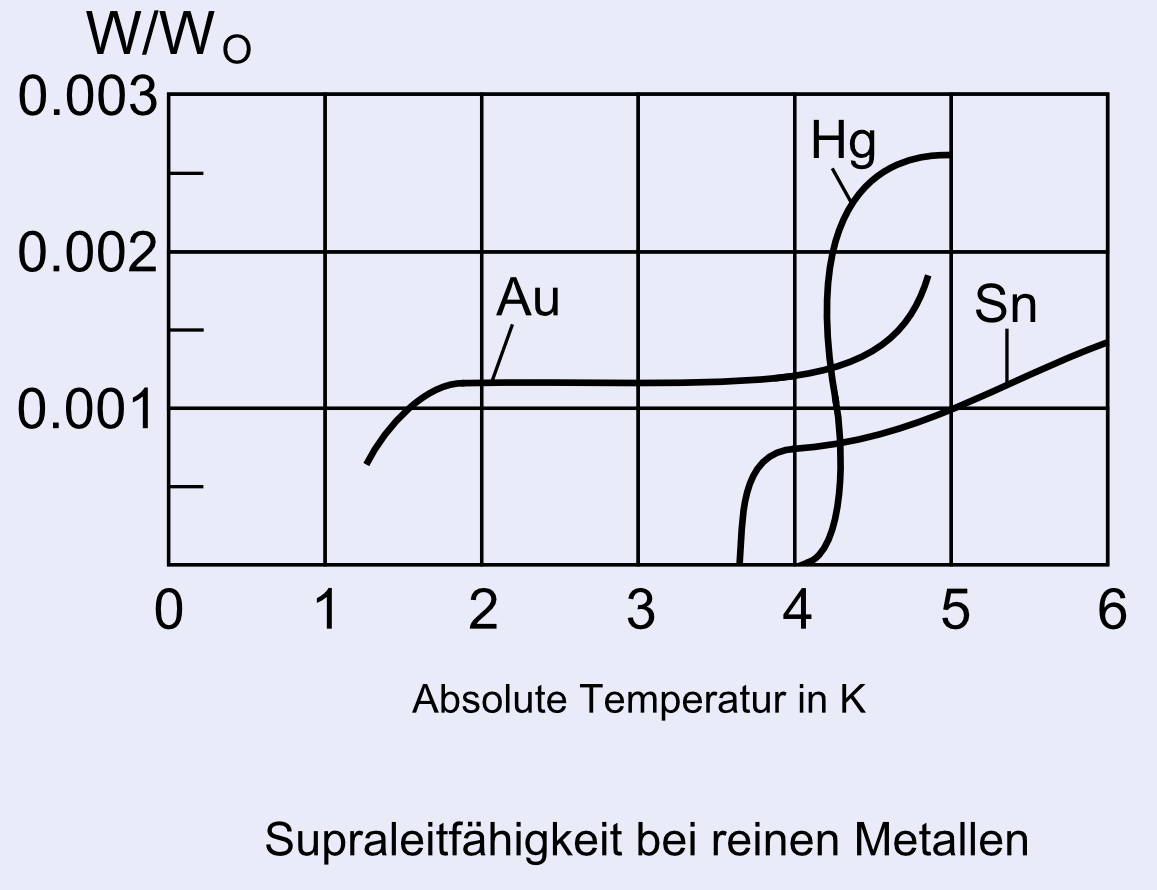
The figure shows the critical temperatures of various metals. Plotted on the Y-axis is the ratio of W (the resistance of the metal at a given temperature) to Wo (the resistance at 0 °C).
When W/Wo equals 0, the state of absolute superconductivity is reached. Historically, intermetallic compounds such as Nb₃Sn and Nb₂Zr were first used in superconducting cables, as their Tc is 18 K (absolute temperature) and thus higher than that of pure metals. However, this requires liquid helium to cool the conductor to close to absolute zero. In 1986, a ceramic superconductor consisting of Y-Ba-Cu oxides was invented, which immediately attracted considerable attention. The invention was significant because, instead of expensive helium cooling, cheaper liquid nitrogen cooling (-210 °C) was sufficient. The ceramic superconductor does, however, have a number of disadvantages: its current density is low (i.e. it loses its superconductivity under high current), it is water-soluble and therefore sensitive to moisture, and there are limits to the strength of the magnetic field it can withstand. However, the foreseeable progress in thin-film production by vapour deposition suggests that such superconductors could soon be used in printed circuit boards. Research into suitable solders for superconducting printed circuit boards will then also become important. In the 21st century, superconductors could play an important role in projects such as electricity generation using superconducting magnetic coils, the construction of high-speed ships or maglev trains, or electricity storage. A maglev train, for example, in which the carriages hover above the track thanks to superconductivity, could cover the Berlin–Amsterdam or Berlin–Warsaw routes in two hours, or the Berlin–Budapest route in three hours.