
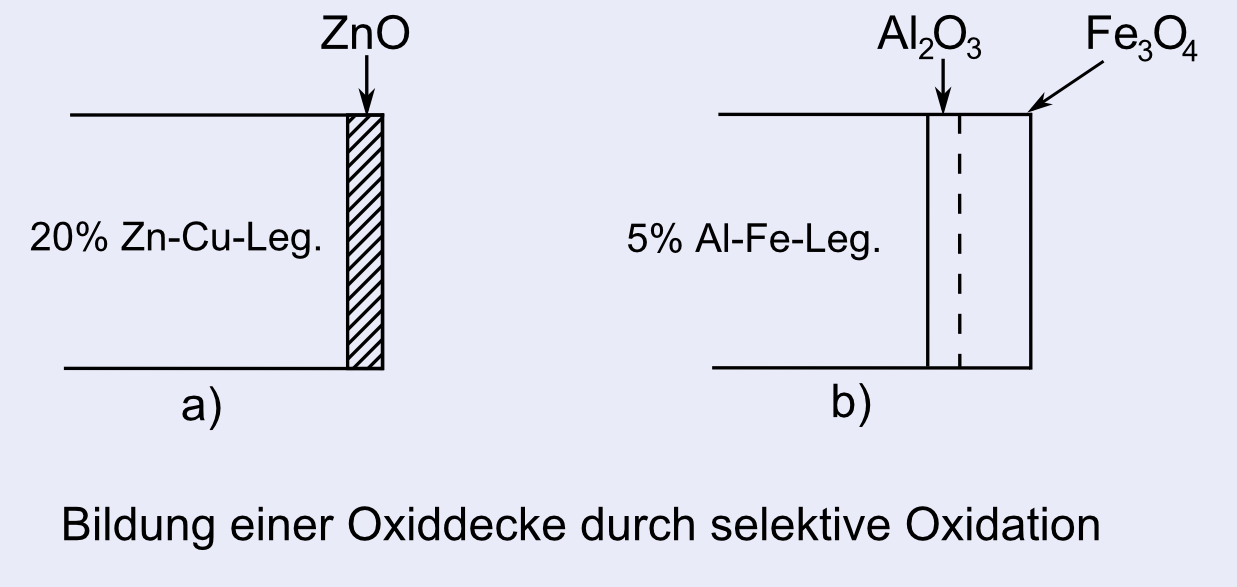
Selective oxidation (preferred oxidation)
Increasing the oxidisability of an alloy by adding oxygen-affine elements. If, for example, a copper-tin alloy containing 20 % tin is allowed to oxidise, as shown in Figure (a), a dense coating of ZnO forms on the surface of the oxide layer because the oxygen-affine tin diffuses towards the oxide layer and the interface with the air. This prevents further oxidation of the base material. Figure (b) shows the formation of a multilayer oxide layer with a high content of base metals in alloys of iron with Al, Si, Cr, etc., which makes the material as a whole more resistant to oxidation. This layer formation is utilised in stainless steel.
A Sn–Pb solder alloy with added bismuth forms a Bi₂O₃ layer, which, due to its dull colour, facilitates visual inspection. This, too, is attributable to the selective oxidation of bismuth. Similarly, when a silver-tin alloy is heated, a layer of zinc oxide forms, which counteracts the formation of silver sulphide on the surface. Consequently, no black discolouration occurs due to sulphuric acid gas. If solder alloys contain zinc, selective oxidation also takes place and the metal becomes coated with zinc oxide. However, as the ZnO coating is mechanically fragile, such an alloy is unsuitable for soldering.