
Surface tension
Liquids (including molten metals) tend to minimise their surface area as much as possible and, were it not for the influence of external forces, would assume a shape approximating that of a sphere. This property is known as surface tension. It is based on the attractive forces between the molecules of the melt, which manifest themselves as tension at the surface. Surface tension corresponds to the work required to increase the area of a molten metal by one unit whilst maintaining a constant temperature, and is identical to the Gibbs free energy stored per unit area. In soldering, this phenomenon affects the interface between a liquid and a gaseous phase (air); however, surface tension also occurs at liquid–liquid, solid–liquid and solid–solid phase boundaries, provided that the change in surface area is accompanied by an energy transformation. In principle, surface tension is the result of the interaction of attractive forces between molecules within the respective phases and at the phase boundary; in practice, however, only the surface tension of the melt can be measured. It is determined according to S. Sugden (S. Sugden: J. Chem. Soc., 1922, 121, 858). The measurement of the surface tension of solder using this method is described, for example, by M. A. Carroll, M. E. Warwick, I.T.R.I. Pub. No. 690 as follows: Gas bubbles (argon) are introduced through a tube of radius r, which is immersed to a controlled depth h in the molten metal (solder). The gas pressure initially creates a small gas bubble with a relatively large radius of curvature, which then grows into a hemispherical bubble with the same radius as the tube. Under continued pressure, the bubble grows larger and larger until it detaches from the tube and bursts. Consequently, the highest pressure at which the bubble remains stable is that at which it has the smallest radius. The following equation applies to this maximum pressure:
Pmax = 2γr + gh (ρ1 – ρ0)
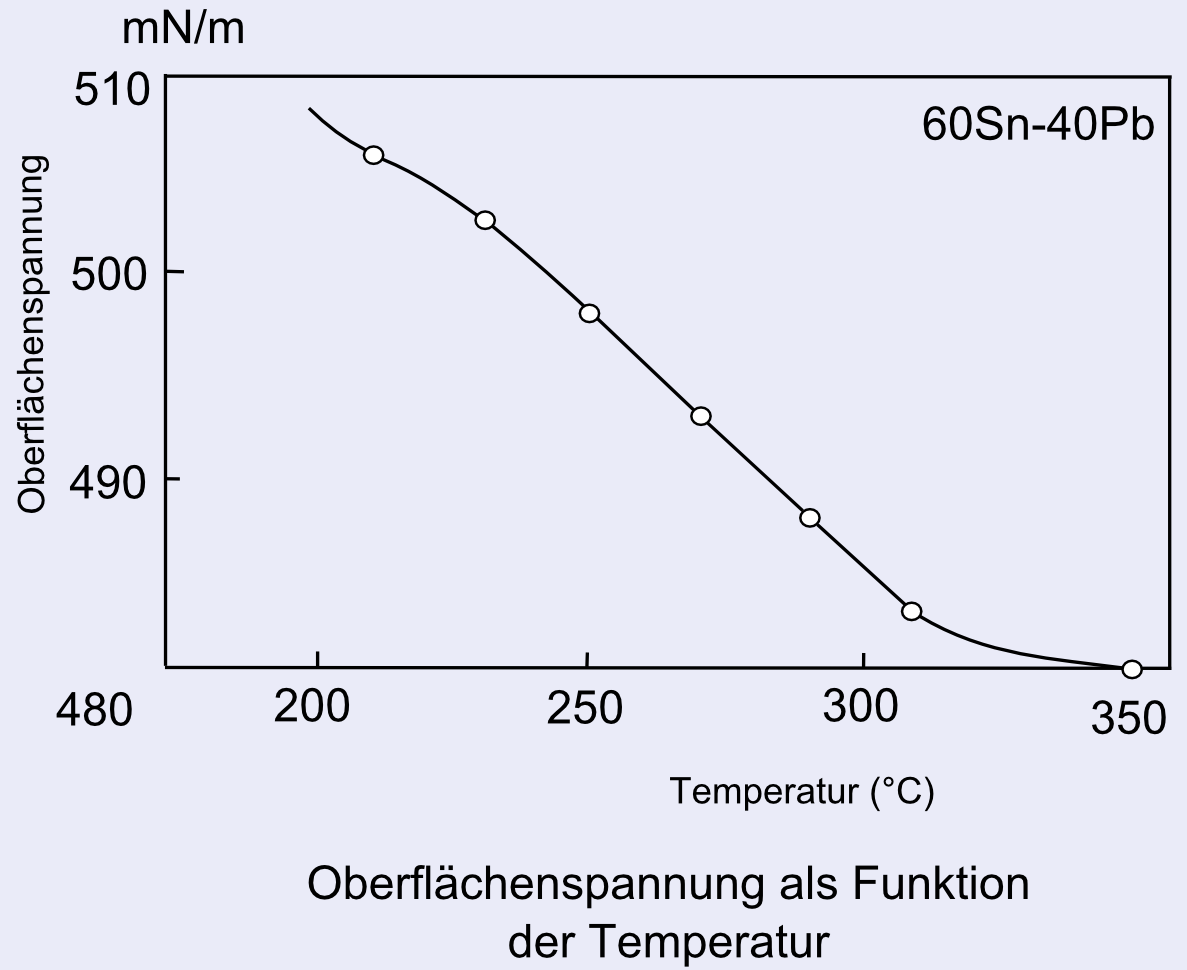
where γ is the surface tension, ρ1 and ρ0 are the respective densities of the melt and the gas, and g is the acceleration due to gravity. The figure shows the relationship between surface tension and the temperature of the solder, as measured in this way. As a general rule, surface tension decreases as the temperature rises. It is also dependent on the chemical composition of the material in question. The decrease in surface tension as the temperature rises is due to changes in the thermal motion of the molecules. During soldering, the effect of the surface tension of the cooling solder causes components to self-align on fine-pitch printed circuit boards. Examples of the surface tension of various substances in air, expressed in dyn/cm, include water at 72.75 (20 °C), mercury at 487 (15 °C) and ethyl alcohol at 22.3 (20 °C). → Gibbs free energy, self-alignment effect.