
Covalent bond
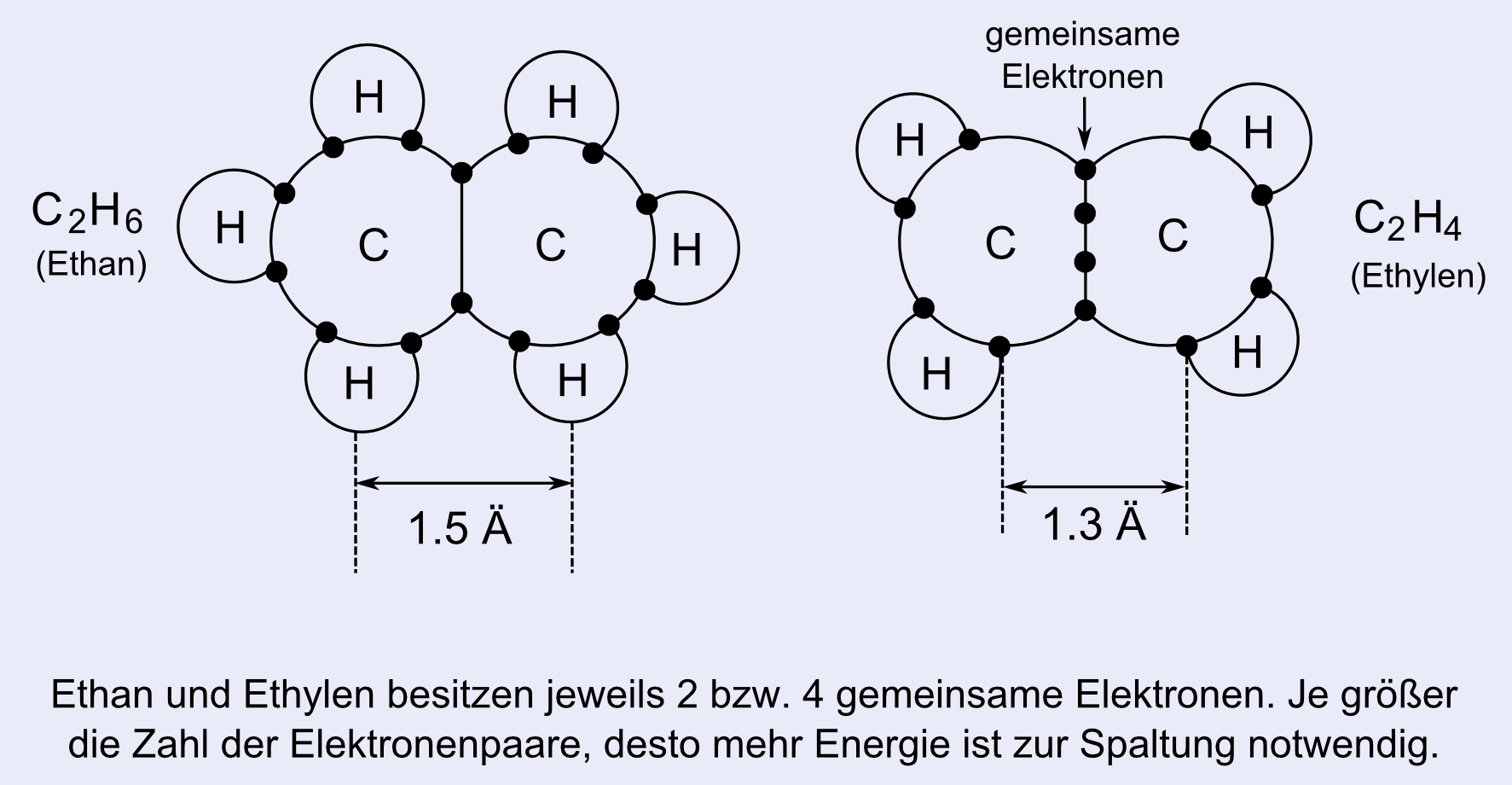
A type of bond in which two atoms share a pair of electrons. To indicate this, the single C–H bond or the double C–C bond are often written as C:H and
C :: C respectively. For this reason, the term ‘electron pair bond’ is also commonly used. Where there are multiple covalent bonds, the atomic distance decreases and, accordingly, more energy is required to break these bonds. The diagram shows the electron pair bonds in ethane (C₂H₆) and ethylene (C₂H₄). The former has one covalent bond (2 electrons), the latter two (4 electrons). With a distance of 1.3 Å (Ångström) between the carbon atoms, the bond in ethylene is shorter than that in ethane (1.5 Å) and is therefore more stable.
The compound becomes even more stable when both electrons in the pair have opposite spins. The thermal dissociation energy acting on an organic flux during soldering is relatively low, as the process takes place at a relatively low temperature. Therefore, when selecting the flux activator, the presence of covalent bonds and the number of electron pairs must also be taken into account.