
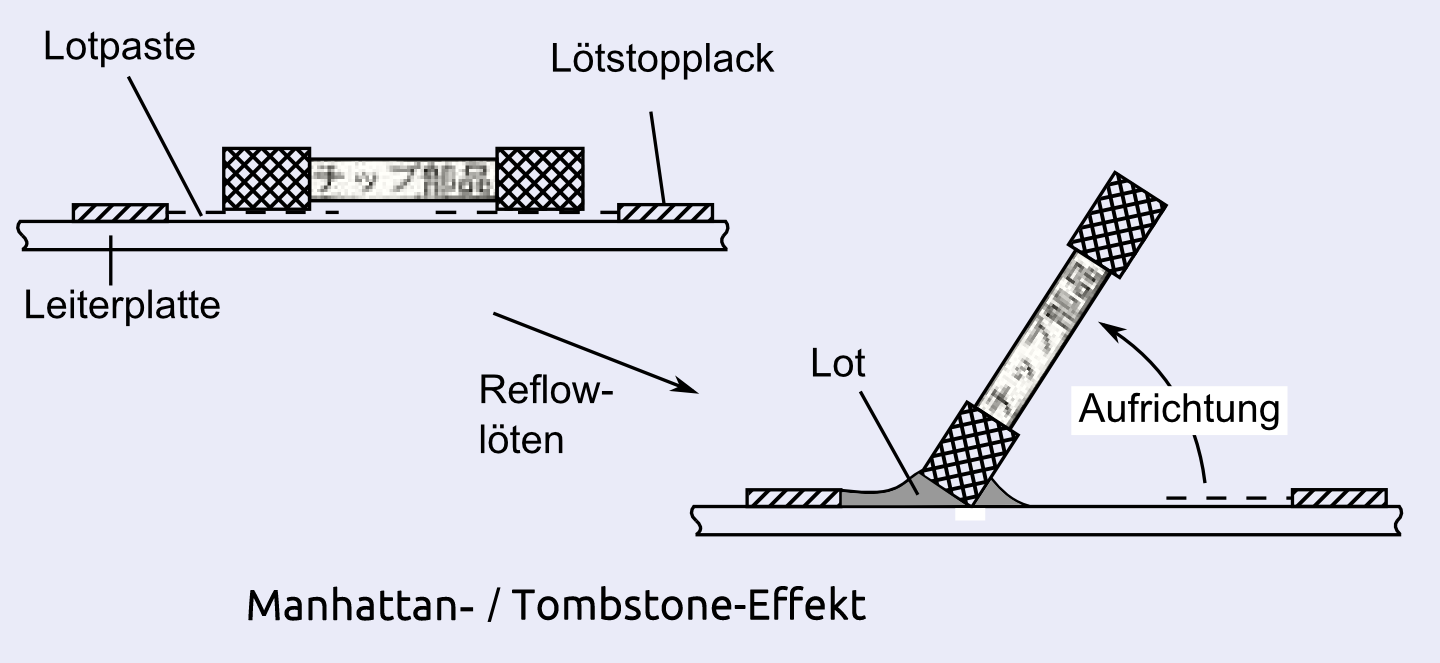
When soldering components, particularly leadless chips, it can happen that, after one side has already been soldered in place, the other side lifts up, causing the component to stand at an angle on the printed circuit board. The chip then resembles a gravestone, which is why this fault is known by that name.
This phenomenon occurs when there is an uneven temperature distribution on the printed circuit board, the solder paste has been applied unevenly to the pad areas, the surface of the solder powder has oxidised due to preheating, or the solvent has partially evaporated, resulting in uneven soldering.
In this case, the solder on one pad of a pair of pads melts faster than on the other and, due to its surface tension, pulls the end of the chip downwards, causing it to stand upright (see fig.). As this phenomenon is reminiscent of New York’s closely packed rows of high-rise buildings, the name ‘Manhattan effect’ was coined. On the other hand, the chips standing at an angle resemble gravestones, which is why the name ‘tombstone effect’ is also commonly used. This usually occurs when the solder wets the pad on only one side.