
Mixing solder paste correctly
- Source
- Almit Compendium 5.0, pages 141 to 142
- Length
- 2 pages
- Author
- Michael Mendel, Managing Director, Almit GmbH
- Topic
- Solder paste, storage, processing
Solder paste must be stored in the fridge to ensure that the product’s key characteristics are preserved as effectively as possible.
However, during storage at low temperatures, an inhomogeneous mixture of solder powder and flux forms, a condition which results in poor rolling properties. Careful mixing is essential to recombine these components into a homogeneous mass and thereby achieve optimal conditions for processing.
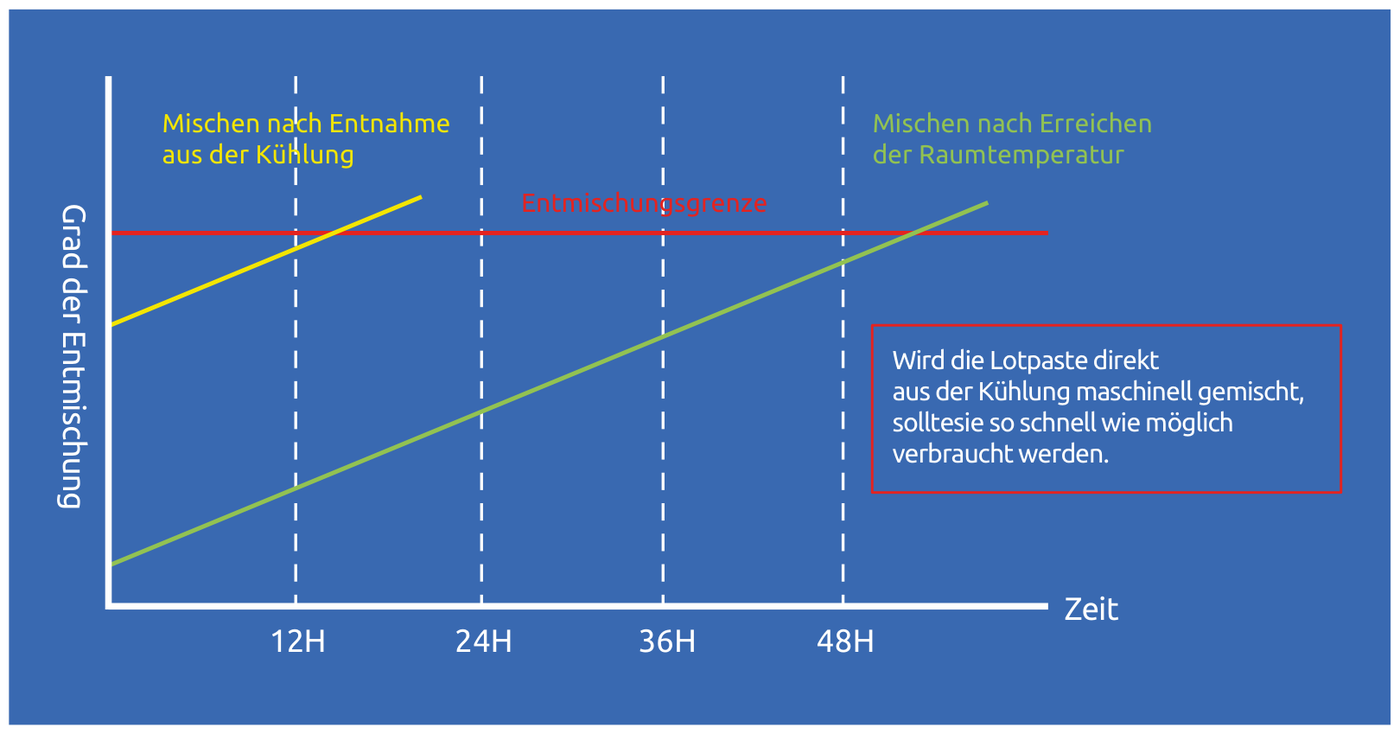
Whether mixing manually with a spatula or using a solder paste mixer, the paste must not be mixed immediately after being removed from the fridge. Allow the paste time to reach room temperature. For a 500 g container that has been cooled to 5 °C, this takes approximately 60 minutes. After the solder paste has been removed from the fridge, it has a high viscosity.
If mixing is carried out immediately in this state, the ‘stick-slip’ effect is likely to occur. In this process, the metal particles rub against one another, causing intense heating – in places exceeding 1,000 degrees – which causes the flux to separate. Leaded paste is particularly susceptible to this, as the flux it contains has a low heat resistance.
Manual mixing of the solder paste with a spatula
Once the solder paste has reached room temperature, you can begin mixing it using the spatula. Stir slowly to minimise the ingress of air into the paste as much as possible. If too much air enters the solder paste, it will expand during the reflow process and lead to solder beads.
Also, take care not to stir too much, as excessive stirring reduces the viscosity of the solder paste and promotes ‘slumping’.
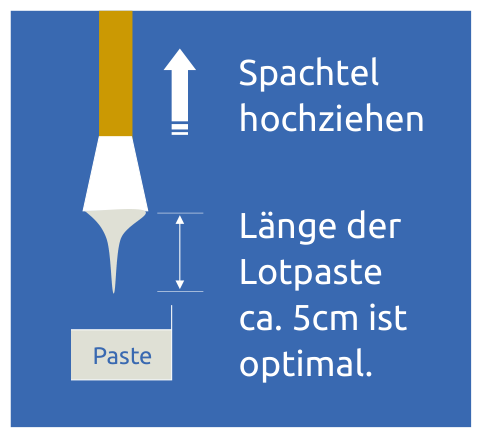
To check whether the paste is homogeneous enough, lift the spatula upwards after mixing and check the length of paste remaining on the spatula. Approximately 5 cm is ideal.
Machine mixing of solder paste using a solder paste mixer

With this method too, you must wait until the solder paste has reached room temperature. The optimal mixing time varies depending on the type of solder paste and the mixing device; it is usually between three and five minutes. During mixing, the particles in the solder paste rub against one another, generating heat. This can cause the flux to separate.
However, take care to ensure that the mixing process does not take too long, as otherwise the paste will heat up. The aim of mixing is to restore the mixture of solder powder and flux – which has become inhomogeneous due to storage in the fridge – to a homogeneous mass. In an inhomogeneous state, good rolling properties cannot be achieved. The aim is not to increase the temperature or to remove air bubbles.
Optimal processing conditions for solder pastes
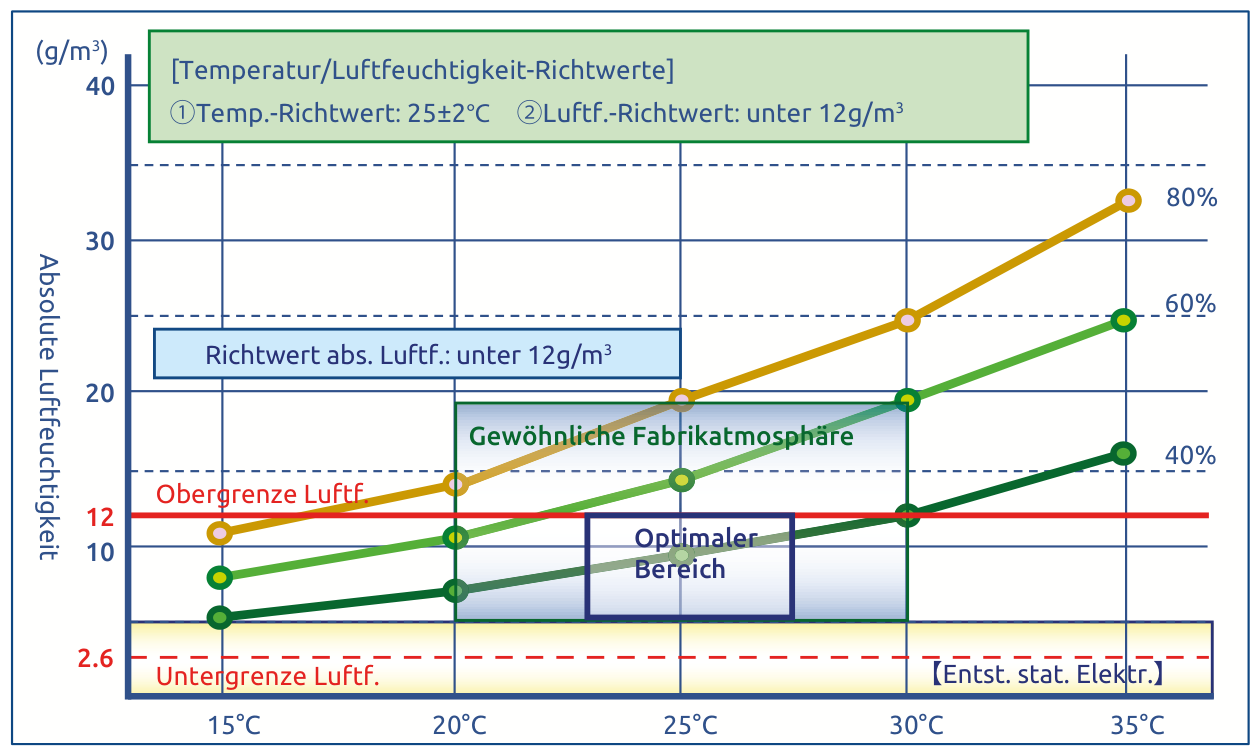
The graph below illustrates how the processing conditions for solder paste – and consequently the print quality – vary depending on temperature and relative humidity. Absolute humidity indicates how many grams of water are present in one cubic metre of air. Relative humidity describes the actual proportion relative to the maximum. If, for example, the maximum is 20 g/m³ but only 10 g/m³ is measured, the relative humidity is 50 %.
Michael Mendel, Managing Director
Almit GmbH
Questions about your process?
Our applications engineering team will assess your production process – from storage through to printing and the reflow profile.