
Eutectic
If two metals, A and B, are mixed in a specific ratio to produce an alloy, the melting point of the alloy is, in some cases, lower than the melting points of the individual metals. The alloy with the lowest melting point is called a eutectic alloy. A eutectic consisting of two metals, A and B, is referred to as a binary eutectic; one consisting of A, B and C is a ternary eutectic. The notation is E eutectic cooling heating A+B.
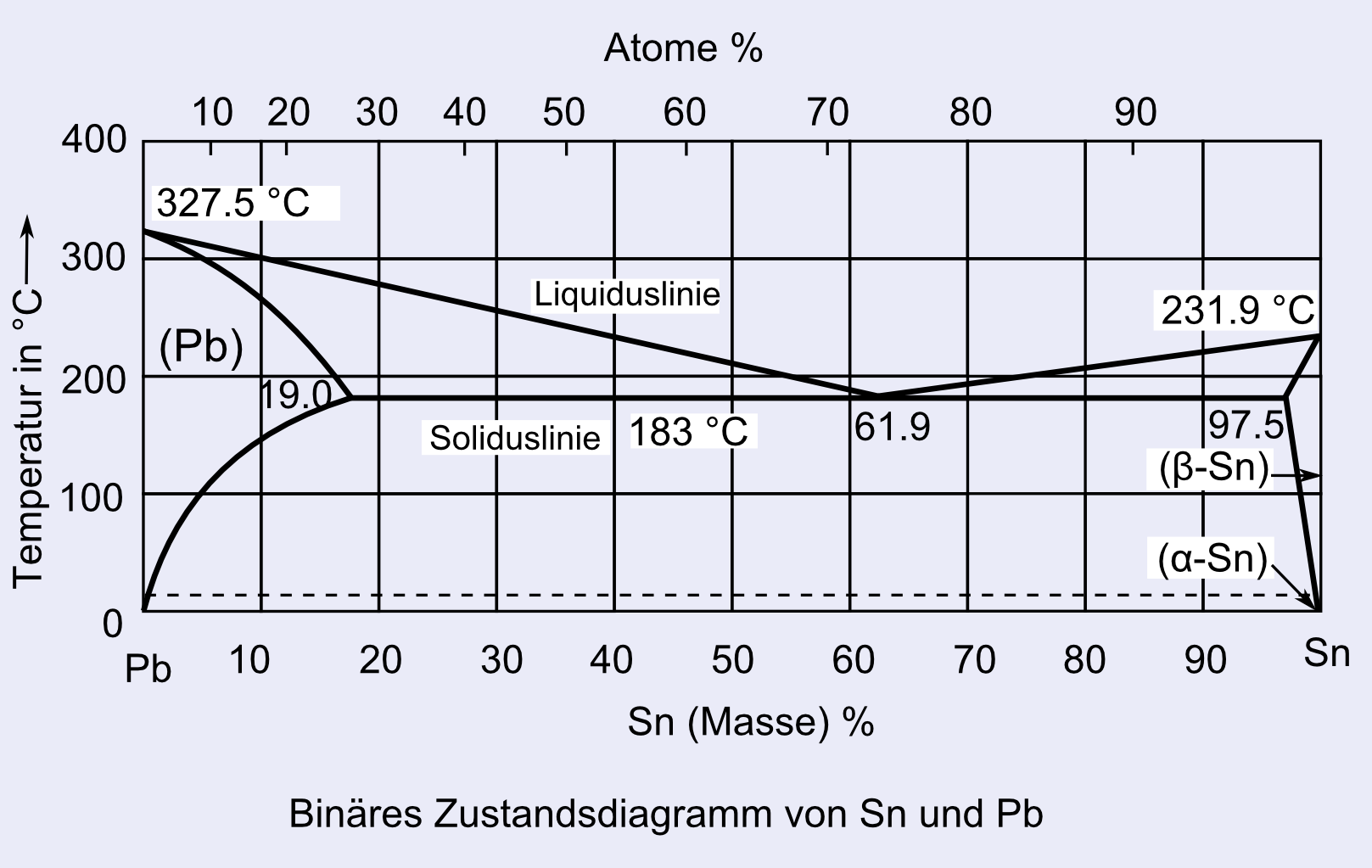
The figure shows the phase diagram (also known as a phase chart) for an alloy of lead and tin, from which it can be seen that a eutectic is formed when the tin content is 63 % (by mass) and the lead content is correspondingly adjusted.
Whilst the melting point of lead is 327 °C and that of tin is 232 °C, the melting point of the eutectic alloy is 183 °C. Until 2006, this was the most widely used alloy for solders. Within this eutectic alloy, lead and tin are merely very finely mixed together, without, however, reacting chemically. Eutectic alloys are therefore mechanical mixtures. The eutectic is the alloy with the lowest potential energy. It should be noted that at the eutectic temperature, Sn and Pb crystallise simultaneously from the melt; however, this does not happen instantaneously but takes some time. In zones a, at the ends of the phase diagram, Sn forms a solid solution in Pb, and vice versa.