
Electromigration (migration)
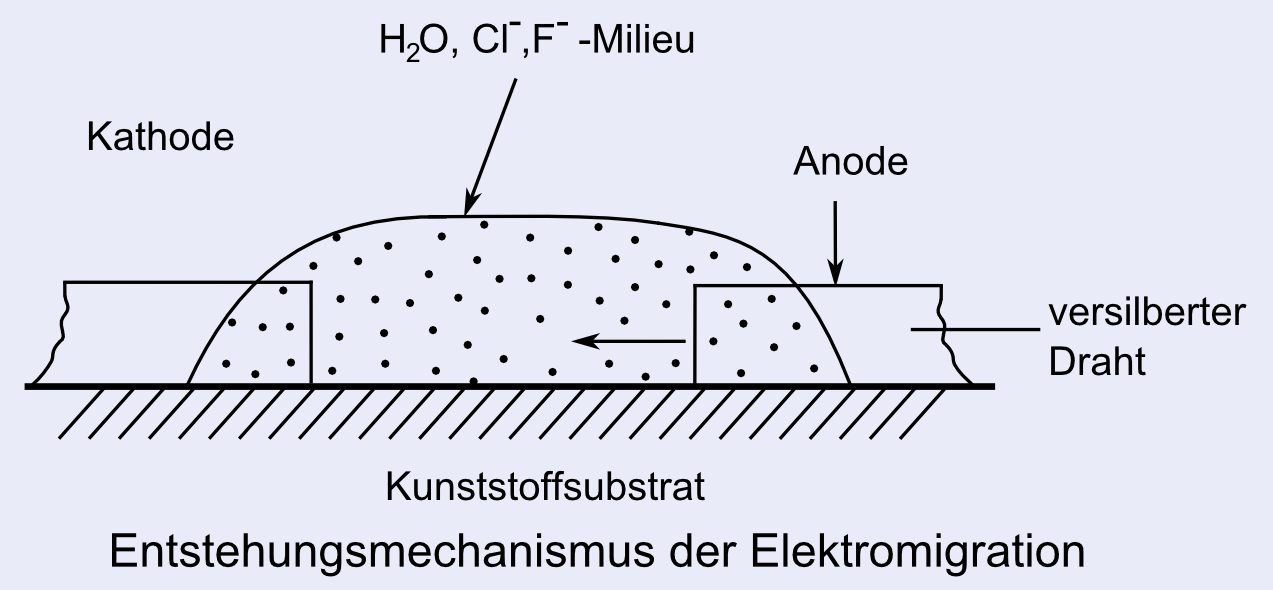
The direct current flowing during the operation of a device can cause an electrolytic reaction to take place on the surface of the flux residues at a solder joint on a printed circuit board, particularly in high-humidity conditions. As shown in Figure 1, water containing chloride and fluoride ions is then present between two connecting wires. This acts as an electrolyte and results in a slight current flowing between the two wires. For example, after soldering silver-coated wires without subsequent cleaning, some of the flux residues dissolve due to ambient humidity and form ions. At the anode, the reaction Ag → Ag⁺ + e then takes place; copper dissolves and migrates through the electrolyte to the cathode, where it loses its charge and precipitates as metallic copper. From there, the copper grows as a tree-like crystal structure (dendrite) until it forms a conductive connection between the terminals and causes a short circuit. This disrupts the function of the printed circuit board.
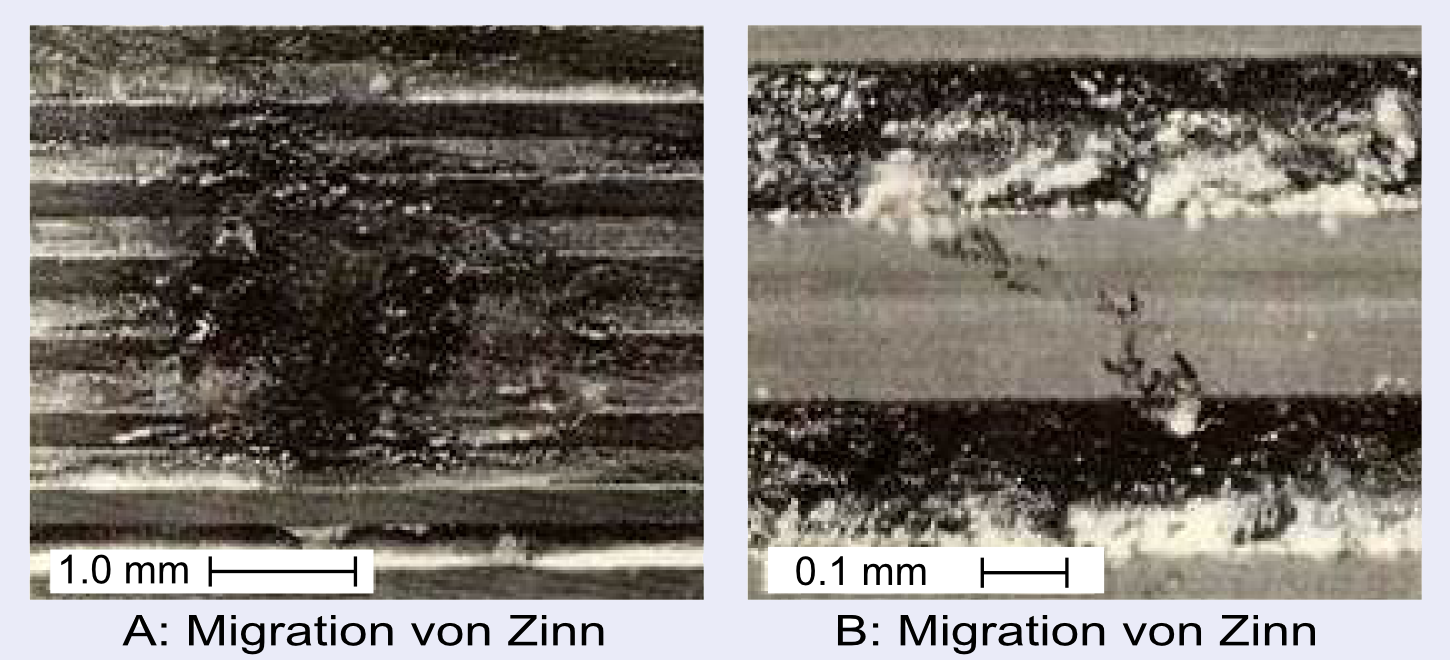
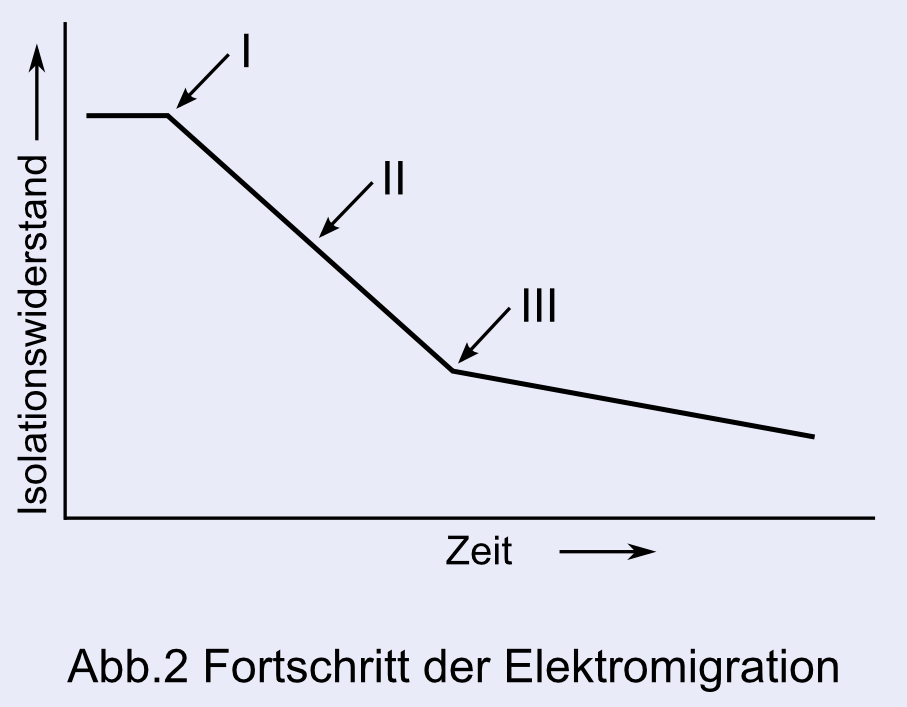
Direct currents generally lead easily to electromigration at silver electrodes; however, this can also occur with tin solders. Microscopic images A and B show the migration of tin, using the example of a glass-fibre-reinforced epoxy resin printed circuit board with comb-shaped tracks and a track spacing of 0.4 mm, which was first coated with flux, then soldered at 250 °C using the wave soldering process, and subsequently subjected to a direct current voltage of 100 V for 96 hours at 60 °C and 95 % relative humidity. Electromigration passes through three distinct stages (see Fig. 2): I – initial stage, II – actual migration, III – slowed migration.
It can be seen that, whilst migration decreases in stage III, it does not come to a complete halt. Electromigration can be prevented as follows:
Use of non-polar polystyrene or polyethylene as the base material instead of polar phenolic resins. 1.) Removal of flux residues, which absorb moisture, through thorough cleaning. 2.) Coating of the spaces between conductors with solder resist. However, pores in the resist, even if they are tiny, promote electromigration and should therefore be avoided. 3.) Use of flux-cored solder with a flux that does not form hygroscopic residues, e.g. NoClean flux of the RMA type.