
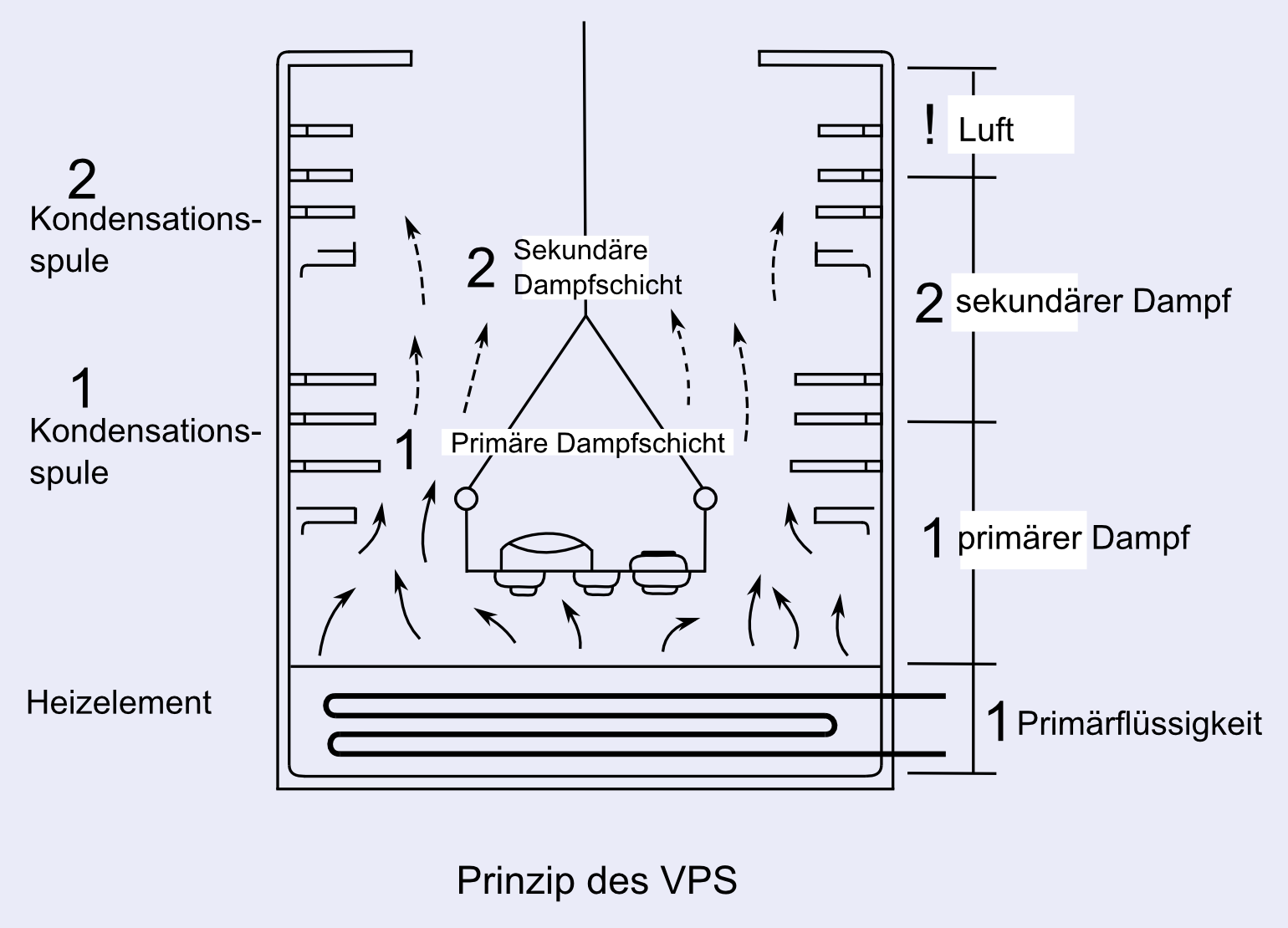
Vapour-phase soldering (VPS) is used when assembling heat-sensitive components onto printed circuit boards. The vapour of inert fluoride liquids is used as the heat transfer medium, primarily the product Fluorinert FC-70 from 3M, which has a boiling point of 215 °C. This method offers the following advantages: 1.) In the vapour phase, the temperature is uniform; whilst this does not allow for the selective heating of individual components, it prevents heat damage to the printed circuit board. 2.) Less overheating than with infrared reflow soldering allows for easier removal of flux residues. 3.) As the solder does not oxidise in the vapour phase, a less active flux than usual can be used. 4.) Thanks to the uniform heating, smaller chips can be mounted beneath larger components. Disadvantages of the process include the currently high cost of the inert liquid and the risk of contamination from flux. However, precautions are being taken to prevent the vapour from escaping, additional heat sources are being used, and other improvements are being made.
A soldering process developed by Western Electric (USA) in 1975, in which perfluorocarbon, fluoropolyether, perfluorotriamylamine and other chemicals are used as vapour-phase media. These liquids are characterised by a wide temperature range, thermal stability, chemical inertness, non-flammability, low vapour pressure, low surface tension and high density, and are marketed under names such as Fluorinert (3M) and Multifluor (Ausimont), amongst others. As the heat of condensation (latent heat) released during the transition from the vapour phase to the liquid phase is utilised for heating, heat transfer is faster than in convection reflow soldering.