
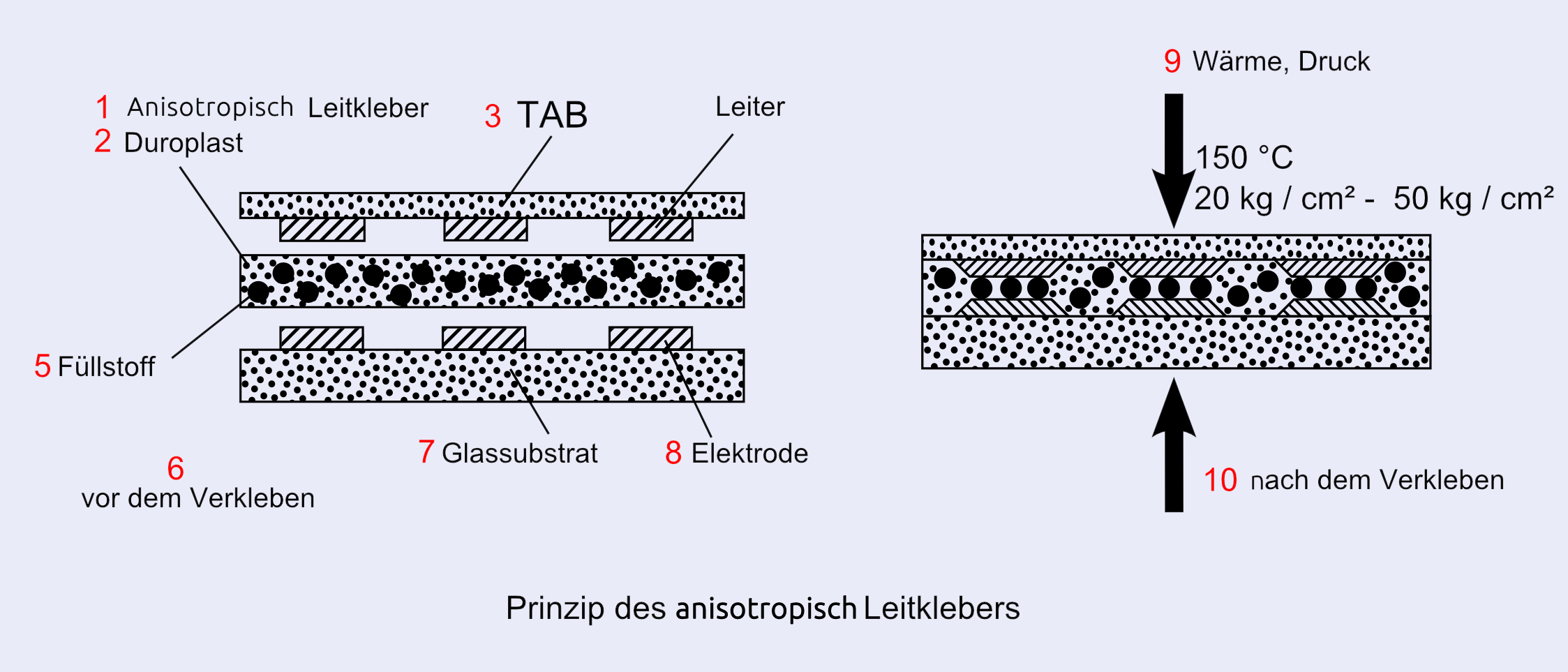
Anisotropic conducting film
An adhesive film approximately 20–30 µm thick, containing a filler consisting of conductive particles 3–15 µm thick. In their initial state, the particles are dispersed within the adhesive, so that the film as a whole behaves as an insulator. The adhesive film is applied between the conductor patterns to be joined and then pressed together whilst heat is applied. This joins the upper and lower conductor tracks and simultaneously creates a conductive connection. Thermosetting epoxy or acrylic resins are used as the adhesive. Processing takes place at a temperature of approximately 150 °C and a pressure of approximately 20–50 kg/cm². This method was originally developed in 1977 but had to be adapted to the ever-decreasing pitch distances on printed circuit boards. With this process, the pitch can be as narrow as 0.1 mm. Carbon fibre particles were initially used as fillers, but solder powder has become more common in recent times. Its particles deform under heat and pressure, thereby forming conductive bonds more easily. Metallised particles are also used. The process is now frequently used in plasma display assemblies.