
Amorphous alloy
When metals – as well as ceramics and other materials – are heated beyond their melting point, their atoms begin to move in a disorderly manner (Brownian motion). As soon as the material cools down, these atoms immediately reform a regular atomic lattice, much like children playing in the school playground who line up in a row at the teacher’s call.
Of course, the formation of the crystal lattice does not happen instantaneously. During the transition from the molten state to the solid state, the atoms of the metal or ceramic material require a certain finite amount of time to assume their ordered positions.
For metals, this time span is of the order of one hundred-thousandth or one-millionth of a second. The cooling rate is therefore 10⁵–10⁸ °C/sec. However, there are no precise research findings on this. If the material is quenched faster than this cooling rate, a transitional state results:
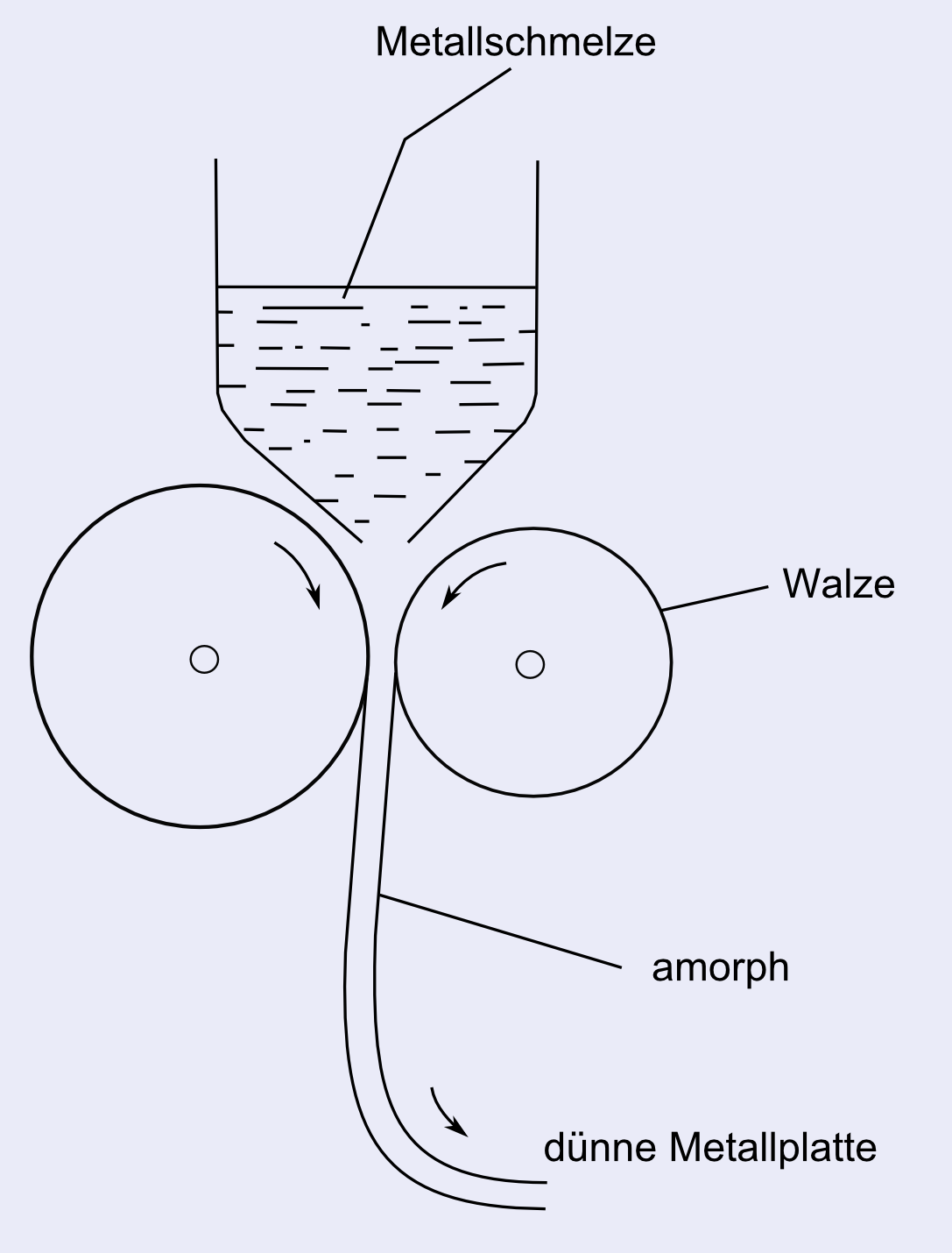
This transitional state is both polycrystalline, like an ordinary metal, and non-crystalline, and is therefore referred to as an amorphous alloy. As such rapid quenching is practically impossible to achieve, silicon or boron are used as interstitial elements to enable an amorphous state to be achieved even at a lower cooling rate. As the figure shows, amorphous alloys are produced by pouring the melt onto a rapidly rotating roller, resulting in extremely thin metal foils. The alloys produced in this way possess 1.) good mechanical properties, 2.) high corrosion resistance and 3.) high electrical resistance. Today, they are used, for example, in acoustic recording heads.